Raja Rao - Collected Stories
Здесь есть возможность читать онлайн «Raja Rao - Collected Stories» весь текст электронной книги совершенно бесплатно (целиком полную версию без сокращений). В некоторых случаях можно слушать аудио, скачать через торрент в формате fb2 и присутствует краткое содержание. Год выпуска: 2014, Издательство: Penguin, Жанр: Классическая проза, на английском языке. Описание произведения, (предисловие) а так же отзывы посетителей доступны на портале библиотеки ЛибКат.
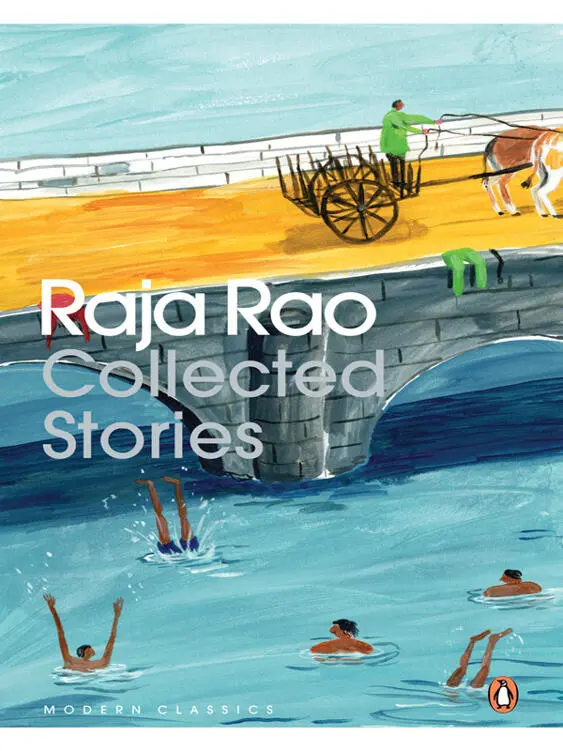
- Название:Collected Stories
- Автор:
- Издательство:Penguin
- Жанр:
- Год:2014
- ISBN:нет данных
- Рейтинг книги:5 / 5. Голосов: 1
-
Избранное:Добавить в избранное
- Отзывы:
-
Ваша оценка:
Collected Stories: краткое содержание, описание и аннотация
Предлагаем к чтению аннотацию, описание, краткое содержание или предисловие (зависит от того, что написал сам автор книги «Collected Stories»). Если вы не нашли необходимую информацию о книге — напишите в комментариях, мы постараемся отыскать её.
Collected Stories — читать онлайн бесплатно полную книгу (весь текст) целиком
Ниже представлен текст книги, разбитый по страницам. Система сохранения места последней прочитанной страницы, позволяет с удобством читать онлайн бесплатно книгу «Collected Stories», без необходимости каждый раз заново искать на чём Вы остановились. Поставьте закладку, и сможете в любой момент перейти на страницу, на которой закончили чтение.
Интервал:
Закладка:
‘I am not a Brahmin,’ I said half-jokingly, half-seriously.
‘You are. You are. You want to make fun of me.’
‘No, Javni, suppose you adopt me?’
She laughed again.
‘If you do not adopt me, I shall die now and grow into a lamb in my next life and you will buy it. What will you do then?’
She did not say anything. It was too perplexing.
‘Now,’ I said, feeling sleepy, ‘now, Javni, go to sleep and think again tomorrow morning whether you will adopt me or not.’
‘Adopt you! You are a god, Ramappa, a god! I cannot adopt you.’
I dozed away. Only in the stillness I heard Javni saying: ‘Goddess, Great Goddess, as I vowed, I will offer thee my lamb. Protect the child, protect Mother, protect her brother, protect Master, O Goddess! Protect me!’
The Goddess stood silent, in the little temple by the Cauvery, amidst the whisper of the woods.
A July morning, two summers later. Our cart rumbled over the boulders of the street, and we were soon at the village square. Javni was running behind the cart, with tears rolling down her cheeks. For one full week I had seen her weeping all the time, all the time dreading the day when we should leave her and she would see us no more. She was breathless. But she walked fast, keeping pace with the bullocks. I was with my sister in the back of the cart, and my brother-in-law sat in front, beside the cart-man. My sister too was sad. In her heart she knew she was leaving a friend. Yes. Javni had been her friend, her only friend. Now and again they gazed at each other, and I could see Javni suddenly sobbing like a child.
‘Mother, Mother,’ she would say approaching the cart, ‘don’t forget me.’
‘I will not. No, I assure you, I will not.’
Now my sister too was in tears. ‘Even if she should, I will not,’ I added. I myself should have wept, had I not been so civilized.
When we touched the river, it was already broad morning. Now, in the summer, there was so little water that the ferry was not plying and we were going to wade through. The cart-man said he would rest the bullocks for a moment, and I got out partly to breathe the fresh air and more to speak to Javni.
‘Don’t weep,’ I said to her.
‘Ramappa, how can I help but weep? Shall I ever see again a family of gods like yours? Mother was kind to me, kind like a veritable goddess. You were so, so good to me, and Master—.’ Here she broke again into sobs.
‘No, Javni. In contact with a heart like yours, who will not bloom into a god?’
But she simply wept. My words meant nothing to her. She was nervous, and she trembled over and over again. ‘Mother, Mother,’ she would say between her sobs, ‘O Mother!’
The cart-man asked me to get in. I got into the cart with a heavy heart. I was leaving a most wonderful soul. I was in. The cart-man cried, ‘Hoy, hoyee!’ And the bulls stepped into the river.
Till we were on the other bank, I could see Javni sitting on a rock, and looking towards us. In my heart I seemed still to hear her sobs. A huge pipal rose behind her, and, across the blue waters of the river and the vast, vast sky above her, she seemed so small, just a spot in space, recedingly real. Who was she?
NIMKA
I met Nimka in Paris yesterday. Nimka (or Nimotchka) is a White Russian of Caucasian origin, but she prefers to call herself Circassian — it gives her mystery distinction. Nimka has green mongoloid eyes, and a soft lolling tongue that contains rounded sweetness. When I knew her first, about twenty years ago, she served in some restaurant of the Quartier Latin, which gave her food and function and the few hundred francs that were necessary to make her mother live, from week to week. Nimka’s mother was of course brought up at the Smolny, and the Smolny courtyard seemed to play a more important part in their family history than the Revolution and the Civil War. For in the Smolny courtyard, everyone on their walks de jeunes filles dreamt, and they dreamt such glorious dreams, that some Grand Duke of course went to a ball, and of course the Circassian beauty was the most ravishing of all that he had ever seen (and Smolny taught such rare bashfulness, it made even the horses at the sledges neigh) and the Imperatrice, naturally, would hear nothing of it all, but some high priest intervened, and as the Court loved escapades, the couple fled to Switzerland, and the Emperor was duly white and red with ire, but what was, was, and after all the Circassian beauty had a father who was a general, and he was made bigger and brought to the Court, and the fault was of course laid on Count Tolstoy who destroyed every vestige of Society, and Tolstoy wrote a letter to the Countess Straganza Boriloff, a letter which is still a treasure in the little room— sous l’escalier A, un bis, as the concierge shouts — and you knock at the door and this Circassian princess opens the door to you, with a smile that would warm your heart even on this cold and wet summer of 1953. When I say you are warmed by Nimka’s heart, I mean it, for I have sat hour after hour in her little room in Rue Fosse Saint Jacques, where no sun ever shone, and even the concierge’s cat had to go and sit by the sill to see if there’s sun shining anywhere in the sky. Nimka, of course, made such lovely borscht for her mother — they lived on the ground floor that opened on the yard, and students went in and out of the main door, casting mysterious glances at this young princess who fed the concierge’s cat. Some of them had read Gorki’s Twenty-six Men and a Girl, and the thought went through their minds that this princess may well be their inviolable deity. Nimka had naturally never read Gorki — how could she — but she knew what was right from what was wrong without her mother saying anything. The Tolstoy letter, duly framed and hung on the wall — the Ikon from Kiev stood a little further down in the corner — gave every advice that anyone could ever need. Tolstoy had said, in his rough flourishing hand— there were many French words in his epistle which showed to whom he was addressing himself— ‘Il n’y a pas de doute que— Auguste Comte dit quelquefois — d’autre part il faut bien le dire — je suis, etc., etc. . ’ Tolstoy’s flourishing hand said that the evil must be met with good. The good is what had distinction, and the bad what is successful. Even the cat knew what is good — one hadn’t to call the cat when mother’s meal was over and one brought the rest to the courtyard; the cat waited there, as though the right thing would come from the right place at the most appropriate time. He who knows himself good is known by the animals he has. The cat never miaowed — you hadn’t, like the concierge, to call out Minou; Minou, the little white-streaked black thing was ever furrily present with uplifted gratitude. The old princess even left her small portion to the cat, and so the young Nimotchka left some of her foods for her mother. That is goodness if goodness needs a definition. Nimotchka was good, very good, and of a simple true beauty, as though you cannot efface it even were you to cut her face with many crosses. Her beauty had certainty, it had a rare equilibrium, and a naughtiness that was feminine and very innocent. It projected a quality of assurance that you were good, even were you bad, for this beauty could not be bad, so you had to be good. It was beauty — it always will be, and you cannot take it, and as such you cannot soil yourselves. How could you, for when you contemplate beauty, you end in contemplation — you may even have a cup of tea. Nimotchka loved tea — of course — and I loved it because she loved it.
I used to go to Nimotchka — I was a student too, and at the Sorbonne — and, on Sunday mornings when she came back from church, she loved to have friends visiting her. That day, the lunch service was later, so you had an hour more. Nimka was gay, and when she came back, I read to her some text from the Ramayana or the Mahabharata, the story of Nala and Damayanti, and the exile of the royal couple always moved her. She made a link between the Smolny courtyard and the palace of Damayanti, and she had only to invent the Swan. I was the Swan then — I was the Swan now. Nimka knew the Indian saying that the swan knows how to separate milk from water — the good from the bad, and as I knew her to be good, she recognized me a swan. The swan sailed in and out and India became the land where all that is wrong everywhere goes right there. In India, the Smolny courtyard exists — it could not but exist — look at the number of Maharajas, the Maharajas of Kapurthala and His Highness the Aga Khan, all Indians and you saw their pictures in the newspapers. They assured you of your very existence— you had a right to exist in righteousness, for they existed and their decorous faces lit up the pages of the newspapers. Nimka, whom I had once taken to the Théâtre des Champs Elysées to see Uday Shankar dance, actually met the Yuvaraja of Mysore. I introduced her to him, and she gave such a curtsey and a smile— it made her certain her assuredness was right. The mother was all grateful for my kindness. And in a few months a new picture went up on their wall. It was the picture of Mahatma Gandhi, for Tolstoy was a friend of Mahatma Gandhi (I read her the full text of Tolstoy’s letter to Mohandas Gandhi — the one in Romain Rolland’s Life of Gandhi , editions Stock) and so Tolstoy was right and India was right, and since she was right and India was right, and since she could not put up a picture of me on the wall, she put up Mahatma Gandhi’s. It gave great beauty to Tolstoy’s face — the one looked the disciple, and the other the master. Since I was a son of India, I was, as it were, a sort of grandson, and she was, so to say, of the same status as I. That made everything possible, the conversation, the gentle looks, and a dinner now and again — one had an afternoon off every fortnight, in those days — which made affinity permissible. I could also take her out to Chinese restaurants, and she loved to be the Princess. She had her mother’s mink coat, of course, and a pearl necklace they had saved against all odds — it was to be her marriage gift. Nimka, I think, loved me, but somehow that necklace came in the way. She could not imagine me and the necklace altogether — that necklace was made of pain, it stood there as a reminder of man’s inner strength against outer odds — it meant struggle and passion and poverty — the bow of Rama is easier to break than to twist the screw of that Russian necklace, the hand that could twist it needed a more masculine grasp, a more painful nobility, a graver happiness. The Indian is too simple in his depth — if there’s no concierge and the cat, there’s no goodness. Success is sin. Gandhi is poverty. The Maharaja is proof of truth. Truth is unnaked. Love is unsaid. So, Nimotchka fell in love with Michel.
Читать дальшеИнтервал:
Закладка:
Похожие книги на «Collected Stories»
Представляем Вашему вниманию похожие книги на «Collected Stories» списком для выбора. Мы отобрали схожую по названию и смыслу литературу в надежде предоставить читателям больше вариантов отыскать новые, интересные, ещё непрочитанные произведения.




Обсуждение, отзывы о книге «Collected Stories» и просто собственные мнения читателей. Оставьте ваши комментарии, напишите, что Вы думаете о произведении, его смысле или главных героях. Укажите что конкретно понравилось, а что нет, и почему Вы так считаете.