Raja Rao - Collected Stories
Здесь есть возможность читать онлайн «Raja Rao - Collected Stories» весь текст электронной книги совершенно бесплатно (целиком полную версию без сокращений). В некоторых случаях можно слушать аудио, скачать через торрент в формате fb2 и присутствует краткое содержание. Год выпуска: 2014, Издательство: Penguin, Жанр: Классическая проза, на английском языке. Описание произведения, (предисловие) а так же отзывы посетителей доступны на портале библиотеки ЛибКат.
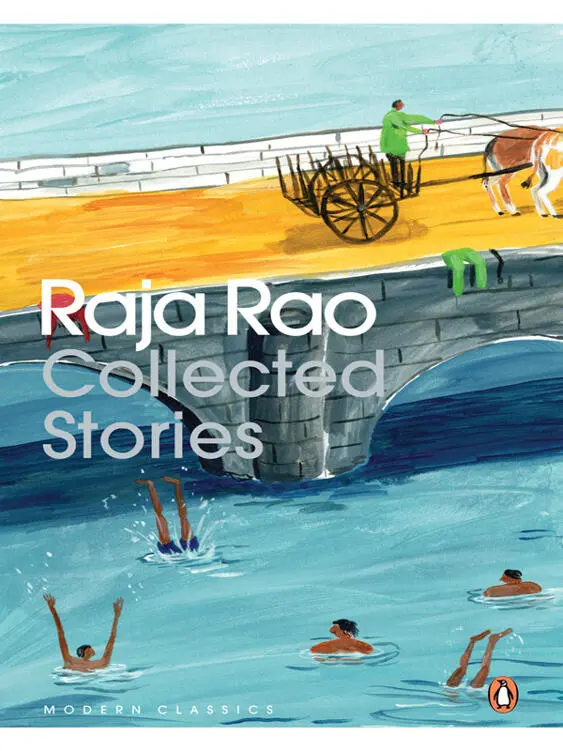
- Название:Collected Stories
- Автор:
- Издательство:Penguin
- Жанр:
- Год:2014
- ISBN:нет данных
- Рейтинг книги:5 / 5. Голосов: 1
-
Избранное:Добавить в избранное
- Отзывы:
-
Ваша оценка:
Collected Stories: краткое содержание, описание и аннотация
Предлагаем к чтению аннотацию, описание, краткое содержание или предисловие (зависит от того, что написал сам автор книги «Collected Stories»). Если вы не нашли необходимую информацию о книге — напишите в комментариях, мы постараемся отыскать её.
Collected Stories — читать онлайн бесплатно полную книгу (весь текст) целиком
Ниже представлен текст книги, разбитый по страницам. Система сохранения места последней прочитанной страницы, позволяет с удобством читать онлайн бесплатно книгу «Collected Stories», без необходимости каждый раз заново искать на чём Вы остановились. Поставьте закладку, и сможете в любой момент перейти на страницу, на которой закончили чтение.
Интервал:
Закладка:
‘But if I am not a Revenue Inspector,’ I insisted.
‘You must be — you must be!’ she cried, as if I were insulting myself.
‘All right, I shall be a Revenue Inspector in order to have you,’ I joked.
‘As if it were not enough that I should bleed myself to death in being one,’ added my brother-in-law, as he entered through the back door, dust-covered and breathless.
Javni rose up and ran away as if in holy fear. It was the Master.
‘She is a sweet thing,’ I said to my sister.
‘Almost a mother!’ she added, and smiled.
In the byre Javni was talking to the calf.
My brother-in-law was out touring two or three days in the week. On these days Javni usually came to sleep at our house, for my sister had a terror of being alone. And, since it had become a habit, Javni came as usual even when I was there. One evening, I cannot remember why, we had dined early, and unrolling our beds, we lay down when it was hardly sunset. Javni came, peeped from the window and called in a whisper, ‘Mother, Mother!’
‘Come in, you monkey,’ answered my sister.
Javni opened the door and stepped in. She had a sheet in her hand, and, throwing it on the floor, she went straight into the byre where her food was usually kept. I could not bear that. Time and again I had quarrelled with my sister about it all. But she would not argue with me. ‘They are of the lower class, and you cannot ask them to sit and eat with you,’ she would say.
‘Of course!’ I said. ‘After all, why not? Are they not like us, like any of us? Only the other day you said you loved her as if she were your elder sister or mother.’
‘Yes!’ she grunted angrily. ‘But affection does not ask you to be irreligious.’
‘And what, pray, is being irreligious?’ I continued, furious.
‘Irreligious. Irreligious. Well, eating with a woman of a lower caste is irreligious. And, Ramu,’ she cried desperately, ‘I have enough of quarrelling all the time. In the name of our holy mother can’t you leave me alone!’ There, tears!
‘You are inhuman!’ I spat, disgusted.
‘Go and show your humanity!’ she grumbled, and, hiding her face beneath the blanket, she wept harder.
I was really much too ashamed and too angry to stay in my bed. I rose and went into the byre. Javni sat in the dark, swallowing mouthfuls of rice that sounded like a cow chewing the cud. She thought I had come to go into the garden, but I remained beside her, leaning against the wall. She stopped eating, and looked deeply embarrassed.
‘Javni,’ I said tenderly.
‘Ramappa!’ she answered, confused.
‘Why not light a lantern when you eat, Javni?’
‘What use?’ she replied, and began to chew the cud.
‘But you cannot see what you are eating,’ I explained.
‘I cannot. But there is no necessity to see what you eat.’ She laughed as if amused.
‘But you must!’ I was angry.
‘No, Ramappa. I know where my rice is, and I can feel where the pickle is, and that is enough.’
Just at that moment, the cow threw a heapful of dung, which splashed across the cobbled floor.
‘Suppose you come with me into the hall,’ I cried. I knew I could never convince her.
‘No, Ramappa. I am quite well here. I do not want to dirty the floor of the hall.’
‘If it is dirty, I will clean it,’ I cried, exasperated.
She was silent. In the darkness I saw the shadow of Javni near me, thrown by the faint starlight that came from the garden door. In the corner the cow was breathing hard, and the calf was nibbling at the wisps of hay. It was a terrible moment. The whole misery of the world seemed to be weighing all about and above me. And yet — and yet — the suffering — one seemed to laugh at it all.
‘Javni,’ I said affectionately, ‘do you eat at home like this?’
‘Yes, Ramappa.’ Her tone was sad.
‘And why?’
‘The oil is too expensive, Ramappa.’
‘But surely you can buy it?’ I continued.
‘No, Ramappa. It costs an anna a bottle, and it lasts only a week.’
‘But an anna is nothing,’ I said.
‘Nothing! Nothing!’ She spoke as if frightened. ‘Why, my learned Ramappa, it is what I earn in two days.’
‘In two days!’ I had rarely been more surprised.
‘Yes, Ramappa, I earn one rupee each month.’ She seemed content.
I heard an owl hoot somewhere, and far, far away, somewhere too far and too distant for my rude ears to hear, the world wept its silent suffering plaints. Had not the Lord said: ‘Whenever there is misery and ignorance, I come’? Oh, when will that day come, and when will the Conch of Knowledge blow?
I had nothing to say. My heart beat fast. And, closing my eyes, I sank into the primal flood, the moving fount of Being. Man, I love you.
Javni sat and ate. The mechanical mastication of the rice seemed to represent her life, her cycle of existence.
‘Javni,’ I inquired, breaking the silence, ‘what do you do with the one rupee?’
‘I never take it,’ she answered laughing.
‘Why don’t you take it, Javni?’
‘Mother keeps it for me. Now and again she says I work well and adds an anna or two to my funds, and one day I shall have enough to buy a sari.’
‘And the rest?’ I asked.
‘The rest? Why, I will buy something for my brother’s child.’
‘Is your brother poor, Javni?’
‘No. But, Ramappa, I love the child.’ She smiled.
‘Suppose I asked you to give it to me?’ I laughed, since I could not weep.
‘Oh, you will never ask me, Ramappa, never. But, Ramappa, if you should, I would give it to you.’ She laughed too, content and amused.
‘You are a wonderful thing!’ I murmured.
‘At your feet, Ramappa!’ She had finished eating, and she went into the bathroom to wash her hands.
I walked out into the garden and stood looking at the sparkling heavens. There was companionship in their shining. The small and the great clustered together in the heart of the quiet limpid sky. God, knew they caste? Far away a cartman chanted forth:
The night is dark;
Come to me, mother.
The night is quiet;
Come to me, friend.
The winds sighed.
On the nights when Javni came to sleep with us, we gossiped a great deal about village affairs. She had always news to tell us. One day it would be about the postman Subba’s wife, who had run away with the Mohammedan of the mango shop. On another day it would be about the miraculous cure of Sata Venkanna’s wife, Kanthi, during her recent pilgrimage to the Biligiri temple. My sister always took an interest in those things, and Javni made it her affair to find out everything about everybody. She gossiped the whole evening till we both fell asleep. My sister usually lay by the window, I near the door, and Javni at our feet. She slept on a bare wattle-mat, with a cotton sheet for a cover, and she seemed never to suffer from cold. On one of these nights when we were gossiping, I pleaded with Javni to tell me just a little about her own life. At first she waved aside my idea; but, after a moment, when my sister howled at her, she accepted it, still rather unhappily. I was all ears, but my sister was soon snoring comfortably.
Javni was born in the neighbouring village of Koteballi, where her father cultivated the fields in the winter and washed clothes in the summer. Her mother had always work to do, since there were childbirths almost every day in one village or the other, and, being a hereditary midwife, she was always sent for. Javni had four sisters and two brothers, of whom only her brother Bhima remained. She loved her parents, and they loved her too; and, when she was eighteen, she was duly married to a boy whom they had chosen from Malkad. The boy was good and affectionate, and he never once beat her. He too was a washerman, and ‘What do you think?’ said Javni proudly, ‘he washed clothes for the Maharaja, when he came here.’
Читать дальшеИнтервал:
Закладка:
Похожие книги на «Collected Stories»
Представляем Вашему вниманию похожие книги на «Collected Stories» списком для выбора. Мы отобрали схожую по названию и смыслу литературу в надежде предоставить читателям больше вариантов отыскать новые, интересные, ещё непрочитанные произведения.









Обсуждение, отзывы о книге «Collected Stories» и просто собственные мнения читателей. Оставьте ваши комментарии, напишите, что Вы думаете о произведении, его смысле или главных героях. Укажите что конкретно понравилось, а что нет, и почему Вы так считаете.