Raja Rao - Collected Stories
Здесь есть возможность читать онлайн «Raja Rao - Collected Stories» весь текст электронной книги совершенно бесплатно (целиком полную версию без сокращений). В некоторых случаях можно слушать аудио, скачать через торрент в формате fb2 и присутствует краткое содержание. Год выпуска: 2014, Издательство: Penguin, Жанр: Классическая проза, на английском языке. Описание произведения, (предисловие) а так же отзывы посетителей доступны на портале библиотеки ЛибКат.
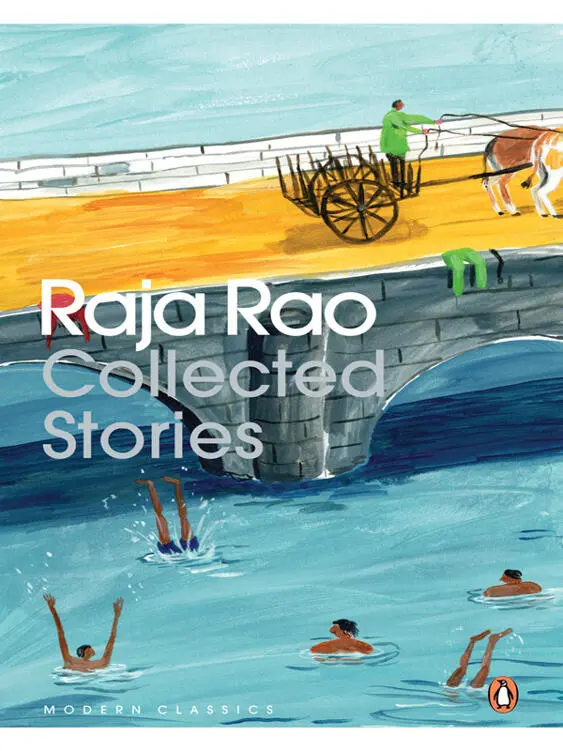
- Название:Collected Stories
- Автор:
- Издательство:Penguin
- Жанр:
- Год:2014
- ISBN:нет данных
- Рейтинг книги:5 / 5. Голосов: 1
-
Избранное:Добавить в избранное
- Отзывы:
-
Ваша оценка:
Collected Stories: краткое содержание, описание и аннотация
Предлагаем к чтению аннотацию, описание, краткое содержание или предисловие (зависит от того, что написал сам автор книги «Collected Stories»). Если вы не нашли необходимую информацию о книге — напишите в комментариях, мы постараемся отыскать её.
Collected Stories — читать онлайн бесплатно полную книгу (весь текст) целиком
Ниже представлен текст книги, разбитый по страницам. Система сохранения места последней прочитанной страницы, позволяет с удобством читать онлайн бесплатно книгу «Collected Stories», без необходимости каждый раз заново искать на чём Вы остановились. Поставьте закладку, и сможете в любой момент перейти на страницу, на которой закончили чтение.
Интервал:
Закладка:
Now, Michel was a friend of mine. He was nineteen, and had a fine mask of dignity. He had gone through the Ecole Normale, and was at the Rue d’Ulm. I knew him for he’d taken Sanskrit for his Aggregation and I often met him at the Institut de la Civilisation Indienne at the Sorbonne. He was pale, with a nervous twitch of the nose, and his hands ever trying to adjust his eye-glasses, as though however much he wanted to see clearly, he just could not see clearly. He said to me, ‘When my teachers say green, I just do not know what green is — when they say red, I just do not know what red is — I know them as names of colours. All my life I just wanted to see — see it, the object, the object as reality, and my friend, what can I do? I just cannot look at it. I am a failure. I am damned. My father died in the war, and left my mother a widow of twenty-one. I am the hope of the family — hope indeed, he who cannot distinguish between red and green. Colour, yes, a name. A name is everything. Abelard, that old sensualist, was right. We are all nominalists. The object exists because of its name. Remove the name, and the object is space. Remove the space, and the object is the Reality. Poetry must be made of reality. Vocables are voluntary creations. We just invent language as we invent breath. Breath,’ he said, opening his waistcoat, as though he wanted more air, and he stopped. Nimka, who served us, would wait with her plate till the speech was over. She loved his dignified voice and his love for scribbling all over the tablecloth. He wrote vocables. He invented vocables.
And one day when I’d gone out on Easter holidays and returned, I saw Nimka and Michel arm in arm. They smiled to me very sweetly. Michel was a poet. The poet is sacred. Tolstoy was not a poet. He was a writer. But then he was a poet all right. Michel wrote beautiful things. He said beautiful things. How he laughed, when Nimka laughed. I was their saint and protector. Since Michel lived in Rue d’Ulm and she couldn’t take him to Rue Saint Jacques, they met in my room, in Rue du Sommerard. Michel read to her his poems. She never wore the pearl necklace for him. She became grave. I knew she never allowed him to touch her. Thus she respected me. Only once, said Michel, she allowed him to kiss her, and that was in a church (the Rumanian one, behind Rue du Sommerard). She thought it improper — it had to do with the flesh — and she had to hide it from her mother. She decided then to marry, marry anyone. She could not marry me — I was too far, too distant and different. She could not marry Michel — he had kissed her. Michel was so desperate. Nimka married, almost a month after that, Count Vergilian Kormaloff, who ran the vegetarian restaurant, off the Pantheon. She bore him a child very soon, and though there was so much warmth in her heart, her face was infinitely sad. Sorrow seemed to sit on her brow, for the noble count, apart from being twenty years her elder and a widower, was interested in betting on horses. He lost everything he ever had on horses. Then he started borrowing from his clients. One day his restaurant too had to be sold. He left Nimotchka during the days of the Czechoslovak crisis, and ran to Monte Carlo to make money. Boris, his little son, never saw him again.
When Hitler occupied France, I wondered what would have happened to Nimka and her mother. When the Hitler police saw the picture of Tolstoy and Gandhi, they never worried her, wrote Nimka. During the war, she said, she became, for Boris’ sake, a mannequin. She knew nothing wrong could happen to her. Success she despised most of all. She liked to live as her mother had taught her to live. The mother had died during the Occupation. She believed that one day truth would reign in the world. She hoped Mahatma Gandhi might still save the world. She liked Hitler, for he liked India. . At seventeen Boris studied at the Lycée Louis-le-Grand. Boris knew all was good. So when the Russians invited the Russians from all over the world to return, he was so proud (anyway he did not like to do military service in France) and he went, hoping to come back and take his mother. Boris never returned, of course. Mahatma Gandhi was shot, and Nimka knew that was the price of righteousness.
Nimka lives in Rue des Ecoles, not far from Rue du Sommerard, and she knits pullovers for the Grands Magasins. She sold her pearl necklace and put the money into a little cloth shop off Rue Poitou (for food and clothing are essentials of life and you cannot lose on that) and the returns are not too bad. The Ikon and the Tolstoy letter still adorn the walls, and the picture of Mahatma Gandhi has gone up above the bed. He knows, does Mahatma Gandhi, the pinching pain of mankind. With every scrub of the floor, and with every cry of the child in the street, there’s a voice that responds, and that is Mahatma Gandhi’s. Mahatma Gandhi, said Nimka to me yesterday, is not a man, he is not a saint, he is a country. Green fields must billow into the bright sun, and men must bend to collect the corn. The swan must fly there, and goodness is good for it is not success. Virtue is the woman’s privilege, man is the undiscoverable. Nimka was not sad. Her heart contained an intimacy of sorrow that was almost kin of joy. She was warm, of course, and spoke beautifully. Her French accent had that silvery touch of the Slavs that makes the language almost sing. Nimka asked nothing of life. She asked nothing of me. When I said goodbye, she did not say when shall I see you again? She knew the life that has ended is eternal. When you are shot you become immortal.
INDIA — A FABLE
Advayataiva siva
(Non-duality alone is auspicious)
— Sri SankaraNever was the Luxembourg so beautiful as on that fragile spring day. March had come and gone boisterously, cold winds blew in April, and then the immense sunshine came. The pools were transparent, the sky full of ochre clouds, the trees cut through the air with their leaves, the earth was hot. Men came out, old men with coughs and whiskers, and sat by the ponds reading newspapers. The old, fat women removed their kerchiefs and spoke garrulous words. The Sorbonnard girls opened their blouses to let the cool air breathe down them, single silver bangles on their wrists, and cigarettes held lighted in the air. They read d’Alembert or Henri Becque, while the young men basked in the sun and slept.
The children scampered all over the park. I sat under Anne of Austria (1629–1687?), grey, big-headed, big-bosomed — some old tragic royalty bulging with posthumous importance. My thoughts were about morganatic marriages, U.N. statistics, parks and books, and the chocolat chez Alsecia rue d’Assas whose taste would not leave my mouth. The cold wind blew over my mouth. The cold wind blew over my chest, and I sat up. A child of five or six, pink-skinned and clear-eyed, was dragging a wooden camel along the path.
‘Where are you going?’ I asked.
‘To the oasis of Arabia,’ he said, and stopped.
‘Where’s that?’ I asked, trying to see whom he was with. A woman, under a tree — his nanny no doubt — was standing, her arms round the peeling trunk of the oak. A young man, in kepi and Sunday shine, stood by her, at once disconsolate and happy. He hoped spring would remove his sorrow.
‘Speak to the Monsieur, Pierrot,’ she cried, so as to have more time with the young man.
‘You know where your oasis is?’ I asked.
‘Oh, yes, the oasis is all water, and big like this. My camel goes there to drink.’
‘Let’s go there,’ I said. He stopped me, turned back furtively to his nanny, and then suddenly, ‘Look, you’ve faces in your buttons. Ah, faces, faces,’ he said, and gazed up at me. He did not know whether to come forward or not, his hand upraised, holding the string of his camel. ‘You’ve faces in your buttons,’ he repeated and laughed.
Читать дальшеИнтервал:
Закладка:
Похожие книги на «Collected Stories»
Представляем Вашему вниманию похожие книги на «Collected Stories» списком для выбора. Мы отобрали схожую по названию и смыслу литературу в надежде предоставить читателям больше вариантов отыскать новые, интересные, ещё непрочитанные произведения.


Обсуждение, отзывы о книге «Collected Stories» и просто собственные мнения читателей. Оставьте ваши комментарии, напишите, что Вы думаете о произведении, его смысле или главных героях. Укажите что конкретно понравилось, а что нет, и почему Вы так считаете.