Jonathan Foer - Here I Am
Здесь есть возможность читать онлайн «Jonathan Foer - Here I Am» весь текст электронной книги совершенно бесплатно (целиком полную версию без сокращений). В некоторых случаях можно слушать аудио, скачать через торрент в формате fb2 и присутствует краткое содержание. Год выпуска: 2016, Издательство: Hamish Hamilton, Жанр: Историческая проза, на английском языке. Описание произведения, (предисловие) а так же отзывы посетителей доступны на портале библиотеки ЛибКат.
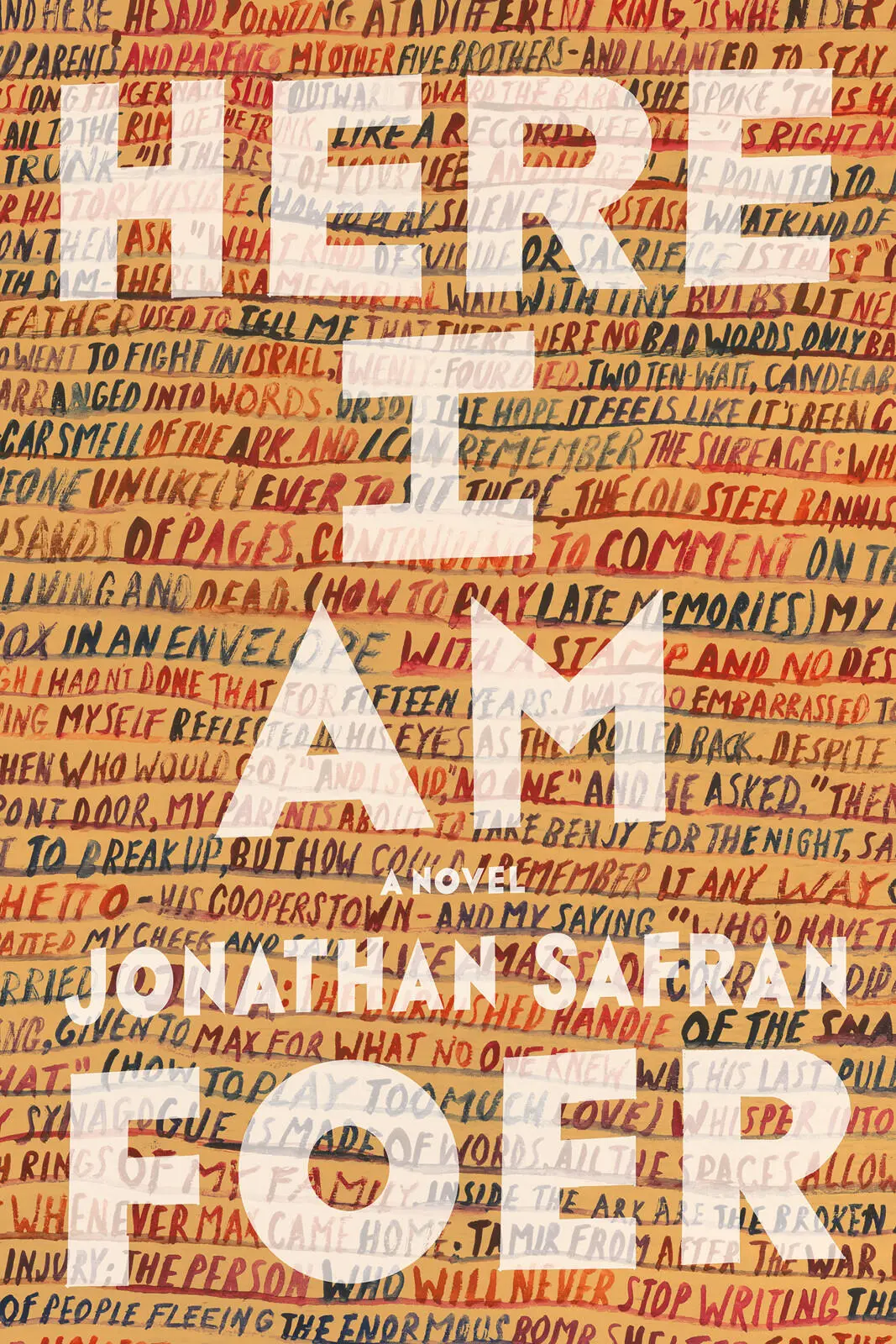
- Название:Here I Am
- Автор:
- Издательство:Hamish Hamilton
- Жанр:
- Год:2016
- ISBN:нет данных
- Рейтинг книги:5 / 5. Голосов: 1
-
Избранное:Добавить в избранное
- Отзывы:
-
Ваша оценка:
Here I Am: краткое содержание, описание и аннотация
Предлагаем к чтению аннотацию, описание, краткое содержание или предисловие (зависит от того, что написал сам автор книги «Here I Am»). Если вы не нашли необходимую информацию о книге — напишите в комментариях, мы постараемся отыскать её.
How do we fulfill our conflicting duties as father, husband, and son; wife and mother; child and adult? Jew and American? How can we claim our own identities when our lives are linked so closely to others’? These are the questions at the heart of Jonathan Safran Foer’s first novel in eleven years-a work of extraordinary scope and heartbreaking intimacy.
Unfolding over four tumultuous weeks in present-day Washington D.C.,
is the story of a fracturing family in a moment of crisis. As Jacob and Julia and their three sons are forced to confront the distances between the lives they think they want and the lives they are living, a catastrophic earthquake sets in motion a spiraling conflict in the Middle East. At stake is the very meaning of home — and the fundamental question of how much life one can bear.
Showcasing the same high-energy inventiveness, hilarious irreverence, and emotional urgency that readers and critics loved in his earlier work,
is Foer’s most searching, hard-hitting, and grandly entertaining novel yet. It not only confirms Foer’s stature as a dazzling literary talent but reveals a mature novelist who has fully come into his own as one of the most important writers of his generation.
Here I Am — читать онлайн бесплатно полную книгу (весь текст) целиком
Ниже представлен текст книги, разбитый по страницам. Система сохранения места последней прочитанной страницы, позволяет с удобством читать онлайн бесплатно книгу «Here I Am», без необходимости каждый раз заново искать на чём Вы остановились. Поставьте закладку, и сможете в любой момент перейти на страницу, на которой закончили чтение.
Интервал:
Закладка:
“Billie?”
“Hello,” she said, extending her hand to Jacob. “We haven’t actually met, although I’ve heard a lot about you.”
Precisely what? Jacob wanted to ask, but instead took her hand and said, “And I’ve heard a lot about you.” A lie. “All good things, by the way.” The truth.
“I was upstairs helping Sam with his bar mitzvah apology, and it occurred to us that we don’t know what, exactly, qualifies as an apology. Does an apology require an explicit disavowal?”
Jacob shot Julia a look of check out the vocabulary on this one .
“Could he simply describe what happened and explain? Are the words I’m sorry strictly necessary?”
“Why isn’t Sam asking?”
“He’s walking Argus. And he asked me to.”
“I’ll come up in a bit and help out,” Jacob said.
“I’m not sure that’s necessary or, really, wanted . We just kind of need to know what’s meant by apology.”
“I think an explicit disavowal is required,” Julia said, “but no need for the words I’m sorry .”
“That was my instinct,” Billie said. “OK. Well, thanks.”
She turned to leave the room, and Julia called her back: “Billie.”
“Yes?”
“Did you hear any of the conversation we were having? Or just that Mark is nice?”
“I don’t know.”
“You don’t know if you heard anything? Or you don’t know if you feel comfortable answering?”
“The latter.”
“It’s just that—”
“I understand.”
“We haven’t yet spoken with the boys—”
“I really understand.”
“And there’s a lot of context,” Jacob chimed in.
“My parents are divorced. I get it.”
“We’re just finding our way,” Jacob said, “just figuring things out.”
“Your parents are divorced?” Julia asked.
“Yes.”
“When?”
“Two years ago.”
“I’m sorry.”
“I don’t blame myself for their divorce, and neither should you.”
“You’re funny,” Julia said.
“Thank you.”
“The divorce obviously didn’t get in the way of you becoming an amazing person.”
“Well, we’ll never know what I could have been otherwise.”
“You’re really funny.”
“I really thank you.”
“We know this puts you in an awkward position,” Jacob added.
“It’s fine,” Billie said, and turned to leave once again.
“Billie?” Julia said.
“Yes?”
“Would you describe your parents’ divorce as a loss?”
“For whom?”
“I want to change my wish,” Benjy said.
“Benjy?”
“I ought to go,” Billie said, turning to leave.
“You don’t have to go,” Julia said. “Stay.”
“I wished for you to believe Sam.”
“Believe him about what?” Jacob said, gathering Benjy onto his knee.
“I ought to,” Billie said, and headed up.
“I don’t know,” Benjy said. “I just heard him talking to Max, and he said he wished you believed him. So I made his wish my wish.”
“It’s not that we don’t believe him,” Jacob said, re-finding his anger at Julia for being unable to take Sam’s side.
“So what is it?”
“Do you want to know what Sam and Max were talking about?” Julia asked.
Benjy nodded.
“Sam got in trouble in Hebrew school because they found a piece of paper on his desk with some bad words on it. He says he didn’t do it. His teacher is sure that he did.”
“So why don’t you believe him?”
“We don’t not believe him,” Jacob said.
“We always want to believe him,” Julia said. “We always want to take the side of our children. But we don’t think Sam is telling the truth this time. That doesn’t make him a bad person. And it doesn’t make us love him any less. This is how we love him. We’re trying to help him. People make mistakes all the time. I make mistakes all the time. Dad does. And we all count on each other’s forgiveness. But that requires an apology. Good people don’t make fewer mistakes, they’re just better at apologizing.”
Benjy thought about that.
He craned his neck to face Jacob, and asked, “So why do you believe him?”
“Mom and I believe the same thing.”
“You also think he lied?”
“No, I also think people make mistakes and deserve forgiveness.”
“But do you think he lied?”
“I don’t know, Benjy. And neither does Mom. Only Sam knows.”
“But do you think he lied?”
Jacob put his palms on Benjy’s thighs and waited for the angel to call out. But no angel. And no ram. Jacob said, “We think he isn’t telling the truth.”
“Could you call Mr. Schneiderman and ask him to change my note?”
“Sure,” Jacob said, “we can do that.”
“But how would you tell him my new wish without saying it?”
“Why don’t you just write it and give it to him?”
“He’s already there.”
“Where?”
“The Wailing Wall.”
“In Israel?”
“I guess.”
“Oh, then don’t worry. I’m sure his trip was canceled and you’ll have a chance to change your wish.”
“Why?”
“Because of the earthquake.”
“What earthquake?”
“There was an earthquake in Israel last week.”
“A big one?”
“You haven’t heard us talking about it?”
“You talk about lots of things that you don’t talk about to me. Is the Wall going to be OK?”
“Of course,” Julia said.
“If anything’s going to be OK,” Jacob added, “it’s the Wall. It’s been OK for more than two thousand years.”
“Yeah, but there used to be three other walls.”
“There’s a great story about that,” Jacob said, hoping he would be able to remember what he’d just promised to deliver. The story had lain dormant since he was told it in Hebrew school. He couldn’t remember the telling, and he hadn’t thought about it since, yet there it was, a part of him — a part to be handed down. “When the Roman army conquered Jerusalem, the order was given to destroy the Temple.”
“It was the Second Temple,” Benjy said, “because the first was destroyed.”
“That’s right. Good for you for knowing that. Anyway, three of the walls went down, but the fourth one resisted.”
“Resisted?”
“Struggled. Fought back.”
“A wall can’t fight back.”
“Wouldn’t be destroyed.”
“OK.”
“It stood firm against hammers, and pickaxes, and clubs. The Romans had elephants push against the wall, they tried to set fire to it, they even invented the wrecking ball.”
“Cool.”
“But nothing, it seemed, would bring the fourth wall down. The soldier in charge of the Temple’s destruction reported back to his commanding officer that they had destroyed three of the Temple’s walls. But instead of admitting that they couldn’t knock down the fourth one, he suggested they leave it up.”
“Why?”
“As proof of their greatness.”
“I don’t get it.”
“When people would see the wall, they would be able to conjure the immensity of the Temple, the foe they defeated.”
“What?”
Julia clarified: “They would see how huge the actual Temple must have been.”
“Right,” Benjy said, taking it in.
Jacob turned to Julia. “Isn’t there some organization rebuilding destroyed synagogues in Europe from their foundations? It’s like that.”
“Or the 9/11 Memorial.”
“There’s a word for it. I heard it once … A shul . Right, shul .”
“Like synagogue?”
“Wonderful coincidence, but no. It’s Tibetan.”
“Where would you have learned a Tibetan word?”
Читать дальшеИнтервал:
Закладка:
Похожие книги на «Here I Am»
Представляем Вашему вниманию похожие книги на «Here I Am» списком для выбора. Мы отобрали схожую по названию и смыслу литературу в надежде предоставить читателям больше вариантов отыскать новые, интересные, ещё непрочитанные произведения.









Обсуждение, отзывы о книге «Here I Am» и просто собственные мнения читателей. Оставьте ваши комментарии, напишите, что Вы думаете о произведении, его смысле или главных героях. Укажите что конкретно понравилось, а что нет, и почему Вы так считаете.