Jonathan Foer - Here I Am
Здесь есть возможность читать онлайн «Jonathan Foer - Here I Am» весь текст электронной книги совершенно бесплатно (целиком полную версию без сокращений). В некоторых случаях можно слушать аудио, скачать через торрент в формате fb2 и присутствует краткое содержание. Год выпуска: 2016, Издательство: Hamish Hamilton, Жанр: Историческая проза, на английском языке. Описание произведения, (предисловие) а так же отзывы посетителей доступны на портале библиотеки ЛибКат.
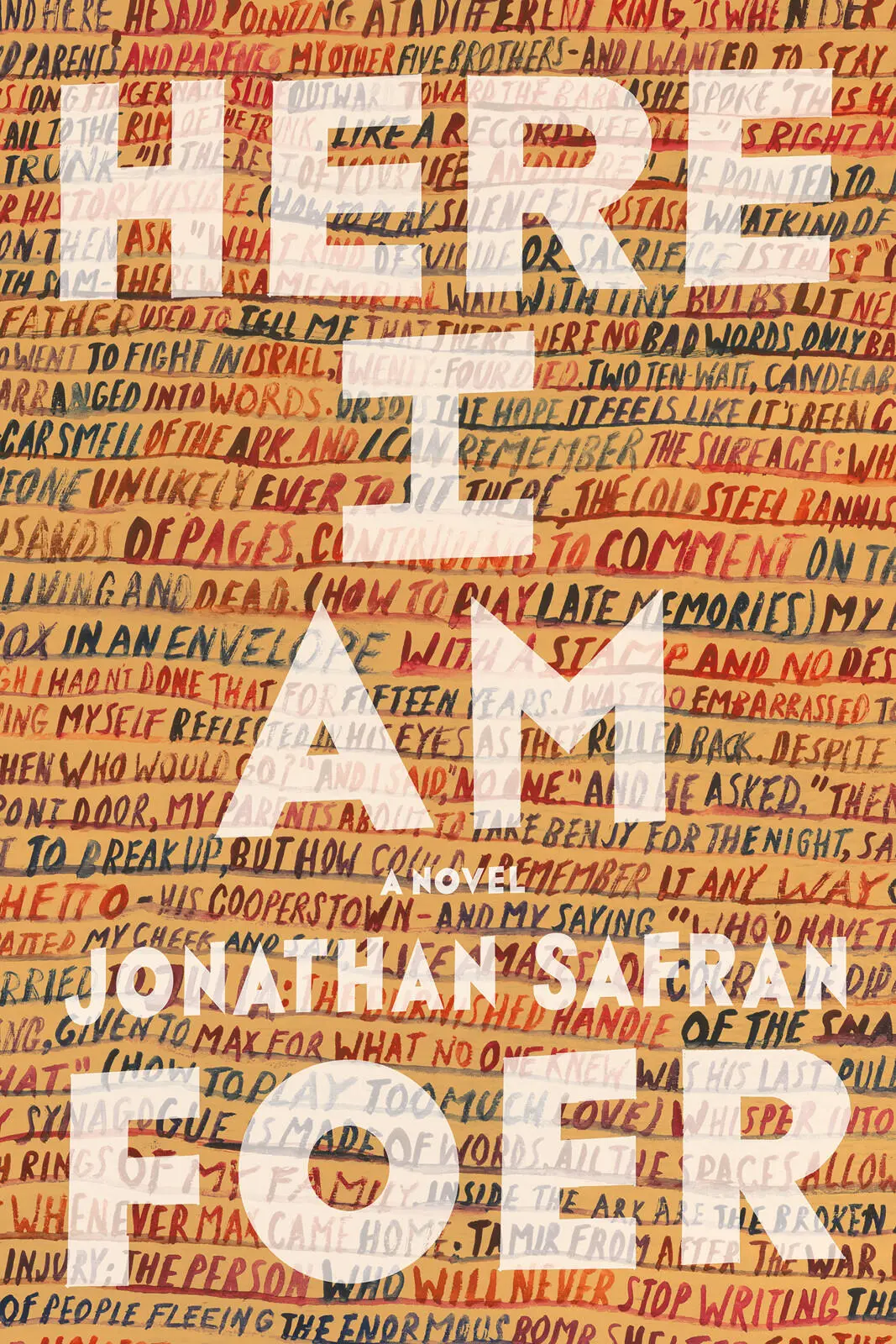
- Название:Here I Am
- Автор:
- Издательство:Hamish Hamilton
- Жанр:
- Год:2016
- ISBN:нет данных
- Рейтинг книги:5 / 5. Голосов: 1
-
Избранное:Добавить в избранное
- Отзывы:
-
Ваша оценка:
Here I Am: краткое содержание, описание и аннотация
Предлагаем к чтению аннотацию, описание, краткое содержание или предисловие (зависит от того, что написал сам автор книги «Here I Am»). Если вы не нашли необходимую информацию о книге — напишите в комментариях, мы постараемся отыскать её.
How do we fulfill our conflicting duties as father, husband, and son; wife and mother; child and adult? Jew and American? How can we claim our own identities when our lives are linked so closely to others’? These are the questions at the heart of Jonathan Safran Foer’s first novel in eleven years-a work of extraordinary scope and heartbreaking intimacy.
Unfolding over four tumultuous weeks in present-day Washington D.C.,
is the story of a fracturing family in a moment of crisis. As Jacob and Julia and their three sons are forced to confront the distances between the lives they think they want and the lives they are living, a catastrophic earthquake sets in motion a spiraling conflict in the Middle East. At stake is the very meaning of home — and the fundamental question of how much life one can bear.
Showcasing the same high-energy inventiveness, hilarious irreverence, and emotional urgency that readers and critics loved in his earlier work,
is Foer’s most searching, hard-hitting, and grandly entertaining novel yet. It not only confirms Foer’s stature as a dazzling literary talent but reveals a mature novelist who has fully come into his own as one of the most important writers of his generation.
Here I Am — читать онлайн бесплатно полную книгу (весь текст) целиком
Ниже представлен текст книги, разбитый по страницам. Система сохранения места последней прочитанной страницы, позволяет с удобством читать онлайн бесплатно книгу «Here I Am», без необходимости каждый раз заново искать на чём Вы остановились. Поставьте закладку, и сможете в любой момент перейти на страницу, на которой закончили чтение.
Интервал:
Закладка:
“No idea,” Jacob said. “But I learned it.”
“So? Are you going to make us pull down the Tibetan Webster’s ?”
“I could be getting this wrong, but I think it’s a physical impression left behind. Like a footprint. Or the channel where water flowed. Or in Connecticut — the matted grass where Argus had slept.”
“A snow angel,” Benjy said.
“That’s a great one,” Julia said, reaching for his face.
“Only, we don’t believe in angels.”
Jacob touched Benjy’s knee. “What I said was that while there are angels in the Torah, Judaism doesn’t really encourage—”
“You’re my angel,” Julia told Benjy.
“And you’re actually my tooth fairy,” he said.
Jacob’s wish would have been to have learned his life lessons before it was too late to apply them. But like the wall into which he’d have tucked it, the wish conjured an immensity.
* * *
After Benjy had left the room, and the rehearsal had wrapped up, and Max was fed a second dinner that wasn’t spinach lasagna, and the door separating Sam and Billie from the rest of the world was judged sufficiently cracked, Jacob decided to go run some unnecessary errands at the hardware store: buy a shorter hose that would tuck away less awkwardly, replenish the AAA battery supply, maybe fondle some power tools. On his way, he called his father.
“I give in,” he said.
“Are you on Bluetooth?”
“Yes.”
“Well, get off it, so I can hear you.”
“It’s illegal to hold the phone while driving.”
“And it gives you cancer, too. Cost of doing business.”
Jacob brought the phone to his face and repeated, “I give in.”
“That’s great to hear. With reference to what?”
“Let’s bury Grandpa here.”
“Really?” Irv asked, sounding surprised, and pleased, and heartbroken. “What brought that on?”
The reason — whether he was persuaded by his father’s pragmatism, or was tired of reorganizing his life to spend time with a dead body, or was too preoccupied with the burial of his family to keep up the fight — simply didn’t matter all that much. It took them eight days, but the decision was made: they would bury Isaac in Judean Gardens, a very ordinary, pretty-enough cemetery about thirty minutes outside the city. He would get visitors, and spend eternity among his family, and while it might not be the nonexistent and tarrying Messiah’s first or thousandth stop, He’d get there.
THE GENUINE VERSION
Eyesick, the threadbare beginnings of an avatar, was in the middle of a digital lemon grove — the clearly marked and barbed-wire-ringed private property of a lemonade corporation that used kinda funny videos, featuring kinda trustworthy actors, to persuade concerned-but-not-motivated consumers to believe that what they were drinking had something to do with authenticity. Sam hated such corporations nearly half as much as he hated himself for being just another spoon-fed idiot-cog who grinned and whatever the past tense of “bear it” is while hating, and announcing his hatred of, corporations. He would never trespass in life itself. He was too ethical, and too much of a coward. (Sometimes it was hard to differentiate.) But that was one of the many, many great things about Other Life — perhaps the explanation for his addiction to it: it was an opportunity to be a little less ethical, and a little less of a coward.
Eyesick was trespassing, yes, but he wasn’t there to start a fire, chop down trees, do graffiti (or whatever is the proper way of saying that), or even to trespass, really. He’d gone there to be alone. Among the seemingly infinite columns of trunks, beneath the duvet of lemons, he could be by himself. It’s not like he felt a great need to be alone. Need was a word that Sam’s mom might use.
“Do you need to get any homework done before we go to dinner?”
“ Finished ,” he would say, taking great pleasure in throwing the correction back at her.
“Do you need to get any homework finished before we go to dinner?”
“Need?”
“Yes. Need.”
He took no pleasure in the great pleasure he seemed to take in being a smart-ass with her. But he needed to do it. He needed to push back against his instinct to cling to her; he needed to alienate what he needed to draw close, but more than anything, he needed not to be the object of her needs. It was bodily. It wasn’t her continued need to kiss him that repulsed him, but her overt efforts to manage that need. He was disgusted — revolted, nauseated — by her stolen touches: fixing his hair for a moment longer than necessary, holding his hand while cutting his fingernails (something he knew how to do himself, but needed her to do, but only in exactly the right and limited way). And her stolen glances: when he was coming out of a pool, or worse, taking off a shirt for an impromptu load of laundry. What she stole was stolen from him, and it inspired not only disgust, and not only auger, but resistance. You can have what you want, but you cannot take it.
Eyesick was seeking aloneness in a lemon grove because Sam was sitting shiva for Isaac, avoiding conversations with relatives whose central processing units were programmed to shame him. Why else would a second cousin he hadn’t seen in years feel a need to mention acne? To mention voice-dropping? To wink while asking about girlfriends?
Eyesick was seeking aloneness. Not to be by himself, but to be away from others. It’s different.
> Sam?
> …
> Sam, is that you?
> Who are you talking to?
> YOU.
> Me?
> You. Sam.
> Who are you?
> I KNEW it was you.
> Who knew?
> You don’t recognize me?
Recognize? The avatar addressing Eyesick was a lion with a plush rainbow mane; a brown suede vest with opalescent buttons, largely concealed beneath a white tuxedo with tails down to the end of his tail (which was itself adorned with a cubic zirconia heart); bleached teeth largely concealed by lipsticked lips (insofar as a lion has lips); a snout that was just a bit too moist; ruby pupils (not ruby-colored, but gemstones); and mother-of-pearl claws with peace signs and Stars of David etched into them. If it was good, it was very good. But was it good?
There was no recognition. Only the surprise of having been discovered in a moment of reflection, and the shame of having been named and known.
It would be possible, in theory, for someone with sufficient tech savvy and insufficient joie de vivre to trace Eyesick back to Sam. But it would require an effort that he couldn’t imagine anyone he knew — anyone who knew him —making. Except maybe Billie.
Putting aside his parents’ virtuosically lame and quarter-hearted attempts to “check in” on his computer usage, it never ceased to amaze Sam what he could get away with.
Proof: he shoplifted from the corner grocery that still had his family name above the door, the store his great-grandfather had opened with more dead brothers than words of English. Sam shoplifted enough junk food — enough bags of Cheetos (punctured with the sharpened end of a bent paper clip to release the air and allow for compression), enough Mentos boners in his pockets — from the earnest Korean immigrants, who kept lemon slices by the register to keep their fingers moist enough to grip cash, to open his own corner store, but this one with a different name, preferably with no name, preferably: STORE. Why did he do all that stealing? Not to eat what he took. He never did, never once. He always, always returned the goods — the returning requiring far more illicit prowess than the stealing. He did it to prove that he could, and to prove that he was horrible, and to prove that no one cared.
Читать дальшеИнтервал:
Закладка:
Похожие книги на «Here I Am»
Представляем Вашему вниманию похожие книги на «Here I Am» списком для выбора. Мы отобрали схожую по названию и смыслу литературу в надежде предоставить читателям больше вариантов отыскать новые, интересные, ещё непрочитанные произведения.






Обсуждение, отзывы о книге «Here I Am» и просто собственные мнения читателей. Оставьте ваши комментарии, напишите, что Вы думаете о произведении, его смысле или главных героях. Укажите что конкретно понравилось, а что нет, и почему Вы так считаете.