Jonathan Foer - Here I Am
Здесь есть возможность читать онлайн «Jonathan Foer - Here I Am» весь текст электронной книги совершенно бесплатно (целиком полную версию без сокращений). В некоторых случаях можно слушать аудио, скачать через торрент в формате fb2 и присутствует краткое содержание. Год выпуска: 2016, Издательство: Hamish Hamilton, Жанр: Историческая проза, на английском языке. Описание произведения, (предисловие) а так же отзывы посетителей доступны на портале библиотеки ЛибКат.
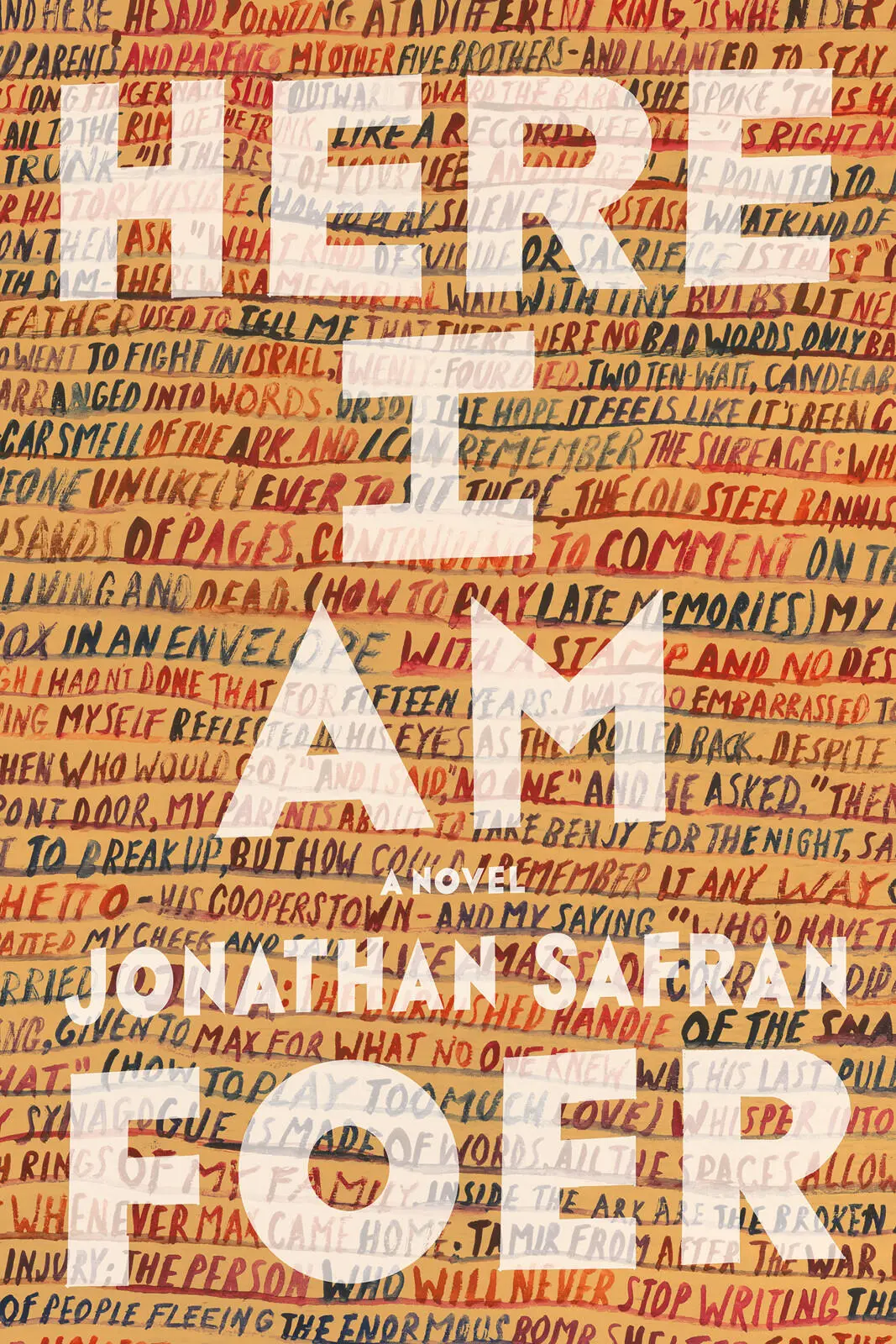
- Название:Here I Am
- Автор:
- Издательство:Hamish Hamilton
- Жанр:
- Год:2016
- ISBN:нет данных
- Рейтинг книги:5 / 5. Голосов: 1
-
Избранное:Добавить в избранное
- Отзывы:
-
Ваша оценка:
Here I Am: краткое содержание, описание и аннотация
Предлагаем к чтению аннотацию, описание, краткое содержание или предисловие (зависит от того, что написал сам автор книги «Here I Am»). Если вы не нашли необходимую информацию о книге — напишите в комментариях, мы постараемся отыскать её.
How do we fulfill our conflicting duties as father, husband, and son; wife and mother; child and adult? Jew and American? How can we claim our own identities when our lives are linked so closely to others’? These are the questions at the heart of Jonathan Safran Foer’s first novel in eleven years-a work of extraordinary scope and heartbreaking intimacy.
Unfolding over four tumultuous weeks in present-day Washington D.C.,
is the story of a fracturing family in a moment of crisis. As Jacob and Julia and their three sons are forced to confront the distances between the lives they think they want and the lives they are living, a catastrophic earthquake sets in motion a spiraling conflict in the Middle East. At stake is the very meaning of home — and the fundamental question of how much life one can bear.
Showcasing the same high-energy inventiveness, hilarious irreverence, and emotional urgency that readers and critics loved in his earlier work,
is Foer’s most searching, hard-hitting, and grandly entertaining novel yet. It not only confirms Foer’s stature as a dazzling literary talent but reveals a mature novelist who has fully come into his own as one of the most important writers of his generation.
Here I Am — читать онлайн бесплатно полную книгу (весь текст) целиком
Ниже представлен текст книги, разбитый по страницам. Система сохранения места последней прочитанной страницы, позволяет с удобством читать онлайн бесплатно книгу «Here I Am», без необходимости каждый раз заново искать на чём Вы остановились. Поставьте закладку, и сможете в любой момент перейти на страницу, на которой закончили чтение.
Интервал:
Закладка:
Sitting with her now, rehearsing the horrible conversation, Jacob wondered if maybe, all those years, he had misunderstood the spaces surrounding Julia: her quiet, her steps back. Maybe they weren’t buffers of defense, but of the most extreme humility, the purest generosity. What if she wasn’t withdrawing, but beckoning? Or both at the same time? Withdrawing and beckoning? And more to the point: making a world for their children, even for Jacob.
“You won’t cry,” he told her, trying to enter the space.
“Would it be bad to?”
“I don’t know. I suppose, all things being equal, it would be best not to impose that on them. Impose isn’t the right word. I mean … You know what I mean.”
“I do.”
He was surprised, and further embodied, by her I do . “We’ll go over this a few dozen times and it’ll feel different.”
“It will never not destroy me.”
“And the adrenaline in the moment will help hold the tears back.”
“You’re probably right.”
You’re probably right. It had been a long time — it had felt like a long time, Dr. Silvers would correct — since she’d deferred to his emotional judgment in any way. Since she hadn’t reflexively bucked against it. There was a kindness in those words— you’re probably right —that disarmed him. He didn’t need to be right, but he needed that kindness. What if, all those times she reflexively bucked against, or simply dismissed, his perspective, she’d given him a you’re probably right ? He would have found it very easy to concede inside that kindness.
“And if you cry,” Jacob said, “you cry.”
“I just want to make it easy on them.”
“No chance of that.”
“As easy as it can be.”
“Whatever happens, we’ll find our way.”
We’ll find our way. What an odd assurance, Julia thought, when the point of the conversation they were rehearsing was precisely that they couldn’t find their way. Not together. And yet the assurance took the form of togetherness: we .
“Maybe I’ll get a glass of water,” she said. “Do you want one?”
“I’ll go to the door and whine when I really need it.”
“You think the kids are losing?” she asked as she walked to the kitchen. Jacob wondered if the water was just an excuse to face away when asking that question.
“I’m just going to turn on the TV for one second. On mute. I just need to see what’s happening.”
“What about what’s happening here?”
“I’m here. You asked if I think the kids are losing. Yes, I think that’s the only way to describe it.”
A map of the Middle East, swooping arrows indicating the movements of various armies. There had been skirmishes, mostly with Syria and Hezbollah in the north. The Turks were taking an increasingly hostile tone, and the newly formed Transarabia was amassing planes and troops in what had been Jordan. But it was containable, controllable, plausibly deniable.
Jacob said, “Rest assured, I’ll be crying.”
“What?”
“I’ll have some water.”
“I didn’t hear what you said.”
“I said, even if you don’t see me crying, I’ll be crying.”
That was something — that felt like something — he needed to say. He’d always known — always felt —that Julia believed she had a stronger emotional engagement with the children, that being a mother, or a woman, or simply herself, created a bond that a father, man, or Jacob was incapable of. She’d subtly suggest it all the time — it felt like she was subtly suggesting it — and would every now and then outright say it, although it was always couched in talk of all the things that were special to his relationship with them, like having fun.
Her perception of their parental identities generally broke that way: depth and fun. Julia breast-fed them. Jacob made them crack up with over-the-top versions of airplane-into-the-mouth feeding. Julia had a visceral, uncontrollable need to check in on them while they slept. Jacob woke them up if the game went into extra innings. Julia taught them words like nostalgia, angst , and pensive . Jacob liked to say, “There’s no bad language, only bad usage,” as a way of justifying the supposedly good usage of words like douche and shitty , which Julia hated as much as the kids loved.
There was another way of looking at that dichotomy of depth and fun, one that Jacob had spent innumerable hours considering with Dr. Silvers: heaviness and lightness. Julia brought weight to everything, opening up a space for every intimated emotion, urging a fleshed-out conversation about each passing remark, perpetually suggesting the value of sadness. Jacob felt that most problems weren’t problems, and those that were could be resolved with distraction, food, physical activity, or the passage of time. Julia always wanted to give the kids a life of gravity: culture, trips abroad, black-and-white movies. Jacob saw no problem with — saw the great good in — bubblier, dumber activities: water parks, baseball games, terrible superhero movies that brought great pleasure. She understood childhood as the period of soul formation. He understood it as life’s only opportunity to feel safe and happy. Each saw the myriad shortcomings and absolute necessity of the other.
“Do you remember,” Julia asked, “however many years ago, when my friend Rachel came to our seder?”
“Rachel?”
“From architecture school? Remember, she came with her twins?”
“And no husband.”
“Right. He’d had a heart attack at the gym.”
“Cautionary tale.”
“You remember?”
“Sure, that year’s sympathy invite.”
“I guess she went to yeshiva as a girl, or had some kind of rigorous Jewish education. I hadn’t realized that, and ended up feeling so embarrassed.”
“By what?”
“What illiterate Jews we are.”
“But she had a great time, didn’t she?”
“She did.”
“So save your embarrassment.”
“It was years ago.”
“Embarrassment is the Parmalat of emotions.”
That got a great laugh — it felt great to Jacob — from Julia. An irrepressible laugh in the midst of so much tactical strategizing.
“What made you remember her now?”
Silence can be as irrepressible as laughter. And it can accumulate, like weightless snowflakes. It can collapse a ceiling.
“I’m not sure,” Julia said.
Jacob tried to pitch the conversation’s roof: “Maybe you were remembering how it felt to be judged.”
“Maybe. I don’t think she was judging. But I felt judged.”
“And you’re afraid of feeling judged?” Jacob asked.
A few nights before, Julia had awoken as if from a nightmare, although she had no memory of any dream. She went down to the kitchen, found the Georgetown Day student directory in the “crap drawer,” and confirmed that Benjy would be the only child in his class with two addresses.
“I’m afraid of our family being judged,” she said.
“Do you judge yourself?”
“Don’t you?”
“I’m going to be the sympathy invite this year, aren’t I?”
Julia smiled, grateful for the deflection.
“Why should this year be different from all other years?”
Their first shared laugh in weeks.
Jacob wasn’t used to this warmth, and it confused him. This was not what he was expecting when rehearsing for this rehearsal of a conversation. He’d anticipated something subtly passive-aggressive. He assumed he’d have to sample a buffet of shit, never having the guts — never finding justification in the cost-benefit analysis of self-defense — to draw upon the small arsenal of retorts he’d prepared.
Читать дальшеИнтервал:
Закладка:
Похожие книги на «Here I Am»
Представляем Вашему вниманию похожие книги на «Here I Am» списком для выбора. Мы отобрали схожую по названию и смыслу литературу в надежде предоставить читателям больше вариантов отыскать новые, интересные, ещё непрочитанные произведения.








Обсуждение, отзывы о книге «Here I Am» и просто собственные мнения читателей. Оставьте ваши комментарии, напишите, что Вы думаете о произведении, его смысле или главных героях. Укажите что конкретно понравилось, а что нет, и почему Вы так считаете.