Jonathan Foer - Here I Am
Здесь есть возможность читать онлайн «Jonathan Foer - Here I Am» весь текст электронной книги совершенно бесплатно (целиком полную версию без сокращений). В некоторых случаях можно слушать аудио, скачать через торрент в формате fb2 и присутствует краткое содержание. Год выпуска: 2016, Издательство: Hamish Hamilton, Жанр: Историческая проза, на английском языке. Описание произведения, (предисловие) а так же отзывы посетителей доступны на портале библиотеки ЛибКат.
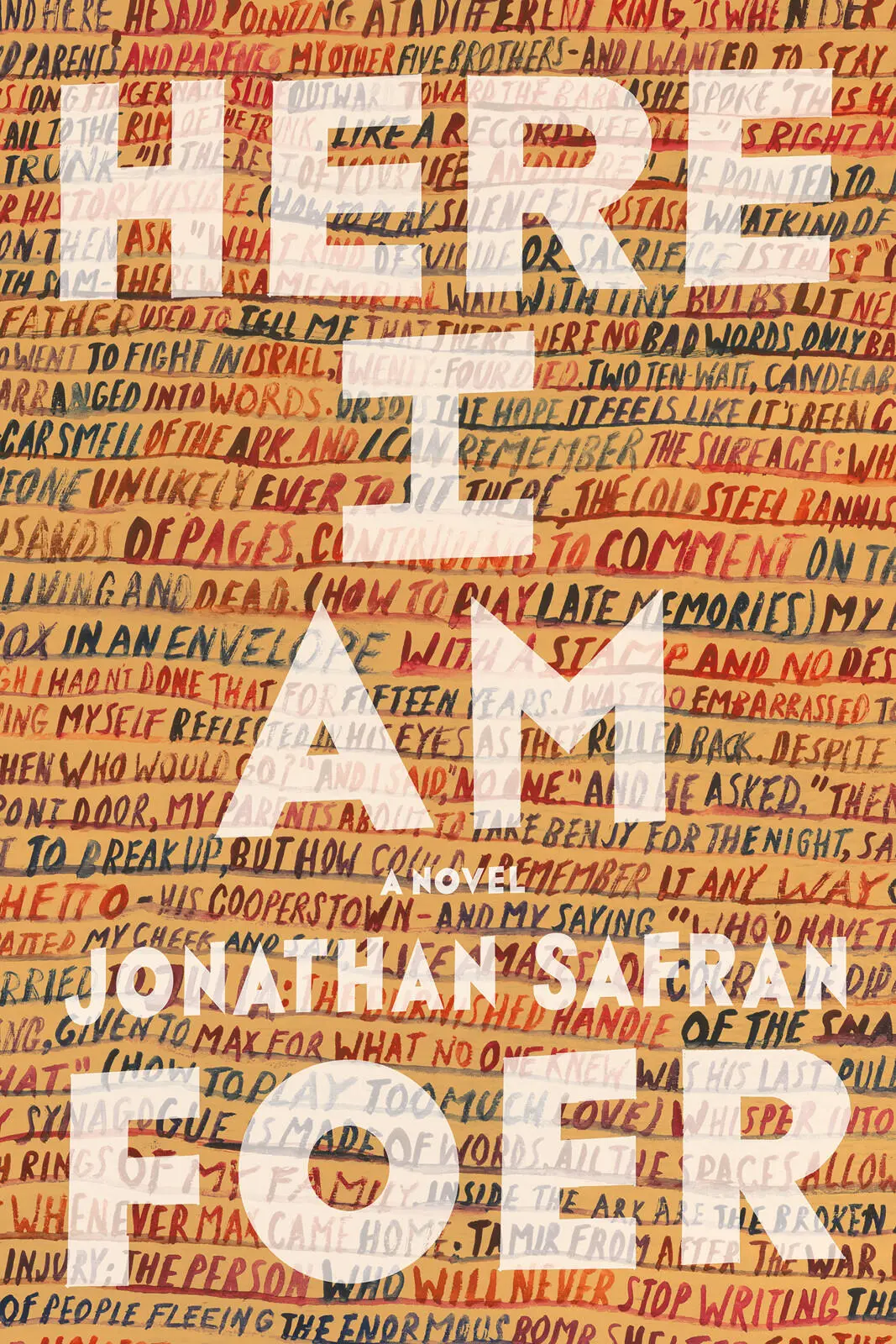
- Название:Here I Am
- Автор:
- Издательство:Hamish Hamilton
- Жанр:
- Год:2016
- ISBN:нет данных
- Рейтинг книги:5 / 5. Голосов: 1
-
Избранное:Добавить в избранное
- Отзывы:
-
Ваша оценка:
Here I Am: краткое содержание, описание и аннотация
Предлагаем к чтению аннотацию, описание, краткое содержание или предисловие (зависит от того, что написал сам автор книги «Here I Am»). Если вы не нашли необходимую информацию о книге — напишите в комментариях, мы постараемся отыскать её.
How do we fulfill our conflicting duties as father, husband, and son; wife and mother; child and adult? Jew and American? How can we claim our own identities when our lives are linked so closely to others’? These are the questions at the heart of Jonathan Safran Foer’s first novel in eleven years-a work of extraordinary scope and heartbreaking intimacy.
Unfolding over four tumultuous weeks in present-day Washington D.C.,
is the story of a fracturing family in a moment of crisis. As Jacob and Julia and their three sons are forced to confront the distances between the lives they think they want and the lives they are living, a catastrophic earthquake sets in motion a spiraling conflict in the Middle East. At stake is the very meaning of home — and the fundamental question of how much life one can bear.
Showcasing the same high-energy inventiveness, hilarious irreverence, and emotional urgency that readers and critics loved in his earlier work,
is Foer’s most searching, hard-hitting, and grandly entertaining novel yet. It not only confirms Foer’s stature as a dazzling literary talent but reveals a mature novelist who has fully come into his own as one of the most important writers of his generation.
Here I Am — читать онлайн бесплатно полную книгу (весь текст) целиком
Ниже представлен текст книги, разбитый по страницам. Система сохранения места последней прочитанной страницы, позволяет с удобством читать онлайн бесплатно книгу «Here I Am», без необходимости каждый раз заново искать на чём Вы остановились. Поставьте закладку, и сможете в любой момент перейти на страницу, на которой закончили чтение.
Интервал:
Закладка:
“We were just talking about dinner,” Jacob said.
“Yeah, I know.”
“You heard?”
“I thought you were calling us for dinner.”
“It’s only four thirty.”
“I thought—”
“You’re hungry?”
“What’s for dinner?”
“What’s that have to do with your hunger?” Jacob asked.
“Just wondering.”
“Lasagna and some veggie or another,” Julia said.
“Plain lasagna?”
“Spinach.”
“I’m not hungry.”
“Well, you have an hour to work up an appetite for spinach lasagna.”
“I think Argus needs a walk.”
“I just gave him a walk,” Jacob said.
“Did he poo?”
“I can’t remember.”
“You would remember if he’d pooed,” Max said. “He needs to poo. He’s doing that thing where he licks at the beginning of a poo that needs to come out.”
“Why are you telling us this, instead of just walking him?”
“Because I’m working on my speech for Great-Grandpa’s funeral, and I need to concentrate.”
“You’re giving a speech?” Jacob asked.
“You aren’t?”
Julia was touched by Max’s charmingly narcissistic initiative. Jacob was ashamed by his own narcissistic thoughtlessness.
“I’ll say a few words. Or actually, Grandpa will probably speak on our behalf.”
“Grandpa doesn’t speak on my behalf,” Max said.
“Work on your speech,” Julia said. “Dad will walk Argus.”
“I did walk Argus.”
“Until he poos.”
Max went to the kitchen and came out with a box of unhealthy organic cereal, which he took back to his room.
Julia called up: “Cereal should be in your mouth or in the box. Nowhere else.”
Max called down: “I can’t swallow it?”
“Maybe it’s a mistake to talk to all of them at once,” Jacob said, careful with his volume. “Maybe we should talk to Sam first.”
“I suppose I could see the—”
“Jesus.”
“What?”
Jacob gestured at the TV that was now always on. There were images from a soccer stadium in Jerusalem, a stadium in which Jacob and Tamir had seen a game more than two decades before. There were a dozen bulldozers. It wasn’t clear what they were doing, or why Israel would allow such images to be broadcast, and that not-knowing was terrifying. Could they be preparing a military site? Digging a mass grave?
The news that reached America was scattershot, unreliable, and alarmist. The Blochs did what they did best: balanced overreaction with repression. If in their hearts they believed they were safe, they overworried, talked and talked, whipped themselves, and one another, into foams of anguish. From the comfort of the living room, they followed the unfolding news like a sporting event, and at times caught themselves rooting for drama. There were even small, shameful disappointments when estimates of destruction were revised downward, or when what appeared to be an act of aggression turned out to be only an accident. It was a game whose unreal danger was to be talked up and savored, so long as the outcome was fixed. But if there was an inkling of any real danger, if the shit started to thicken — as it was soon to do — they dug until the blades of their shovels threw sparks: It’ll be fine, it’s nothing .
Tamir was largely absent. He spent part of every day trying to find a way home, but never with any success. If he talked with Rivka or Noam, he did so privately and didn’t share anything. And to Jacob’s amazement, he still wanted to sightsee, schlepping an unenthusiastic Barak from monument to monument, museum to museum, Cheesecake Factory to Ruth’s Chris Steakhouse. It was so easy for Jacob to see in Tamir what he couldn’t see in himself: a refusal to acknowledge reality. He sightsaw so he wouldn’t have to look.
The scene at the stadium was replaced with the face of Adia, the young Palestinian girl whose entire family had been killed in the earthquake and who was found wandering the streets by an American photojournalist. The story touched the world, and kept touching it. Maybe it was as simple as her beautiful face. Maybe it was how they held hands. It was a feel-good piece amid the tragedy, but it was a tragedy, Jacob thought, or at least inauspicious, that the good feeling was between a Palestinian and an American. At some point, Max started sleeping with a newspaper photo of Adia under his pillow. When her orphanage collapsed and she went missing, Max went missing, too. Everyone knew where he was — it was only his voice, gaze, and teeth that were hidden — but no one knew how to find him.
“Hello?” Julia asked, shaking her hand in front of Jacob’s face.
“What?”
“You’ve been watching while we’ve been talking?”
“Out of the corner of my eye.”
“I realize the Middle East is collapsing, and that the entire world will get sucked into the vortex, but this is actually more important right now.”
She got up and turned off the TV. Jacob thought he heard it sigh in relief.
“Go walk Argus, then let’s finish this.”
“He’ll go to the door and whine when he really needs it.”
“Why make him really need it?”
“When it’s time, I mean.”
“You think we should talk to Sam first? Before the others?”
“Or Sam and Max. Just in case one of them starts crying. Benjy is going to follow their lead, so we should give them a chance to digest and gather themselves.”
“Or just let them all cry together,” Julia said.
“Maybe just Sam first. He’s probably going to have the strongest reaction — whatever that reaction will be — but he’s also the most able to process it.”
Julia touched one of the art books on the coffee table.
“What if I cry?” she asked.
The question embodied Jacob, made him want to touch her — grasp her shoulder, press his palm to her cheek, feel the ridges and valleys of their fingerprints align — but he didn’t know if that was acceptable anymore. Her stillness throughout the conversation didn’t feel standoffish, but it did create a space around her. What if she cried? Of course she would cry. They would all cry. They’d wail. It would be horrible. The kids’ lives would be ruined. Tens of thousands of people would die. Israel would be destroyed. He wanted all of that, not because he craved horror, but because imagining the worst kept him safe from it — focusing on doomsday allowed for the day to day.
On a drive to visit Isaac many years before, Sam had asked from the backseat, “God is everywhere, right?”
Jacob and Julia exchanged yet another where-the-hell-did- that -come-from look.
Jacob handled it: “That’s what people who believe in God tend to think, yes.”
“And God has always been everywhere?”
“I suppose so.”
“So here’s what I can’t figure out,” he said, watching the early moon follow them as they drove. “If God was everywhere, where did He put the world when He made it?”
Jacob and Julia exchanged another look, this one of awe.
Julia turned to face Sam, who was still looking out the window, his pupils constantly returning, like a typewriter carriage, and said, “You are an amazing person.”
“OK,” Sam said, “but where did He put it?”
That night, Jacob did a bit of research and learned that Sam’s question had inspired volumes of thought over thousands of years, and that the most prevalent response was the kabbalistic notion of tzimtzum. Basically, God was everywhere, and as Sam surmised, when He wanted to create the world, there was nowhere to put it. So He made Himself smaller. Some refered to it as an act of contraction, others a concealment. Creation demanded self-erasure, and to Jacob, it was the most extreme humility, the purest generosity.
Читать дальшеИнтервал:
Закладка:
Похожие книги на «Here I Am»
Представляем Вашему вниманию похожие книги на «Here I Am» списком для выбора. Мы отобрали схожую по названию и смыслу литературу в надежде предоставить читателям больше вариантов отыскать новые, интересные, ещё непрочитанные произведения.




Обсуждение, отзывы о книге «Here I Am» и просто собственные мнения читателей. Оставьте ваши комментарии, напишите, что Вы думаете о произведении, его смысле или главных героях. Укажите что конкретно понравилось, а что нет, и почему Вы так считаете.