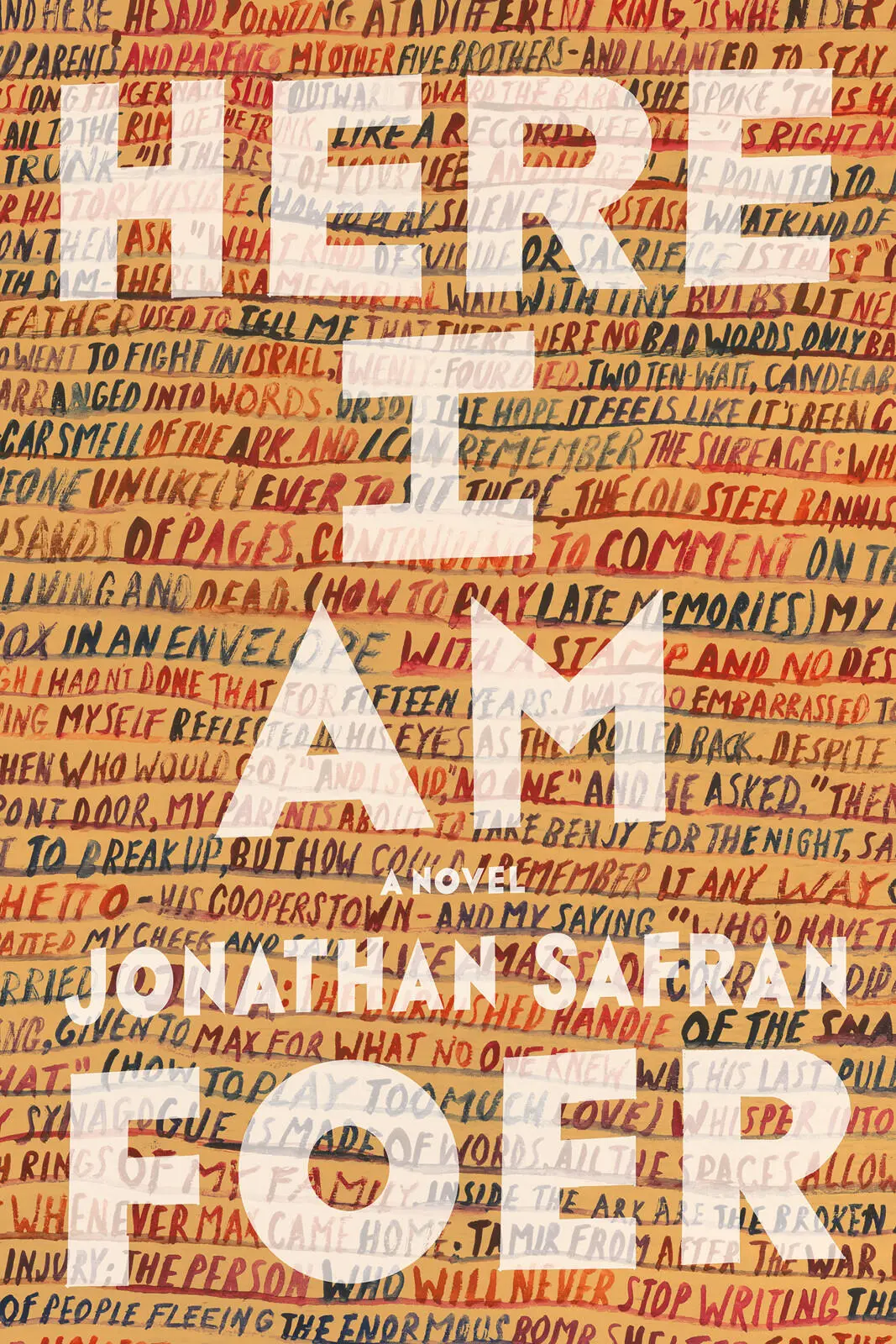
Jonathan Foer - Here I Am
Здесь есть возможность читать онлайн «Jonathan Foer - Here I Am» весь текст электронной книги совершенно бесплатно (целиком полную версию без сокращений). В некоторых случаях можно слушать аудио, скачать через торрент в формате fb2 и присутствует краткое содержание. Год выпуска: 2016, Издательство: Hamish Hamilton, Жанр: Историческая проза, на английском языке. Описание произведения, (предисловие) а так же отзывы посетителей доступны на портале библиотеки ЛибКат.
- Название:Here I Am
- Автор:
- Издательство:Hamish Hamilton
- Жанр:
- Год:2016
- ISBN:нет данных
- Рейтинг книги:5 / 5. Голосов: 1
-
Избранное:Добавить в избранное
- Отзывы:
-
Ваша оценка:
Here I Am: краткое содержание, описание и аннотация
Предлагаем к чтению аннотацию, описание, краткое содержание или предисловие (зависит от того, что написал сам автор книги «Here I Am»). Если вы не нашли необходимую информацию о книге — напишите в комментариях, мы постараемся отыскать её.
How do we fulfill our conflicting duties as father, husband, and son; wife and mother; child and adult? Jew and American? How can we claim our own identities when our lives are linked so closely to others’? These are the questions at the heart of Jonathan Safran Foer’s first novel in eleven years-a work of extraordinary scope and heartbreaking intimacy.
Unfolding over four tumultuous weeks in present-day Washington D.C.,
is the story of a fracturing family in a moment of crisis. As Jacob and Julia and their three sons are forced to confront the distances between the lives they think they want and the lives they are living, a catastrophic earthquake sets in motion a spiraling conflict in the Middle East. At stake is the very meaning of home — and the fundamental question of how much life one can bear.
Showcasing the same high-energy inventiveness, hilarious irreverence, and emotional urgency that readers and critics loved in his earlier work,
is Foer’s most searching, hard-hitting, and grandly entertaining novel yet. It not only confirms Foer’s stature as a dazzling literary talent but reveals a mature novelist who has fully come into his own as one of the most important writers of his generation.
Here I Am — читать онлайн бесплатно полную книгу (весь текст) целиком
Ниже представлен текст книги, разбитый по страницам. Система сохранения места последней прочитанной страницы, позволяет с удобством читать онлайн бесплатно книгу «Here I Am», без необходимости каждый раз заново искать на чём Вы остановились. Поставьте закладку, и сможете в любой момент перейти на страницу, на которой закончили чтение.
Интервал:
Закладка:
“The appearance of enjoying life?” Sam asked.
“I’m just saying that some sensitivity is required.”
“Let me tell you the right way to think about it,” Tamir began.
“Maybe later,” Jacob said.
“So no band,” Sam said. “Is that enough to make sure we don’t appear to enjoy life?”
“In Israel we don’t even have bar mitzvah parties,” Tamir said.
“Mazel tov,” Jacob told him. And then, to Sam: “I might also skip the sign-in board.”
“Which I always wanted to skip,” Sam said.
“Which I spent three weeks making for you,” Julia said.
“You made it over the course of three weeks ,” Jacob corrected.
“What?”
“You didn’t spend three weeks making it.”
“Why do you think that’s an important clarification?”
He all of a sudden didn’t, so he changed course: “I think we should also consider editing the centerpieces.”
“Why?” Julia asked, beginning to understand that he was taking things from her , not Sam.
“I’ve never understood the desire of American Jews to speak words you don’t understand,” Tamir said. “Finding meaning in the absence of meaning — I don’t get it.”
“They’re … festive ,” Jacob said.
“They’re elegant .”
“Wait a minute,” Sam said, “what’s left?”
“What’s left?”
“Exactly,” Tamir said.
“What’s left ,” Jacob said, resting his hand on Sam’s shoulder for the instant before Sam recoiled, “is you becoming a man.”
“What’s left ,” Julia said, “is being with your family.”
“You are the luckiest people in the history of the world,” Tamir said.
“We’re trying,” Jacob said to Sam, who lowered his eyes and said, “This sucks.”
“It won’t,” Julia said. “We’ll make it really special.”
“I didn’t say it will suck. I said it sucks . Presently.”
“You’d rather be in a fridge like Great-Grandpa?” Jacob asked, as surprised as anyone by his words. How could he have thought them, much less vocalized them? Or these: “You’d rather be trapped under a building in Israel?”
“Those are my choices?” Sam asked.
“No, but they are your much-needed perspective. Look at that,” Jacob said, pointing to the muted TV, which showed images of massive earthmoving machines, tires with ladders built into them, pulling apart rubble.
Sam took this in, nodded, averted his eyes to a place yet farther from where they would have met his parents’.
“No flowers,” he said.
“No flowers ?”
“Too beautiful.”
“I’m not sure beauty is the problem,” Julia said.
“The problem,” Tamir said, “is that—”
“It’s part of the problem,” Sam said, talking over Tamir, “so lose ’em.”
“Well, I don’t know about losing them,” Jacob said, “as they’ve already been paid for. But we can ask if it’s still possible to shift the design toward something more in keeping with—”
“And let’s ditch the monogrammed yarmulkes, too.”
“Why?” Julia asked, hurt as only someone who had spent six hours choosing a font, palette, and material for monogrammed yarmulkes could be.
“They’re decorative,” Sam said.
“OK,” Jacob said, “maybe they’d be a bit gauche, considering.”
“ Gauche they are not,” Julia said.
“The problem—” Tamir began, again.
“And it probably goes without saying,” Sam said, as he always did when he was about to say something that did not go without saying, “that we’re not going to have party favors.”
“I’m sorry, I have to draw a line,” Julia said.
“I actually think he’s right,” Jacob said.
“You do?” Julia said. “Actually?”
“I do,” Jacob said, not liking that mimicked actually , actually. “Party favors imply a party.”
“The problem—”
“Of course they don’t.”
“ Party favor, Julia.”
“They imply a social convention, the lack of whose fulfillment would imply extreme rudeness. Jacob .”
“Social convention at the conclusion of a party .”
“So we punish his friends for plate tectonics and the death of Sam’s great-grandfather?”
“Punishing thirteen-year-old children is encumbering them with garbage bags full of tourist tchotchkes from places Sam’s distant and uncared-about relatives live and calling it a favor .”
“You imply an asshole,” Julia said.
“Whoa,” Barak said.
Where had he come from?
“Excuse me?” Jacob said, exactly as Julia would have.
“I’m not chanting Torah,” Julia said. “We know what these words mean.”
“What’s gotten into you?”
“It was always there.”
The television filled with tiny flashes, like fireflies trapped in a jar.
“The problem,” Tamir said, standing up, “is that you don’t have nearly enough problems.”
“Can I state the obvious?” Sam asked.
“No,” his parents said simultaneously — a rare unity.
There was a woman on TV, of unknown ethnicity or nationality, pulling at her hair as she wailed, pulling with enough force to yank her head left and right. There was no ticker across the bottom of the screen. There was no commentary. There was no cause offered for her suffering. There was only the suffering. Only the woman, her hair gathered in the fists she beat against her chest.
ABSORB OR ABSOLVE
When Isaac should have been well into his decomposition in the ground, he was still maintaining freshness in a human crisper in Bethesda. Only for Isaac could the end of misery be the extension of misery. His final wish — made known both in his will and in far too many conversations with Irv, Jacob, and whoever else might be entrusted with the task — was to be buried in Israel.
“But why?” Jacob had asked.
“Because that’s where Jews go.”
“On Christmas break. Not for eternity.”
And when Sam, who was along for the visit, pointed out that he would get far fewer visitors over there, Isaac pointed out that “the dead are dead” and visits are the last things on their brain-dead minds.
“You don’t want to be buried with Grandma and the rest of the family?” Jacob asked.
“We’ll all meet when the moment is right.”
“What the hell does that mean?” Jacob didn’t ask, because there are times when meaning itself means very little. A dying wish is such a time. Isaac had arranged the plot two decades before — it was expensive even then, but he didn’t mind being grave-poor — so all that was required in order to fulfill his last and most lasting wish was to get his body on a plane and work out the logistics on the other side.
But when the time came to drop Isaac’s body in the mailbox, the logistics were impossible: all flights were grounded, and when the airspace reopened, the only bodies the country allowed in were of those prepared to die.
Once the ritually mandated window for a burial-in-one-day had passed, there was no great rush to figure out a solution. But that’s not to say that the family was indifferent to Jewish ritual. Someone had to be with the body at all times between death and burial. The synagogue had a crew for this, but as the days passed, enthusiasm for babysitting the cadaver waned, and more and more responsibility fell to the Blochs. And that responsibility had to be negotiated with the responsibility of hospitably hosting the Israelis: Irv could take them to Georgetown while Jacob sat with Isaac’s body, and then in the afternoon Jacob could take them to the Air and Space Museum to see To Fly! on the perspective-swallowing IMAX while Deborah had the exact opposite experience with Isaac’s body. The patriarch with whom they begrudgingly skyped for seven minutes once a week was now someone they visited daily. By some uniquely Jewish magic, the transition from living to dead transformed the perpetually ignored into the never to be forgotten.
Читать дальшеИнтервал:
Закладка:
Похожие книги на «Here I Am»
Представляем Вашему вниманию похожие книги на «Here I Am» списком для выбора. Мы отобрали схожую по названию и смыслу литературу в надежде предоставить читателям больше вариантов отыскать новые, интересные, ещё непрочитанные произведения.





Обсуждение, отзывы о книге «Here I Am» и просто собственные мнения читателей. Оставьте ваши комментарии, напишите, что Вы думаете о произведении, его смысле или главных героях. Укажите что конкретно понравилось, а что нет, и почему Вы так считаете.