Саймон Моуэр - Prague Spring
Здесь есть возможность читать онлайн «Саймон Моуэр - Prague Spring» весь текст электронной книги совершенно бесплатно (целиком полную версию без сокращений). В некоторых случаях можно слушать аудио, скачать через торрент в формате fb2 и присутствует краткое содержание. Город: London, Год выпуска: 2018, ISBN: 2018, Издательство: Little, Brown Book Group, Жанр: Историческая проза, на английском языке. Описание произведения, (предисловие) а так же отзывы посетителей доступны на портале библиотеки ЛибКат.
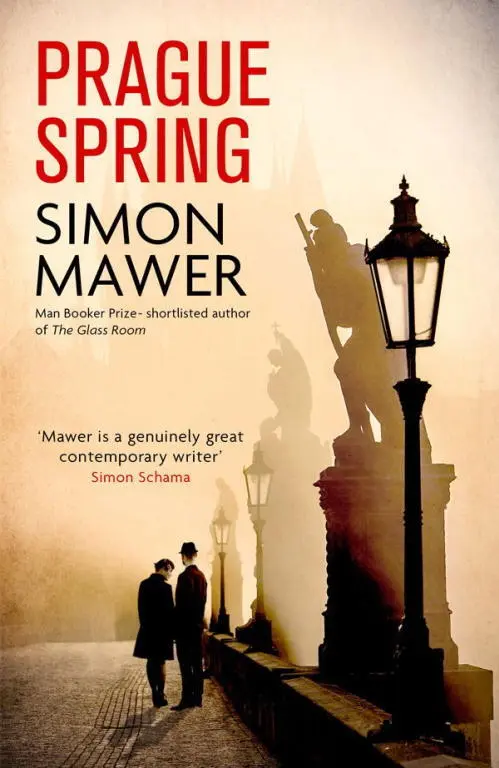
- Название:Prague Spring
- Автор:
- Издательство:Little, Brown Book Group
- Жанр:
- Год:2018
- Город:London
- ISBN:978-1-4087-1113-2
- Рейтинг книги:3 / 5. Голосов: 1
-
Избранное:Добавить в избранное
- Отзывы:
-
Ваша оценка:
Prague Spring: краткое содержание, описание и аннотация
Предлагаем к чтению аннотацию, описание, краткое содержание или предисловие (зависит от того, что написал сам автор книги «Prague Spring»). Если вы не нашли необходимую информацию о книге — напишите в комментариях, мы постараемся отыскать её.
In the summer of 1968, the year of Prague Spring with a Cold War winter, Oxford students James Borthwick and Eleanor Pike set out to hitchhike across Europe, complicating a budding friendship that could be something more. Having reached southern Germany, they decide on a whim to visit Czechoslovakia, where Alexander Dubček’s “socialism with a human face” is smiling on the world.
Meanwhile, Sam Wareham, First Secretary at the British embassy in Prague, observes developments in the country with a diplomat’s cynicism and a young man’s passion. In the company of Czech student Lenka Konečková, he finds a way into the world of Czechoslovak youth, with all its hopes and new ideas; now, nothing seems off-limits behind the Iron Curtain. But the great wheels of politics are grinding in the background; Soviet leader Leonid Brezhnev is making demands of Dubček, and the Red Army is massing on the borders.
This shrewd, engrossing, and sensual novel once again proves Simon Mawer is one of today’s most talented writers of historical spy fiction.
Prague Spring — читать онлайн бесплатно полную книгу (весь текст) целиком
Ниже представлен текст книги, разбитый по страницам. Система сохранения места последней прочитанной страницы, позволяет с удобством читать онлайн бесплатно книгу «Prague Spring», без необходимости каждый раз заново искать на чём Вы остановились. Поставьте закладку, и сможете в любой момент перейти на страницу, на которой закончили чтение.
Интервал:
Закладка:
‘I hope she doesn’t go shooting her mouth off to Stephanie. Not before I’ve had a chance to tell her myself.’
‘Is it serious then?’
‘It’s all a bit sudden, really. Not quite what I expected.’
‘Well, be careful. Playing away from home is not easy in these parts.’
‘Of course I will.’
‘And I won’t breathe a word of it to Madeleine. Mind you, she already thinks you’re a two-timing bastard.’
‘It’s not that simple, Eric.’
‘My dear fellow, it never is. Speaks an expert.’
32
It’s no longer Marienbad, of course, any more than Karlsbad is still Karlsbad. Once again, those are the German names lurking in the collective memory behind the Czech. Now the world-famous spa towns are Mariánské Lázně and Karlovy Vary. Karlovy Vary/Karlsbad may be the more celebrated of the two, but there’s no doubt which is the more beautiful. Mariánské Lázně is a baroque jewel set in green velvet, a belle époque fantasy couched among wooded hills, a courtesan reclining in her bed. This is where Goethe came to take the waters and found his last and unrequited love, Ulrike von Levetzow; where the King-Emperor Edward VII failed to lose weight, chased tail and also encountered fellow emperor Franz-Josef I. Here Chopin stayed with his fiancée Maria Wodzin´ska, Winston Churchill spent part of his honeymoon with the lovely Clementine Hozier and Franz Kafka passed ten agonising days with his fiancée Felice Bauer. Finally, this is where General George Patton, he of the ivory-handled revolvers and a tendency to slap combat-fatigued soldiers, turned up with the US Third Army in May 1945, a fact conveniently forgotten by the government of the Czechoslovak Socialist Republic, which acknowledged the liberation of Czechoslovakia by the Red Army alone.
The hotel Sam had chosen was in need of refurbishment, but beneath the faded paint and crumbling stucco you could see the elaborate wedding-cake decoration that had made the place so famous in its time. He parked the car in front of the main entrance. The Škoda that had followed them throughout the two-hour journey from Prague stopped fifty yards behind them, but he didn’t say anything about it to Lenka.
The receptionist checked them in with as much grace as the desk sergeant at a police station. ‘Chopin suite,’ he said, handing over a key that might have opened a prison cell. The lift was out of order. They carried their suitcases up the main stairs, out of the faded grandeur of the foyer into the drab functionalism of the upper floors where socialist ideals of uniformity and parsimony had long ago chased out any luxury that the nobility of Europe might have recognised. The door to the Chopin suite was marked with the composer’s name, framed by a treble clef and a selection of crochets and quavers. Within there was a sitting room with a plasterwork ceiling that gave only meagre hints of what once might have been, and a bedroom with a fanciful portrait of the composer himself over the bed. Full-height windows overlooked the spa gardens.
‘Did you see?’ Lenka asked as they unpacked. Already there was a kind of familiarity about their relationship, as though matters had been speeded up and domestication was the next step. It wasn’t an unpleasant sensation.
‘Did I see what?’
‘Of course you saw. The car that followed us, the same as before. The same as we saw when we went swimming. They follow you everywhere.’
He watched as she hung her Munich dress in the wardrobe. ‘It’s always like that. You get used to it.’
‘I hate it. It is worse than we had before Dubček. At least we weren’t followed everywhere.’
‘But we were. Anyway, what does it matter as long as they haven’t booked into the room next door?’
She looked round and ambushed him with that smile – a flash of white teeth, a glimpse of naked gum, a creasing of her eyes. ‘I don’t care what they hear,’ she said.
Later they strolled in the spa gardens. Classical pavilions were scattered amongst the lawns, hiding within them the fountains that spurted life-giving waters whose details were specified at each spring – urinary diseases, locomotory diseases, gastrointestinal problems, gynaecological conditions, infertility, all were treatable. ‘If all this were true,’ Sam remarked, ‘you wouldn’t need doctors.’ He took photos, posing Lenka in the pavilion of the Karolina spring and snapping her as she walked through the arcade, alternately in shadow and out. One or two people paused to watch. At the Kolonáda a threadbare band played waltzes and polkas. On either side of the musicians the faces of Gennady Egorkin and Nadezdha Pankova stared out from posters as though expecting less levity, but Lenka ignored their disapproval, taking Sam’s hand and pirouetting with laughter while the musicians smiled and nodded. Sam took photographs of her spinning, her hair thrown out, her skirt billowing.
The recital that evening was held in a marbled hall decked out with neoclassical columns and naked goddesses. Just the two performers at the focus of the lights: Egorkin, dark and tense at the keyboard, and Nadezhda Pankova like a small, live flame (that crimson evening dress) beside him. As Egorkin had said, they’d chosen a demanding programme, opening with the Kreutzer Sonata and, after the interval, moving into the Slav world with Prokofiev and Janáček. The Prokofiev, vivid and melodic, was straightforward enough, but it was in the strange rhythms and echoes of the Janáček violin sonata that the Russian duo found their true métier, piano and violin throwing Janáček’s musical motifs back and forth, sometimes like children at play, sometimes like warring creatures snarling at each other, sometimes like lovers caressing. Melodies initiated by the violin were cut to pieces by the staccato piano, and then the roles were reversed, a lilting piano theme chopped apart by buzzing violin notes. At the end the whole piece reached a taut climax before drifting imperceptibly away into silence, like a person dying.
There was a stillness in the auditorium, breathing suspended, hearts stopped. Then a blizzard of applause. As the storm engulfed them, the couple stood, holding hands aloft, bowing in careful unison. It was only then that Sam noticed something, a glance between the pair, shared smiles hastily suppressed, a second glance that lingered after the smiles had been extinguished. It was that in particular that convinced him, the held glance like a hand clasp that neither wanted to break. The maestro and his protégée were in love.
Dutifully the two musicians settled down to play an encore – a quiet, melodic piece by Tchaikovsky – and while the second round of applause was filling the auditorium Sam and Lenka slipped out and found their way towards the back. At a gilded door, an attendant blocked the way in the impassive manner of a palace guard.
There were a few moments of one-sided argument – only authorised personnel were allowed through – before Sam gave up and took one of his visiting cards from his wallet. He scribbled on the back: Brilliant! And then on an impulse added the name of the hotel where they were staying. ‘Can you see it gets to Maestro Egorkin?’ he asked the attendant, adding a ten-crown note to help the thing on its way. ‘He invited us here and we want to show our appreciation. Do you understand?’
Did he understand? He seemed far beyond understanding anything much, viewing the card with rank suspicion before opening the door behind him and speaking to someone inside. The card disappeared. So did the ten-crown note.
‘Thank you,’ Sam said. ‘Thank you very much.’ Beside him, Lenka swore softly.
At dinner that evening they sat amongst workers who had exceeded their quotas, managers of farming collectives who had manipulated the figures to create an impression of surplus, factory managers who had passed their targets on paper if not in reality, party officials who had kissed the right arses. The men wore ill-fitting, shiny suits, their wives clumsy floral dresses. A pianist played Chopin remarkably well and a master of ceremonies commandeered the microphone to welcome a fraternal delegation from Poland to ‘our Bohemian beauty spot, in the hope that mutual respect and cooperation might always be the bond that ties our two peoples together’. There was scattered applause, but the Polish delegates really wanted to get on with the meal. Soup came and went, the usual thin broth with a dubious liver dumpling floating in it like a turd in a lavatory pan. It was followed by pork and duck weighed down with bread dumplings, each portion carefully defined in grams as though parsimony ruled in the kitchens and every ingredient had to be accounted for.
Читать дальшеИнтервал:
Закладка:
Похожие книги на «Prague Spring»
Представляем Вашему вниманию похожие книги на «Prague Spring» списком для выбора. Мы отобрали схожую по названию и смыслу литературу в надежде предоставить читателям больше вариантов отыскать новые, интересные, ещё непрочитанные произведения.




Обсуждение, отзывы о книге «Prague Spring» и просто собственные мнения читателей. Оставьте ваши комментарии, напишите, что Вы думаете о произведении, его смысле или главных героях. Укажите что конкретно понравилось, а что нет, и почему Вы так считаете.