Саймон Моуэр - Prague Spring
Здесь есть возможность читать онлайн «Саймон Моуэр - Prague Spring» весь текст электронной книги совершенно бесплатно (целиком полную версию без сокращений). В некоторых случаях можно слушать аудио, скачать через торрент в формате fb2 и присутствует краткое содержание. Город: London, Год выпуска: 2018, ISBN: 2018, Издательство: Little, Brown Book Group, Жанр: Историческая проза, на английском языке. Описание произведения, (предисловие) а так же отзывы посетителей доступны на портале библиотеки ЛибКат.
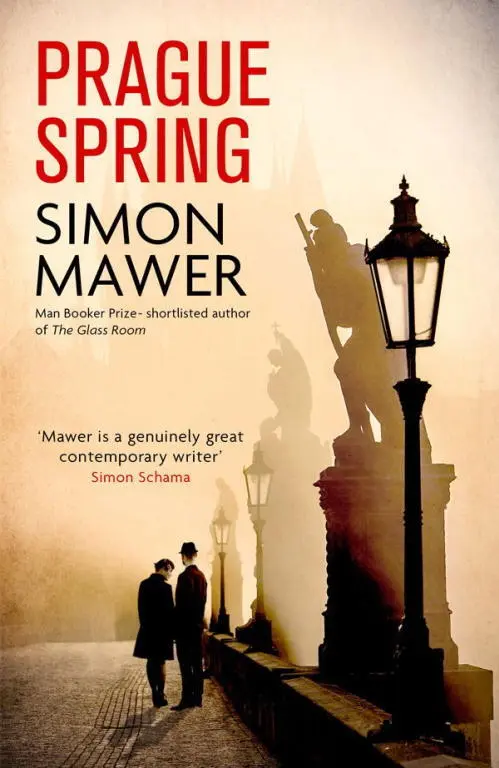
- Название:Prague Spring
- Автор:
- Издательство:Little, Brown Book Group
- Жанр:
- Год:2018
- Город:London
- ISBN:978-1-4087-1113-2
- Рейтинг книги:3 / 5. Голосов: 1
-
Избранное:Добавить в избранное
- Отзывы:
-
Ваша оценка:
Prague Spring: краткое содержание, описание и аннотация
Предлагаем к чтению аннотацию, описание, краткое содержание или предисловие (зависит от того, что написал сам автор книги «Prague Spring»). Если вы не нашли необходимую информацию о книге — напишите в комментариях, мы постараемся отыскать её.
In the summer of 1968, the year of Prague Spring with a Cold War winter, Oxford students James Borthwick and Eleanor Pike set out to hitchhike across Europe, complicating a budding friendship that could be something more. Having reached southern Germany, they decide on a whim to visit Czechoslovakia, where Alexander Dubček’s “socialism with a human face” is smiling on the world.
Meanwhile, Sam Wareham, First Secretary at the British embassy in Prague, observes developments in the country with a diplomat’s cynicism and a young man’s passion. In the company of Czech student Lenka Konečková, he finds a way into the world of Czechoslovak youth, with all its hopes and new ideas; now, nothing seems off-limits behind the Iron Curtain. But the great wheels of politics are grinding in the background; Soviet leader Leonid Brezhnev is making demands of Dubček, and the Red Army is massing on the borders.
This shrewd, engrossing, and sensual novel once again proves Simon Mawer is one of today’s most talented writers of historical spy fiction.
Prague Spring — читать онлайн бесплатно полную книгу (весь текст) целиком
Ниже представлен текст книги, разбитый по страницам. Система сохранения места последней прочитанной страницы, позволяет с удобством читать онлайн бесплатно книгу «Prague Spring», без необходимости каждый раз заново искать на чём Вы остановились. Поставьте закладку, и сможете в любой момент перейти на страницу, на которой закончили чтение.
Интервал:
Закладка:
There follows an intense silence. One thousand people anticipating the moment. Egorkin bows faintly towards Eckstein, then turns to the orchestra. Maybe everything is to his satisfaction. If so, he raises his baton to start, like an artist putting his brush to canvas, and with quiet care paints the first notes – solemn, pensive strokes, a theme played back and forth between woodwind and strings while Birgit Eckstein sits immobile on her plinth, as though cast in pewter. It is only when the orchestra seems about to reach some kind of conclusion that suddenly, almost unexpectedly, she moves to strike her cello. That act brings about a kind of miracle, something strangely organic, a fusion between the sensuous curves of the instrument and the sharp angles of Birgit Eckstein’s small frame, the two contrasting shapes becoming one sonorous body resonating throughout the auditorium, crying out in tones that are almost human. Is it a lament for something innocent that is lost for ever? James tries to cling to the notes as they circle round him, but they are ephemeral, evanescent, each following the other and all dying away before he can work out what to do with them. It is the totality that matters, not the fragments; the whole complex wave equation, not the individual terms. And as he listens, emotion creeps up on him without his being aware of it, like a thief in the night coshing him from behind. His nose stings and his eyes smart. Frau Eckstein’s small figure clutches at the body of the cello, grips its torso between her legs, sways with it, senses – you can tell, from the body of the auditorium you can tell – the vibrations of it with her thighs and her belly as she draws her bow across the strings as though fingering the flesh of a lover. He had never imagined that anything to do with classical music could be so blatantly sexual. And he senses Ellie beside him feeling the same thing. What she cannot experience with sex she can capture here – possession, surrender, the absorption of self into something greater than the individual. Perhaps she knows it. She grips his hand with tight talons while the crescendos, the climaxes, the agonising slides into the depths, the slow, meditative passages work their way through the hall and into the thousand listening minds.
After the performance there is applause and bowing and a bouquet of flowers. While the orchestra stands, the indomitable soloist leaves for the wings before being called back to further plaudits, a strange ritual that takes on some of the qualities of a dance, the conductor holding high her hand as though leading her in a gavotte, Birgit Eckstein carrying her cello with the other, the orchestra players making their own little gestures of applause, the whole thing choreographed by obscure tradition. People call for an encore and on her third re-entry Frau Eckstein offers a faint smile and steps back onto the podium. There is immediate silence. She sits, composes herself for a moment, then lifts her bow, and from the first chord James knows, with the sudden thrill of arcane knowledge, what it will be – the Prelude from Bach’s C-minor cello suite. When the piece comes to the end amidst the storm of more applause, he is in tears.
A novel experience, that, to be moved to tears by the abstract sounds of music. In fact, a first for James. Something to do with the instrument itself, so close to the human voice in tone and timbre, but also something to do with the shock of familiarity, that he knew the player and also that he knew what she was going to play as an encore and recognised it as soon as she struck the first note.
29
After the Dvořák came the interval. All the usual milling around, people not knowing exactly what to say about what they had just heard and what was to come. Sam wondered whether to try and find a drink, but Eric Whittaker was somewhere in the auditorium, and Madeleine with him. And Lenka had brought along those bloody hitchhikers she seemed to have adopted, which made things that bit more awkward. The girl was fine but the boy had seemed out of place in a concert hall. He had even started to applaud after the first movement of the Dvořak until the girl – Ellie, wasn’t it? – hushed him to silence.
‘So why the hell don’t people clap when it’s so good?’ he was demanding as they stood around in the aisle, stretching their legs.
‘Because they don’t,’ the girl retorted.
Sam noticed the Whittakers and couldn’t avoid catching Madeleine’s eye. He excused himself and made his way to the back of the auditorium where there was a fraught conversation in which Eric extolled the virtues of the Elgar Cello Concerto above the Dvořák while Madeleine strained to see who Sam had brought with him.
‘What’s next?’ Eric asked, trying to read the programme. ‘The Brahms Double Concerto, is it?’
Sam translated for him. ‘A Russian violinist called Nadezhda Pankova. Can’t say I’ve heard of her. Apparently studied at the Moscow Conservatory under Igor Oistrakh. Second place in the 1966 Wieniawski Competition in Poznan and third place in the International Tchaikovsky Competition, 1965.’
‘Hardly a star,’ Eric remarked. ‘Studied under Oistrakh? How many thousands?’
A bell rang; people filed back into the auditorium. Madeleine touched Sam’s wrist. ‘Who is the lovely lady, Sam?’
‘A friend.’
‘The friend looks very attractive.’
He feigned indifference. ‘And a couple of hitchhikers she’s taken under her wing. I think I’d better get back…’
They filed back into their seats and settled. The orchestra was returning, followed by Egorkin himself, who now faced the audience with clenched hands held aloft in some kind of demonstration of solidarity. A Russian saluting the Czechs. The applause rose appreciatively, a tide of enthusiasm borne on their awareness of his reputation, his public protest over the trial in Moscow of the dissidents Daniel and Sinyavsky and the subsequent withdrawal of permission for him to travel to the West. They knew well enough where his sympathies lay.
Further applause greeted the soloists, Birgit Eckstein leading the way as befitted the senior player, followed by the young violinist, bringing with her a small reputation, promising abilities and a condescending smile from Birgit Eckstein. Yet, as the pair acknowledged the applause, the young woman’s flame-red evening dress quite consumed Eckstein’s charcoal grey.
There was that collective settling before the music began. And then the conductor raised his baton and launched the piece, the Brahms Double Concerto, a complex interplay of orchestra, violin and cello in which the young Pankova fenced with the more experienced cellist and matched passage for passage, thrust for thrust, always keeping her opponent at bay, all of this without either looking at the other, as though they were two swordsmen fighting blind. Except towards the end of the final movement when the women glanced at each other for a moment, and smiled.
Applause. A tumult of applause. Catharsis.
Afterwards, in a pillared room with views over the river, there was a reception in honour of the musicians. The conductor was there with a small escort from the Soviet embassy to keep him company, while the Soviet ambassador himself, stout, bespectacled and grim, watched in disapproval. Beside him stood the minister for cultural affairs and the mayor of Prague, beaming on everyone as though they were to take the credit. Guests, journalists, photographers clustered round the soloists. Glasses of Moravian wine were raised in salute. Flashbulbs popped like bursts of summer lightning. Thankfully, Eric and Madeleine had gone, in the name of duty, to some diplomatic event or other on the other side of town.
Sam led Lenka towards the Russian group. ‘I don’t want to speak with them,’ Lenka protested, but Sam only laughed. ‘You can do what you please, but if diplomats applied that criterion we’d never talk to anybody.’
Читать дальшеИнтервал:
Закладка:
Похожие книги на «Prague Spring»
Представляем Вашему вниманию похожие книги на «Prague Spring» списком для выбора. Мы отобрали схожую по названию и смыслу литературу в надежде предоставить читателям больше вариантов отыскать новые, интересные, ещё непрочитанные произведения.





Обсуждение, отзывы о книге «Prague Spring» и просто собственные мнения читателей. Оставьте ваши комментарии, напишите, что Вы думаете о произведении, его смысле или главных героях. Укажите что конкретно понравилось, а что нет, и почему Вы так считаете.