Саймон Моуэр - Prague Spring
Здесь есть возможность читать онлайн «Саймон Моуэр - Prague Spring» весь текст электронной книги совершенно бесплатно (целиком полную версию без сокращений). В некоторых случаях можно слушать аудио, скачать через торрент в формате fb2 и присутствует краткое содержание. Город: London, Год выпуска: 2018, ISBN: 2018, Издательство: Little, Brown Book Group, Жанр: Историческая проза, на английском языке. Описание произведения, (предисловие) а так же отзывы посетителей доступны на портале библиотеки ЛибКат.
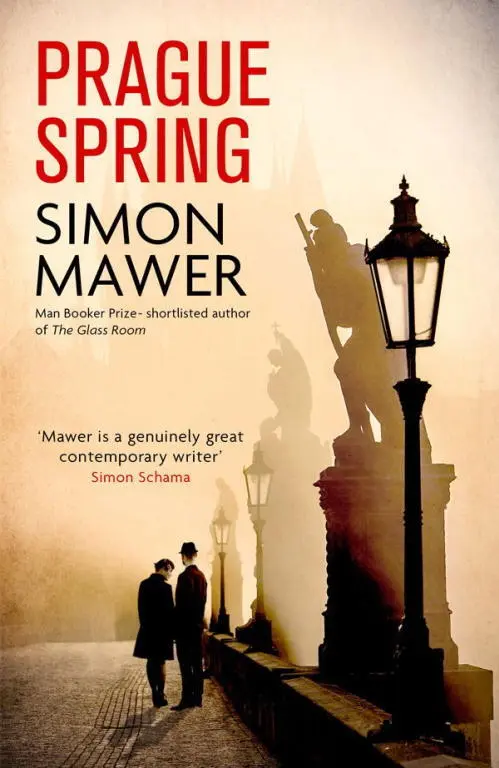
- Название:Prague Spring
- Автор:
- Издательство:Little, Brown Book Group
- Жанр:
- Год:2018
- Город:London
- ISBN:978-1-4087-1113-2
- Рейтинг книги:3 / 5. Голосов: 1
-
Избранное:Добавить в избранное
- Отзывы:
-
Ваша оценка:
Prague Spring: краткое содержание, описание и аннотация
Предлагаем к чтению аннотацию, описание, краткое содержание или предисловие (зависит от того, что написал сам автор книги «Prague Spring»). Если вы не нашли необходимую информацию о книге — напишите в комментариях, мы постараемся отыскать её.
In the summer of 1968, the year of Prague Spring with a Cold War winter, Oxford students James Borthwick and Eleanor Pike set out to hitchhike across Europe, complicating a budding friendship that could be something more. Having reached southern Germany, they decide on a whim to visit Czechoslovakia, where Alexander Dubček’s “socialism with a human face” is smiling on the world.
Meanwhile, Sam Wareham, First Secretary at the British embassy in Prague, observes developments in the country with a diplomat’s cynicism and a young man’s passion. In the company of Czech student Lenka Konečková, he finds a way into the world of Czechoslovak youth, with all its hopes and new ideas; now, nothing seems off-limits behind the Iron Curtain. But the great wheels of politics are grinding in the background; Soviet leader Leonid Brezhnev is making demands of Dubček, and the Red Army is massing on the borders.
This shrewd, engrossing, and sensual novel once again proves Simon Mawer is one of today’s most talented writers of historical spy fiction.
Prague Spring — читать онлайн бесплатно полную книгу (весь текст) целиком
Ниже представлен текст книги, разбитый по страницам. Система сохранения места последней прочитанной страницы, позволяет с удобством читать онлайн бесплатно книгу «Prague Spring», без необходимости каждый раз заново искать на чём Вы остановились. Поставьте закладку, и сможете в любой момент перейти на страницу, на которой закончили чтение.
Интервал:
Закладка:
It was as they were starting their main course that someone came over to their table from the Polish party. Sam half-rose from his seat but the man had eyes only for Lenka. ‘Lenička,’ he called her. ‘My dear Lenička.’
She looked surprised and faintly embarrassed at his attention, but she accepted a kiss on one cheek. ‘This is my friend, Samuel,’ she said. There was a shaking of hands and an exchange of names. Pavel Rovnák, he said. He was slight of build with dark hair and a sallow complexion. He wore a moustache that might once have been a homage to Joseph Stalin but was now trimmed to suit the times. ‘I am an old family friend,’ he explained, ‘but Lenka and I haven’t seen each other for some time. Isn’t it strange how even in a small country such as ours it is still possible to avoid someone’ – he looked accusingly at Lenka – ‘and then to meet up in Mariánské Lazně of all places?’ He paused, as though expecting some matching remark from her, perhaps an explanation of what she was doing there with this foreigner who appeared to speak such excellent Czech. ‘You look well,’ he said to fill the void. ‘And your lovely mother? How is she?’ And then when Lenka had offered her scant information, he turned back to Sam. ‘You are American, perhaps?’
‘English. At the embassy.’
‘Ah, the embassy.’ Rovnák pursed his lips – the moustache twitched – and looked again from one to the other as though searching for further clues. ‘You speak good Czech for a foreigner.’
‘Not as good as Lenka’s English.’
‘She has been studying the language at university. I’m glad you have done so well, zlato .’
Lenka shrugged, as though it was of no account. ‘Are you staying in the hotel?’ she asked.
‘Sadly I have to get back to Prague this evening. In fact’ – he glanced round – ‘I must get back to my table. These Poles cannot be left on their own for too long. It has been good to meet you, Samuel. And Lenička, you must keep in touch.’
Lenka said nothing and went back to her meal. An outburst of laughter greeted the man’s return to his table. Sam waited. Lenka drank some wine then carefully replaced her glass. ‘That’s him,’ she said quietly. ‘I told you about him. The aparátník . Pavel Rovnák.’
Sam had always perceived her as tough – smiling, delightful, but tough. Yet now it was as though he saw her through a magnifying lens. He could glimpse her insecurities, imagine her as a vulnerable young girl, a lumpish fifteen-year-old uncertain of the vagaries of her body, possessed only of a distant memory of her father and subject to a rancorous mother. And there was this man with his amiable and enticing ways, a guarantor of present comforts and future success.
‘I hated that moustache,’ she said, reaching for her glass again.
Rovnák was as good as his word and left when the meal had more or less come to an end and toasts were being drunk. He passed their table on his way out and lifted Lenka’s hand to his lips, renewing his exhortation to keep in touch. But he was very sorry, he just had to be back in Prague by that evening. Otherwise he would have asked Lenka for a dance.
‘His wife keeps him on a tight lead,’ she suggested when he had gone. It was difficult to interpret her tone. Was there some hint of regret there amidst the bitterness? The pianist had exhausted the possibilities of Chopin and begun to feel his way into a few popular numbers – ‘Smoke Gets in Your Eyes’, ‘The Continental’, that kind of thing. The Polish trades unionists and their wives took to the floor. Sam and Lenka followed. For a while they shuffled round amidst the insidious smell of sweet floral perfume and sour body odour that hung around the dancers before Sam suggested they take a breath of fresh air.
The spa gardens were beautiful at night, touched with a glimmer of their former glory. You could almost imagine the ghosts of the pre-war demi-monde encountering phantom crowned heads amongst the fountains and the colonnades. ‘I thought you might be angry to meet my first lover,’ she said as they walked. ‘I have heard that Englishmen can be very jealous.’
‘Not at all. He seemed very polite.’
‘He was wondering if I have become a prostitute.’
‘Don’t be silly.’
‘I could see it in his eyes. And he was calculating what my price might be.’
It wasn’t particularly late when they returned to the hotel but the Polish group had gone and the dining room was shut. Only the disgruntled receptionist remained on duty in the foyer. As Sam took the room key the man handed over an envelope with grim ill-will, as though even passing on a letter went far beyond the call of duty. Sam pocketed the envelope without giving the receptionist the satisfaction of seeing him open it. Through pools of feeble light they climbed the stairs to the first floor. Sam unlocked the door to the Chopin suite and pushed it open for Lenka to go through into the sitting room.
‘What is it?’ she asked.
‘Probably the bill. Just the kind of thing they’d do, in case we go off tomorrow morning without paying.’
But the envelope did not contain the bill. It was a simple one-line note, written in English. Perhaps a stroll to the Kolonáda tomorrow morning? Eight o’clock? It was signed Egorkin.
He smiled. In the more relaxed atmosphere of Mariánské Lazně the man clearly had a way of evading his escort. Lenka had gone into the bathroom. ‘It’s nothing,’ he called to her. He went into the bedroom and looked round, as though hidden microphones might reveal themselves to his gaze. Hotels in which foreigners might stay were notorious for being bugged. You didn’t wonder about it, you assumed it. But all he saw was the broken plasterwork of the ceiling, the heavy velvet curtains, the wardrobe with its poorly silvered mirror, the chest of drawers whose veneer was lifting away at the corners. He waited for her to come from the bathroom, her face scrubbed of makeup and as vulnerable as a young girl’s, before handing her the note and putting his finger to his lips.
She looked at him enquiringly. ‘You will go?’
‘I think so.’
She reached behind her to unzip the dress, the outfit they had bought in Munich, and let it slide to the floor. Then she dropped her slip around her feet and stepped out of it as though stepping out of a pool of water, holding his eye and smiling. ‘Do you like what you see?’
‘Of course I do.’
‘And are you thinking of that man, Pavel Rovnák? Are you jealous of him?’
‘You asked me that already. I’m jealous of what he took from you. But more than that, I’m angry that he used you.’
She unfastened her brassiere and dropped it as carelessly as a child discarding sweet papers. ‘And I used him. So it was on both sides. And it was a long time ago. The past.’
But their love was entirely in the present, a slow, deliberate act, as though they had been lovers for years rather than weeks; at her climax convulsions racked her body in ways that couldn’t be contrived, couldn’t be anything but the ecstasy of the moment. He’d never known this with Steffie, never this intensity, never this incontinence. Anything else might be a lie, but this was not. Yet in the aftermath he looked at her lying there, spent, damp with sweat, and wondered about the hard core of her, that part which had accepted, even welcomed, the attentions of Pavel Rovnák.
Things were different in the morning. The morning was fresh and cool – the town lies six hundred metres above sea level, out of the smog and heat of the lowlands – and Lenka was lying on her back in the chaos of sheets. Sunlight from the open windows caught the froth of dun-coloured hair between her thighs and turned it the colour of honey. She smiled at him, and seemed, with that smile, entirely and delightfully vulnerable – and part of him in a way that he had never imagined a woman might be.
Читать дальшеИнтервал:
Закладка:
Похожие книги на «Prague Spring»
Представляем Вашему вниманию похожие книги на «Prague Spring» списком для выбора. Мы отобрали схожую по названию и смыслу литературу в надежде предоставить читателям больше вариантов отыскать новые, интересные, ещё непрочитанные произведения.






Обсуждение, отзывы о книге «Prague Spring» и просто собственные мнения читателей. Оставьте ваши комментарии, напишите, что Вы думаете о произведении, его смысле или главных героях. Укажите что конкретно понравилось, а что нет, и почему Вы так считаете.