Саймон Моуэр - Prague Spring
Здесь есть возможность читать онлайн «Саймон Моуэр - Prague Spring» весь текст электронной книги совершенно бесплатно (целиком полную версию без сокращений). В некоторых случаях можно слушать аудио, скачать через торрент в формате fb2 и присутствует краткое содержание. Город: London, Год выпуска: 2018, ISBN: 2018, Издательство: Little, Brown Book Group, Жанр: Историческая проза, на английском языке. Описание произведения, (предисловие) а так же отзывы посетителей доступны на портале библиотеки ЛибКат.
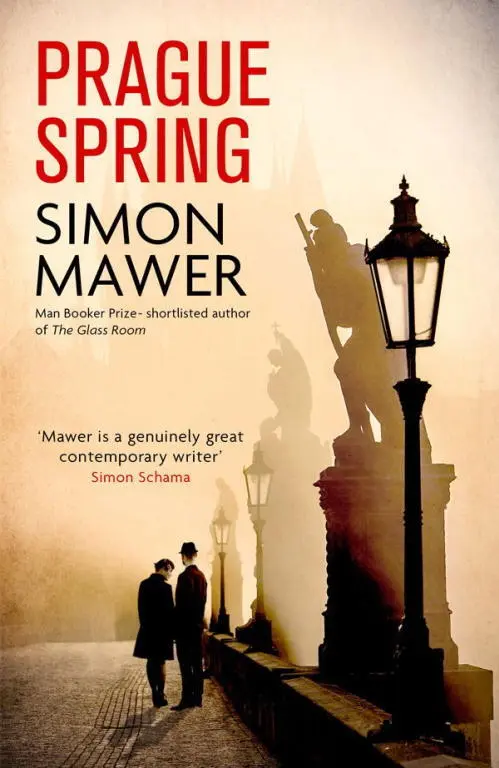
- Название:Prague Spring
- Автор:
- Издательство:Little, Brown Book Group
- Жанр:
- Год:2018
- Город:London
- ISBN:978-1-4087-1113-2
- Рейтинг книги:3 / 5. Голосов: 1
-
Избранное:Добавить в избранное
- Отзывы:
-
Ваша оценка:
Prague Spring: краткое содержание, описание и аннотация
Предлагаем к чтению аннотацию, описание, краткое содержание или предисловие (зависит от того, что написал сам автор книги «Prague Spring»). Если вы не нашли необходимую информацию о книге — напишите в комментариях, мы постараемся отыскать её.
In the summer of 1968, the year of Prague Spring with a Cold War winter, Oxford students James Borthwick and Eleanor Pike set out to hitchhike across Europe, complicating a budding friendship that could be something more. Having reached southern Germany, they decide on a whim to visit Czechoslovakia, where Alexander Dubček’s “socialism with a human face” is smiling on the world.
Meanwhile, Sam Wareham, First Secretary at the British embassy in Prague, observes developments in the country with a diplomat’s cynicism and a young man’s passion. In the company of Czech student Lenka Konečková, he finds a way into the world of Czechoslovak youth, with all its hopes and new ideas; now, nothing seems off-limits behind the Iron Curtain. But the great wheels of politics are grinding in the background; Soviet leader Leonid Brezhnev is making demands of Dubček, and the Red Army is massing on the borders.
This shrewd, engrossing, and sensual novel once again proves Simon Mawer is one of today’s most talented writers of historical spy fiction.
Prague Spring — читать онлайн бесплатно полную книгу (весь текст) целиком
Ниже представлен текст книги, разбитый по страницам. Система сохранения места последней прочитанной страницы, позволяет с удобством читать онлайн бесплатно книгу «Prague Spring», без необходимости каждый раз заново искать на чём Вы остановились. Поставьте закладку, и сможете в любой момент перейти на страницу, на которой закончили чтение.
Интервал:
Закладка:
That moment could stand for ever, preserved in the fixative of memory.
At breakfast she seemed put out at the idea of his meeting Egorkin. ‘Why does he have to steal our time?’
‘I can’t very well ignore him. Maybe you should come as well. To offer your congratulations on his performance.’
‘I’ll wait for you here.’
‘You’re going to sulk.’
‘Sulk? What is sulk?’
‘What you’re doing now.’ He made a face, pouting.
She laughed. ‘ Trucovat .’ And her laughter meant that she wasn’t. So she went back to the room to wait, while Sam, with that morning’s copy of Rudé Právo tucked under his arm, took a stroll in the spa gardens. A few drab figures wandered the paths, but it was early for the crowds and the magnificent wrought-iron Kolonáda was almost empty, like an elaborate stage set waiting for players.
What, he wondered, did the Russian want? Surely not just to thank him for coming all the way to his recital in Mariánske Lazně. He chose a bench and sat to read the paper, a task he had every morning at work, to deliver a digest of the morning’s news for Eric Whittaker to review. Today’s front page announced that the East German leader Walter Ulbricht was visiting Karlsbad with his sidekick Erich Honecker – an unforeseen event that stirred the commentators to a frenzy of speculation. Sam scanned the reports, pausing to read whatever caught his eye – in this case, Dubček meeting the unexpected guests at the airport and a young girl from the Pioneers dutifully presenting the East German leader with a bouquet of flowers and receiving an ill-aimed kiss on the neck in return. There had been a stony silence from the crowd that had gathered to watch. Ulbricht was hated in Czechoslovakia just as he was hated in his own country. But the question uppermost in Sam Wareham’s mind was, what was the man doing here? Leafing through the pages and loathing the newsprint that stained his fingers, he felt like a soothsayer trying to read the entrails of some sacrificial animal and thereby foretell the future. One thing he knew for sure: a visit from Ulbricht was like a knock on the door from the grim reaper himself.
‘ Dobrý den .’
He looked up with a start. Egorkin was standing over him. Seen close and in the clear light of morning he looked older than previously. There were hints of acne scars on his cheeks. He’d cut himself shaving and there was a dab of cotton wool on his neck. Sitting down, he glanced at Sam’s newspaper and said, in Russian, ‘It looks as though we made the right choice to come here rather than Karlsbad. Of course, I am joking. I have no choice in such matters. They decide for me.’ He took out a silver cigarette case and held it out. ‘They’re American,’ he said reassuringly.
‘Thanks, but I’m trying to give them up.’
That seemed to amuse the man. ‘That is exactly what I am doing – converting to American cigarettes after a lifetime of Belomor is as good as giving up.’ He blew smoke away towards the vaulted ironwork overhead.
‘The recital,’ Sam said, ‘was wonderful. You played so well together.’
Egorkin nodded. ‘We are, what do you say in English? In harmony. But I didn’t come here to talk about my music. What I want to do is to explain my situation.’
Sam sat back on the bench and looked out across the gardens. He noticed inconsequential things. A woman walking a poodle. Two children running and laughing ahead of their parents. A fountain shattering sunlight into a thousand fragments. Quotidian events impressed on his retina and, perhaps, his memory. ‘Tell me.’
Egorkin hesitated, as though he had not really thought this through. But he must have. Whatever it was, he must have thought about it long and hard. ‘You perhaps know something of me by reputation.’
‘I know something.’
‘For example, that I have been outspoken about matters in my homeland and so I have been forbidden to travel to the West. My being here in Czechoslovakia is considered a great concession, almost a prize for having accepted my fate with good grace.’
‘I’ve heard something about it.’
Egorkin nodded. ‘And I am only here now because it is early morning and my escort is lazy. Like the whole Soviet system, they watch only when they know they are being watched.’ He laughed. ‘It is not quite as simple as that, however.’
‘I didn’t think it would be.’
‘I expect you to act in an entirely professional manner over this.’
‘Of course I will.’
‘So. There is also the matter of Nadezhda Nikolayevna.’ The Russian seemed to gather his thoughts, or perhaps, his courage. ‘She is, you understand, in love with me. And I’ – he hesitated as though he were not so clear on the matter – ‘I am in love with her.’
The man paused, smoking and looking out of the colonnade. The woman with the poodle had gone, so too the children. An ancient couple, who perhaps had come to the spa to find the key to eternal life, walked past. They looked at Egorkin as though they recognised him.
Sam asked, ‘What does this admittedly awkward state of affairs have to do with a British diplomat?’
Egorkin nodded thoughtfully. Finally he said, ‘I would like your advice. You see’ – another draw on his cigarette – ‘I want your assistance in getting us to the West. We wish to claim political asylum.’
‘You and Nadezhda Nikolayevna?’
‘Exactly. Does that surprise you?’
‘Not entirely. But I don’t see how I can help you. The very best you could expect is to gain entry to one of the Western embassies. You might be granted asylum of some kind, but that might mean the two of you becoming prisoners in the embassy itself. Like Cardinal Mindszenty in Budapest. Twelve years so far. Unless the Czechs would agree to your leaving.’
The man frowned. Dark eyebrows, pockmarked skin, a mouth clamped into a line of disapprobation, as though he had heard discord in the strings. ‘Did you know that the London Symphony Orchestra offered me the post of principal conductor when they got rid of Kertész? I was not able to take the post because my country did not allow it. That is what I have to deal with.’ He fidgeted another cigarette from his case, snapped at the lighter, drew sharply in. Sam continued, dredging up his knowledge of consular affairs.
‘Whether an embassy would give you shelter is entirely at the discretion of the ambassador. You understand that, don’t you? Most countries, including my own, do not recognise the legality of what is known as diplomatic asylum – sanctuary in one of its embassies. Legally a refugee cannot apply for political asylum until he is actually in the receiving country’s territory.’
‘But isn’t an embassy—?’
‘—an extraterritorial possession? That’s a popular misconception. Under international law an embassy remains the territory of the host nation. It’s just that the agents of the host nation may not enter the embassy without the express permission of the ambassador. So you, or anyone else seeking refuge, would be relying on the goodwill of the ambassador. His job would be to consider what risks you might run if he were to insist that you leave his embassy, but above all he would have to consider the best interests of his own country. I’m afraid I’m beginning to sound like a textbook. Or a lawyer. Maybe I will have one of your cigarettes.’
There was a pause for the little ritual of lighting up. Sam attempted a smile. ‘There go my best intentions. Up in smoke.’ He glanced at his watch and wondered when he could politely extricate himself from this conversation. It wasn’t difficult to feel sympathy for Egorkin, a talent put at the mercy of the Soviet state, but the matter was hardly his concern. ‘In your case there would be a further complication because the host country in this case – Czechoslovakia – is not hostile to you, so it is difficult to see what danger you would be in if you were asked to leave the embassy. In Moscow you would clearly be in jeopardy, but here, as things are at the moment…’ He shrugged.
Читать дальшеИнтервал:
Закладка:
Похожие книги на «Prague Spring»
Представляем Вашему вниманию похожие книги на «Prague Spring» списком для выбора. Мы отобрали схожую по названию и смыслу литературу в надежде предоставить читателям больше вариантов отыскать новые, интересные, ещё непрочитанные произведения.






Обсуждение, отзывы о книге «Prague Spring» и просто собственные мнения читателей. Оставьте ваши комментарии, напишите, что Вы думаете о произведении, его смысле или главных героях. Укажите что конкретно понравилось, а что нет, и почему Вы так считаете.