Саймон Моуэр - Prague Spring
Здесь есть возможность читать онлайн «Саймон Моуэр - Prague Spring» весь текст электронной книги совершенно бесплатно (целиком полную версию без сокращений). В некоторых случаях можно слушать аудио, скачать через торрент в формате fb2 и присутствует краткое содержание. Город: London, Год выпуска: 2018, ISBN: 2018, Издательство: Little, Brown Book Group, Жанр: Историческая проза, на английском языке. Описание произведения, (предисловие) а так же отзывы посетителей доступны на портале библиотеки ЛибКат.
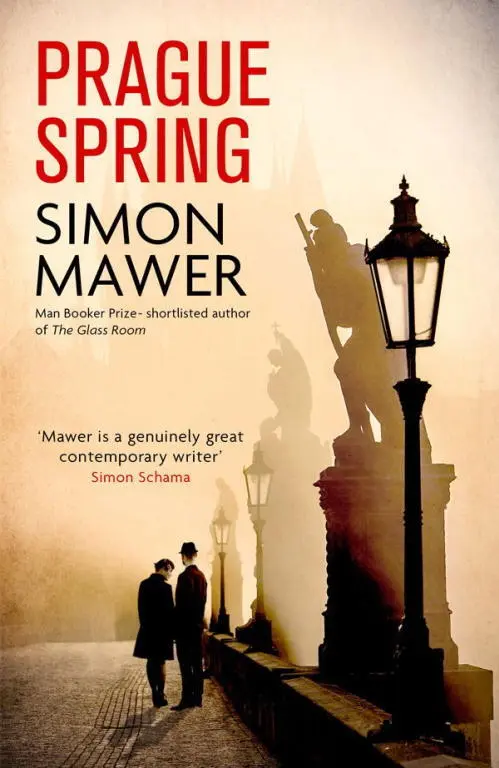
- Название:Prague Spring
- Автор:
- Издательство:Little, Brown Book Group
- Жанр:
- Год:2018
- Город:London
- ISBN:978-1-4087-1113-2
- Рейтинг книги:3 / 5. Голосов: 1
-
Избранное:Добавить в избранное
- Отзывы:
-
Ваша оценка:
Prague Spring: краткое содержание, описание и аннотация
Предлагаем к чтению аннотацию, описание, краткое содержание или предисловие (зависит от того, что написал сам автор книги «Prague Spring»). Если вы не нашли необходимую информацию о книге — напишите в комментариях, мы постараемся отыскать её.
In the summer of 1968, the year of Prague Spring with a Cold War winter, Oxford students James Borthwick and Eleanor Pike set out to hitchhike across Europe, complicating a budding friendship that could be something more. Having reached southern Germany, they decide on a whim to visit Czechoslovakia, where Alexander Dubček’s “socialism with a human face” is smiling on the world.
Meanwhile, Sam Wareham, First Secretary at the British embassy in Prague, observes developments in the country with a diplomat’s cynicism and a young man’s passion. In the company of Czech student Lenka Konečková, he finds a way into the world of Czechoslovak youth, with all its hopes and new ideas; now, nothing seems off-limits behind the Iron Curtain. But the great wheels of politics are grinding in the background; Soviet leader Leonid Brezhnev is making demands of Dubček, and the Red Army is massing on the borders.
This shrewd, engrossing, and sensual novel once again proves Simon Mawer is one of today’s most talented writers of historical spy fiction.
Prague Spring — читать онлайн бесплатно полную книгу (весь текст) целиком
Ниже представлен текст книги, разбитый по страницам. Система сохранения места последней прочитанной страницы, позволяет с удобством читать онлайн бесплатно книгу «Prague Spring», без необходимости каждый раз заново искать на чём Вы остановились. Поставьте закладку, и сможете в любой момент перейти на страницу, на которой закончили чтение.
Интервал:
Закладка:
Once safe inside, she asked if she could use his typewriter. ‘What is the expression? Make iron while it’s hot.’
‘You mean you’re going to write something?’
‘A fejeton for Literární listy . They’ll take this, I’m sure.’
Fejeton , feuilleton. He’d never taken her writing seriously, in fact he’d never seen her write and had only glanced at one or two pieces that appeared under her by-line in the student magazine. But now he watched her sitting at his portable, hammering at the keys, cursing when she couldn’t find diacritical marks and had to reach for a biro to ink them, and he found himself convinced by her energy.
WHAT’S IN A NAME? Lenka typed.
What’s in a name? Juliet wondered, seeing Montague as her enemy but Romeo as her love. That which we call a rose, she observed, by any other name would smell as sweet. These days we have other, less poetic concerns than Juliet of the Capulets. It is not so much a matter of whom can we love but how can we circumnavigate the obstacles of bureaucracy and oppression when burdened with a name that offends the powers that be. So for years my name – the one appended to this article, the one that I have employed throughout my school and university days, the one that my friends know me by – has not been my name but my mother’s maiden name, borrowed from her for the sake of convenience and deception. It was only today, for the first time in my conscious life, that I used the name that my father bequeathed me, a name that throughout my childhood and youth, like a deranged self-loathing Juliet, I attempted to cancel from my life just as surely as my father was cancelled from the life of the Czechoslovak Republic. That name is Vadinský. Lenka Konečková is really Lenka Vadinská.
What’s in a name?
When I was at university – always under my borrowed name of course – I spent some time in the archives of Terezin for my thesis on the role of the Party in the antifascist struggle. Within the sad lists of those admitted to the ghetto I found some thirty Vadinský/Vadinskás, all of whom died in the ghetto or were taken away in one of the transports, some to Treblinka, some to Auschwitz. Amongst them were my paternal grandparents whose names are even now to be found on the wall of the Pinkas synagogue in Josefov.
‘You never told me.’
‘It was obvious, wasn’t it? A Jewish father, you know that. Therefore Jewish grandparents. Therefore dead at Auschwitz or somewhere similar. That is what happened here.’
He left her side and walked over to the window. The strange medieval shadows of the bridge towers were a contrast to the clatter of keys behind him. He thought of what he didn’t know about Lenka, which was almost everything. And then wondered how much you need to know about someone before you fall in love. Probably, he supposed, almost nothing. What did Romeo know of Juliet? Just enough to get both of them killed in the most idiotic way imaginable.
What’s in a name?
At least those grandparents have a memorial of some kind, even if their ashes were scattered to the winds or blown away in a puff of smoke. But my father? After much complaint my mother was eventually given a death certificate by the authorities, and, this year, even a medal of some kind. The death certificate stated baldly the date on which he was killed, but there is no mention of what happened to his body. However, there’s a story going round that the ashes of all the principal victims were dumped secretly in a lake in the Sumava region.
Then there’s another story, that on the way to that lake, the car carrying the remains actually slid off the icy road some kilometres before reaching its destination. It was midwinter and everyone knows what a Tatra is like on slippery roads – it’s that rear engine that does it. So there they were, two members of the security service – let’s call them Švejk and Brouček – stuck in a snowdrift in the middle of the countryside in the middle of winter. It is getting late, the snow is coming down and the rear wheels are spinning uselessly. So Švejk (or was it Brouček?) has the brilliant idea of shovelling the ashes of the people’s enemies under the rear wheels to give some traction in the snow. Thus, in a cloud of flying bits and pieces did Slánský, Clementis, London and all the others, including my father, contribute to the extrication of two members of state security from a snowdrift.
Which story do you believe? The lake or the snowdrift? And which would you like to believe? And which – because this is the key to everything – sounds more perfectly Czech? What is certain is that the whole disposal was done in secret and is unlikely to be properly documented even in the archives of our beloved StB where they keep all the other files, including those of my mother and me… and, no doubt, you.
Except that I changed my name so that Lenka Vadinská would not be stigmatised by being denied access to a university education but instead Lenka Konečková would sail into the faculty of literature. Still – ask my boyfriend – I smell just as much of roses as if I were called Vadinská, or, as I’m sure the authorities would have it, just as much of shit.
He looked over her shoulder at what she had written so far and laughed. ‘Will they allow “shit”?’
She shrugged. ‘We’ll see.’ And went back to her typing while he went back to watching her. Her hunched figure of concentration over the typewriter. Her bare legs. The way her toes moved as though they had life of their own. Things like that.
And then the phone rang. He went out into the hallway to answer it and at first he didn’t recognise the voice on the other end. ‘Mr Samuel Wareham?’ it asked, almost whispering. He might not have known the identity of the caller but he did know the whisper. It was the natural instinct of someone who fears the line may be tapped, as though lowering the voice might make it less easily heard.
‘Sam Wareham here, yes.’
‘This is your pianist friend,’ the voice said. Suddenly the Russian accent was obvious. ‘I would like to meet, is that possible? Immediately. At Stalin?’
‘What is this all about?’
‘Just a meeting, Mr Wareham, at Stalin, you know? As soon as you can.’
It was there in the voice, an urgency and a sense of panic just beneath the surface calm. Sam said, ‘It’ll take me fifteen minutes or so. Is that all right?’
‘Of course.’ And then the line went dead.
He stood for a moment trying to make sense of the call. Stalin was clear enough, although Stalin was no longer there, hadn’t been ever since they blew him up in 1962. Until that moment he had been the largest monumental statue in Europe, a fifteen-metre granite representation of the great leader standing on the edge of the Letná escarpment overlooking the city. All that remained now was the massive stone plinth on which the monument had been erected, but they had called the place u Stalina , ‘at Stalin’, ever since. Tourists went there during the day for the view over the city; couples went there after dark when the view really didn’t matter very much.
‘I’m going to have to go out for a while,’ he told Lenka. ‘Half an hour maybe.’
The typing stopped. She looked round. ‘Now? On your own?’
He considered. Motives clashed against each other – loyalty and betrayal and some ridiculous sense of professional propriety, but also plain fear, fear for her and fear for himself. What if? What if this were all some complicated entrapment? Should he get hold of the SIS man, Harold Saumarez? Backup of some kind? But as far as Sam knew Harold didn’t have a team of heavies to give him help. He’d only panic.
‘On my own.’
She didn’t ask anything more, that was what impressed him. ‘Is it about the same dog as last time?’
Читать дальшеИнтервал:
Закладка:
Похожие книги на «Prague Spring»
Представляем Вашему вниманию похожие книги на «Prague Spring» списком для выбора. Мы отобрали схожую по названию и смыслу литературу в надежде предоставить читателям больше вариантов отыскать новые, интересные, ещё непрочитанные произведения.



Обсуждение, отзывы о книге «Prague Spring» и просто собственные мнения читателей. Оставьте ваши комментарии, напишите, что Вы думаете о произведении, его смысле или главных героях. Укажите что конкретно понравилось, а что нет, и почему Вы так считаете.