Саймон Моуэр - Prague Spring
Здесь есть возможность читать онлайн «Саймон Моуэр - Prague Spring» весь текст электронной книги совершенно бесплатно (целиком полную версию без сокращений). В некоторых случаях можно слушать аудио, скачать через торрент в формате fb2 и присутствует краткое содержание. Город: London, Год выпуска: 2018, ISBN: 2018, Издательство: Little, Brown Book Group, Жанр: Историческая проза, на английском языке. Описание произведения, (предисловие) а так же отзывы посетителей доступны на портале библиотеки ЛибКат.
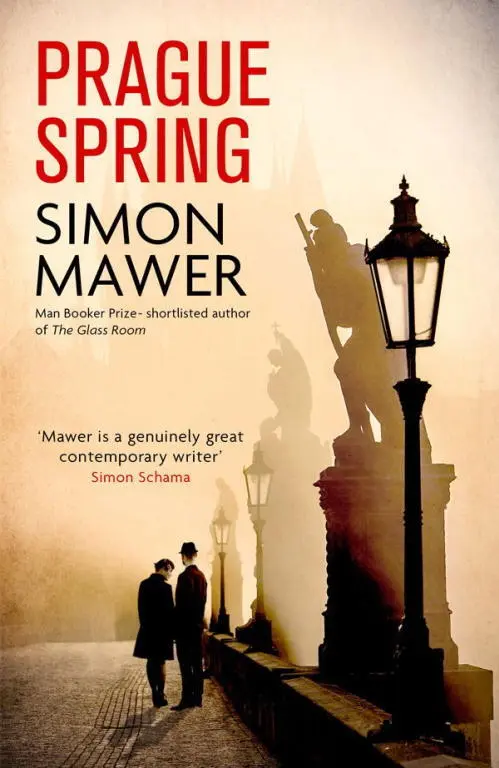
- Название:Prague Spring
- Автор:
- Издательство:Little, Brown Book Group
- Жанр:
- Год:2018
- Город:London
- ISBN:978-1-4087-1113-2
- Рейтинг книги:3 / 5. Голосов: 1
-
Избранное:Добавить в избранное
- Отзывы:
-
Ваша оценка:
Prague Spring: краткое содержание, описание и аннотация
Предлагаем к чтению аннотацию, описание, краткое содержание или предисловие (зависит от того, что написал сам автор книги «Prague Spring»). Если вы не нашли необходимую информацию о книге — напишите в комментариях, мы постараемся отыскать её.
In the summer of 1968, the year of Prague Spring with a Cold War winter, Oxford students James Borthwick and Eleanor Pike set out to hitchhike across Europe, complicating a budding friendship that could be something more. Having reached southern Germany, they decide on a whim to visit Czechoslovakia, where Alexander Dubček’s “socialism with a human face” is smiling on the world.
Meanwhile, Sam Wareham, First Secretary at the British embassy in Prague, observes developments in the country with a diplomat’s cynicism and a young man’s passion. In the company of Czech student Lenka Konečková, he finds a way into the world of Czechoslovak youth, with all its hopes and new ideas; now, nothing seems off-limits behind the Iron Curtain. But the great wheels of politics are grinding in the background; Soviet leader Leonid Brezhnev is making demands of Dubček, and the Red Army is massing on the borders.
This shrewd, engrossing, and sensual novel once again proves Simon Mawer is one of today’s most talented writers of historical spy fiction.
Prague Spring — читать онлайн бесплатно полную книгу (весь текст) целиком
Ниже представлен текст книги, разбитый по страницам. Система сохранения места последней прочитанной страницы, позволяет с удобством читать онлайн бесплатно книгу «Prague Spring», без необходимости каждый раз заново искать на чём Вы остановились. Поставьте закладку, и сможете в любой момент перейти на страницу, на которой закончили чтение.
Интервал:
Закладка:
He smiled. ‘It’s Egorkin. The conductor. He wants to meet me at Stalin.’
‘Letná Park? Is he a queer or something?’
He laughed, looking for a pen and scribbling Harold’s phone number on a scrap of paper. ‘If I’m not back by midnight, ring this number and tell him. He’s Harold.’
She looked at him. She appeared entirely composed, neither concerned nor fearful. ‘Why are you afraid?’
‘Not afraid, just cautious.’
She nodded. ‘I remember cutting a lecture to see Stalin being blown up. We watched from the other side of the river and we cheered when it went BOOM! The police tried to clear us away. People were meant to stay indoors.’
‘It won’t be as dramatic as that this evening.’
‘I hope not.’ She turned back to the typewriter.
What’s in a name? The man I was introducing myself to, using my original name for the first time, happened to be the First Secretary of the Communist Party of Czechoslovakia, Alexander Dubček. There’s a name with import, a sturdy Bohemian oak [1] Dub , an oak. Čech , Bohemian.
(which is ironic because, as we all know, Comrade Dubček is actually Slovak). ‘You appear to know who I am, dear miss,’ he said. ‘Perhaps I might know to whom I am speaking?’ And so I told him.
Recognising my name, the Bohemian (and Slovak) oak seemed to sway in the wind for a moment…
34
The vast Letná parade ground, where the Party gathered to celebrate May Day, appeared deserted; across the road, the Sparta Prague stadium was a mass of darkness. Sam parked the car as inconspicuously as possible, hiding it beneath trees with its number plates masked by bushes. There were people around in the dusk, young lovers looking for somewhere to be alone, a group sitting in a circle on one of the lawns around an apology for a camp fire. A guitar was being strummed. There was laughter, some singing, the glow of cigarettes. A crescent moon was just rising – barely enough light to follow the paths through the trees towards the edge of the plateau where steps led down to a paved esplanade overlooking the river and the Old Town.
Moonlight glimmered faintly on the great curve of the river below. Beyond the water the Old Town buildings were picked out in lights. He could make out the needle-like spires of the Týn Church thrust upwards into the belly of the night sky. Behind him the wall at the back of the esplanade seemed huge, the bastion of a fortress. It was up there that the great monument had once stood, the largest group sculpture in Europe – a gaggle of workers, farm labourers and soldiers all pushing and shoving behind the solemn figure of Joseph Vissaryonovich Dzhugashvili, better known as Stalin, who stood at the front and looked thoughtfully over the city. With bitter irony they nicknamed it fronta na maso , the meat queue. Constructed of seventeen thousand tons of reinforced concrete and clad with thirty thousand blocks of granite, it was an exercise in posthumous sycophancy, because by the time it was finished Stalin had already been dead two years. On the orders of Moscow the grandiose monument was demolished in 1962.
How do you demolish such a monstrosity without getting egg on your face? You first attempt to hide the whole construction behind wooden fencing before blowing it up with a total of one thousand eight hundred pounds of high explosive and hoping that no one notices. As it was built in the most prominent place in the entire city, that is rather difficult.
It is said that President Novotný wept when the monument vanished in a cloud of concrete bits and granite chippings. What is certain is that the original designer of the thing did not shed a tear over its disappearance – he was long dead, having committed suicide a month before it was officially unveiled.
And now? Now there was nothing. Elsewhere in the night sky there were stars, but not there. It was as though the vanished presence of Uncle Joe still cast a kind of shadow, a void that seemed vaster and more frightening than any material monument to the man.
Sam stood close to the wall, feeling happier with his back to the stones. It was like standing on an ill-lit stage, waiting for the lights to come up and the performance to begin. There were others already there, mere blots in the uncertain light: a couple sitting, apparently wrapped in each other’s arms, on the low wall that would be the apron of the stage; a solitary male figure standing apart, smoking. Was that Egorkin?
Shadows played tricks with perspective. Doubts crowded in. This was idiotic. What the hell did the Russian want? He thought of Lenka back in the flat, typing away at her fejeton and thinking of bed. He thought of the bed itself, a place that only had meaning with her couched within it.
Meanwhile on the esplanade a second figure joined the solitary one. The two exchanged a few words and went off together into the shadows. Sam almost laughed out loud. Queers. A world of secrecy and evasion existing below the surface of everyday life just as surely as the world of spies and traitors. Was this, he wondered, Egorkin’s idea of a joke? He lit a cigarette and glanced at his watch. The luminous minute hand crept on. A cigarette seemed as good a measure of time as anything. He’d finish this cigarette and then go.
He took a last drag, dropped the butt on the ground and stamped it out. As he was about to walk away the fused couple on the wall divided amoeba-like into two individuals. One of them walked across the esplanade towards him, leaving the other seated, watching, her face a smudge of white against the shadows.
‘I’m sorry to have kept you,’ Egorkin said. It was hard to make out his expression – just shadows, an abstract combination of dark and light. But his voice was unsteady, as though there was a fracture somewhere deep within it.
‘What the hell’s going on?’
‘It’s… there’s been a problem.’ He glanced behind him at the lonely figure. ‘We are in trouble.’
‘Trouble?’ It sounded ridiculous, the kind of euphemism used to cover teenage pregnancy.
‘We’re being sent back to Moscow. Our programme for the next week has been cancelled. Tomorrow, that’s what I’ve been told.’ His hand darted across the shadows and grabbed Sam’s wrist. ‘We have no time, that’s the truth. We must go now.’
‘Now?’
‘I’m asking you for help. We are. Both of us. Now.’
‘Are you serious?’
‘This is not the moment for jokes, is it? We need to be taken to the British embassy.’
Sam had a moment’s vision of the chaos and confusion were he to knock on the embassy gate at eleven-thirty at night on Friday night with a couple of renegade Russians in tow.
‘Look, I haven’t spoken with anyone yet. Haven’t had the opportunity, and now it’s the weekend. I can’t just turn up with you. They’d have to get the ambassador out of bed. I’m in his bad books already this evening. Me trying to deliver the two of you into his care would be the last straw.’
‘But there is no time. They will soon see that we are both missing. It won’t take them long to realise we have left the hotel.’
‘And if I do get you into the embassy, the story will be in Moscow by lunchtime tomorrow. You’ll end up trapped there with no way of getting you out and Mr Brezhnev demanding satisfaction from the Czechoslovak government.’
‘You have no secrecy?’
‘Locally employed people. Maids, stewards, even some secretaries in the consulate. They all report to the StB.’
‘So what do you suggest?’
It was ridiculous. The whole situation was ridiculous. He could, of course, offer his apologies and walk away. That would be the safer option, at least for Sam Wareham, First Secretary at the British Embassy; not for Gennady Egorkin and Nadezhda Pankova, though. ‘I’ll take you to my flat,’ he said, ‘at least for tonight. Then we’ll see.’
Читать дальшеИнтервал:
Закладка:
Похожие книги на «Prague Spring»
Представляем Вашему вниманию похожие книги на «Prague Spring» списком для выбора. Мы отобрали схожую по названию и смыслу литературу в надежде предоставить читателям больше вариантов отыскать новые, интересные, ещё непрочитанные произведения.



Обсуждение, отзывы о книге «Prague Spring» и просто собственные мнения читателей. Оставьте ваши комментарии, напишите, что Вы думаете о произведении, его смысле или главных героях. Укажите что конкретно понравилось, а что нет, и почему Вы так считаете.