Саймон Моуэр - Prague Spring
Здесь есть возможность читать онлайн «Саймон Моуэр - Prague Spring» весь текст электронной книги совершенно бесплатно (целиком полную версию без сокращений). В некоторых случаях можно слушать аудио, скачать через торрент в формате fb2 и присутствует краткое содержание. Город: London, Год выпуска: 2018, ISBN: 2018, Издательство: Little, Brown Book Group, Жанр: Историческая проза, на английском языке. Описание произведения, (предисловие) а так же отзывы посетителей доступны на портале библиотеки ЛибКат.
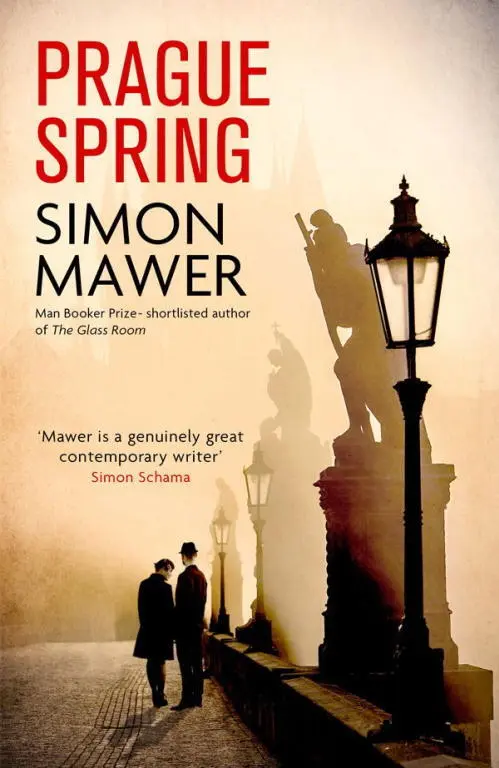
- Название:Prague Spring
- Автор:
- Издательство:Little, Brown Book Group
- Жанр:
- Год:2018
- Город:London
- ISBN:978-1-4087-1113-2
- Рейтинг книги:3 / 5. Голосов: 1
-
Избранное:Добавить в избранное
- Отзывы:
-
Ваша оценка:
Prague Spring: краткое содержание, описание и аннотация
Предлагаем к чтению аннотацию, описание, краткое содержание или предисловие (зависит от того, что написал сам автор книги «Prague Spring»). Если вы не нашли необходимую информацию о книге — напишите в комментариях, мы постараемся отыскать её.
In the summer of 1968, the year of Prague Spring with a Cold War winter, Oxford students James Borthwick and Eleanor Pike set out to hitchhike across Europe, complicating a budding friendship that could be something more. Having reached southern Germany, they decide on a whim to visit Czechoslovakia, where Alexander Dubček’s “socialism with a human face” is smiling on the world.
Meanwhile, Sam Wareham, First Secretary at the British embassy in Prague, observes developments in the country with a diplomat’s cynicism and a young man’s passion. In the company of Czech student Lenka Konečková, he finds a way into the world of Czechoslovak youth, with all its hopes and new ideas; now, nothing seems off-limits behind the Iron Curtain. But the great wheels of politics are grinding in the background; Soviet leader Leonid Brezhnev is making demands of Dubček, and the Red Army is massing on the borders.
This shrewd, engrossing, and sensual novel once again proves Simon Mawer is one of today’s most talented writers of historical spy fiction.
Prague Spring — читать онлайн бесплатно полную книгу (весь текст) целиком
Ниже представлен текст книги, разбитый по страницам. Система сохранения места последней прочитанной страницы, позволяет с удобством читать онлайн бесплатно книгу «Prague Spring», без необходимости каждый раз заново искать на чём Вы остановились. Поставьте закладку, и сможете в любой момент перейти на страницу, на которой закончили чтение.
Интервал:
Закладка:
They crowd into a compartment where four of the places are already taken. Jitka has to sit on Zdeněk’s lap and the rucksacks are piled in anyhow, some on the overhead luggage racks, others on James’s lap. There is laughter, some broken English, much splintered Czech. Jitka has brought her violin; her husband has a guitar which he holds across Jitka’s front and manages to pick at while she laughs and wriggles. The train slides out of the station and traipses through the Prague suburbs. Lenka sits opposite James, a hint of anger lying behind her smile. She’s wearing shorts like something out of the army, except these shorts were probably hers when she was a thirteen-year-old and went on camping trips with the Pioneers or whatever, so they are disturbingly tight, folded in at her crotch in ways he can barely comprehend. And her legs. Blonde, strong, dusted with golden hairs that catch the light from the window as the train rounds a cliff above the river and the sun glares in at their crowded compartment for a moment. He hopes she doesn’t notice his eyes straying down there, but probably she does. You notice the direction of people’s eyeline, don’t you? Exactly where they’re looking, precisely where their glance strays, to the nearest millimetre.
What does she see in that diplomat bloke? What’s he got that James Borthwick doesn’t have?
Almost everything, including her.
Anyway, thank God he’s not here.
Jitka is still full of the wonders of the concert, the thrill of working with Gennady Egorkin and the brilliance of Pankova’s violin-playing. And Eckstein, of course, but the whole world already knows Birgit Eckstein.
‘I didn’t,’ says James, and they laugh.
The conversation slips back into Czech for Zdeněk’s sake. But he’s reading the newspaper – RUDÉ PRÁVO the masthead announces – leafing through the pages, throwing out critical comments here and there. He says something that includes the musicians’ names, Gennady Egorkin and Nadezhda Pankova. Jitka translates: ‘It says the couple have disappeared from their hotel and no one knows where they are.’
Zdeněk adds something. Jitka protests. ‘He says the man is doing indecent things with his violinist. He says all violinists are like that.’ She blushes. ‘Which is not true.’
The train trundles on, through the countryside now – fields, farms, forest, glimpses of a river through the trees. They finally leave it at a halt somewhere on the edge of a small town whose name seems impossible to pronounce, all consonants and no vowels.
The group sets off down a rough lane and into the woods. It’s like a childhood adventure, walking in the forest, along paths that are hard to follow, in directions that James can’t understand. And it is quite unlike anything in Britain, where almost always you walk and climb in open country, on the fells, on the moors, on the bareback mountains; but here there are miles and miles of forest, holding in their shadows something Slavic, something mysterious and mythic, echoing with birdsong as though it’s a cathedral dedicated to some ancient sylvan deity.
They walk on, talking, laughing, occasionally diverting from the path to forage for berries or mushrooms. These are city people suddenly revealed in different guise, in foresters’ garb, at ease in this strange world that seems so distant from the city. Above all, Zdeněk appears truly at home here, identifying plants and mushrooms, pausing to listen and point as, silently, deer cross their path like shadows in the half-light beneath the canopy of leaves. He smells the scent of a fox, points to cones gnawed down by squirrels, shows where boar have been rooting, identifies polecat droppings. There’s an unreal quality to the whole expedition, going from a place Ellie and James have never heard of to a place they don’t know, that is spoken of only in vague, allusive terms by their hosts. You will see. A strange place. An old ruin. A place whose name, if it has a name, is uncertain. We just call it Hrádek .
It isn’t long before they break out of the trees onto a bare promontory and there it is, Hrádek , which means little castle, and that is what it is, the mere bones of a place, the skeleton of a structure that has long since died – a broken circuit of walls, a tracery of outbuildings, a roofless inner keep and a shattered tower. A metal notice, peppered with shot, warns visitors – Pozor! – of unspecified danger. Far below the battlements a river winds through a narrow gorge. And beyond that is a view, a sudden, startling view of miles and miles of wooded hills running away to the east. How far does it go? Because it seems endless, this procession of forest, as though it will not end until it has become other places whose names James barely knows – the Tatra, the Carpathians, the great Russian steppe, the Urals. He thinks of the Pennines rising up behind his home town. How small they seem in memory.
The group sits for a while in the afternoon sun, amongst the ruins of a castle that once belonged to a Boleslav or a Vladislav, Duke of Bohemia, listening to birdsong and the soft movement of the breeze through the trees. Zdeněk sits apart, his face without expression. Jitka is her usual animated self, like a small, sleek rodent. Occasionally she looks directly at James for a moment longer than one might expect. He remembers the touch of her mouth when they were dancing and wonders whether she remembers too, and if she does what she thinks about it. Ellie sits beside Lenka, who is cool and distant.
‘This is very kind of you,’ Ellie tells her. ‘To bring us with you. It’s lovely here.’
Lenka’s smile is tired, as though there are other things on her mind. ‘It is Čechy . What you call Bohemia. It is right that you see it. Everything is not Prague.’ And then she does what to James seems a curious thing: she puts her arm round Ellie. And Ellie moves towards her, puts her head on Lenka’s shoulder, seems, for that moment in the sun, a close friend. Perhaps more. Is that the kind of friendship that women may have and he has never understood? A kind of idyll. Manet might have painted it, or one of the Impressionists. The viewer might ponder the relationship between the various figures, the two men sitting apart, a dark girl who moves between them, laughing at something, two women who sit together, one with her arm round the other.
The tableau is soon broken by the arrival of others on the scene, three men and a woman who come blundering through the trees and are greeted with cries of surprise and delight, as though their coming had not been planned. There are introductions, a bit of fractured English. Lenka translates: these are old friends of Zdeněk and Jitka, childhood friends of Zdeněk, in fact. It is a kind of tradition for them to gather here at the Hrádek in August, something they started years ago when they were all at the local school and have kept up ever since. So for a while the castle is theirs. They gather wood and make a fire against the wall of the inner keep where the stones are soot-blackened beneath the shaft of an ancient chimney. They forage for mushrooms, with Zdeněk’s friends showing remarkable mycological knowledge. And then, as the sun goes down and the evening sets in, they cook sausages and bake potatoes and open the beer that everyone has brought. Afterwards they sing songs round the campfire like an advertisement for the Boy Scouts from the 1930s, Zdeněk and Jitka playing guitar and violin. Some of the music is familiar – American folk songs, Peter, Paul and Mary stuff with a bit of Joan Baez thrown in – but some is quite foreign to Ellie and James. Zdeněk strums the guitar well enough, but it is Jitka’s playing that captivates, the classical violinist transfigured by the flicker of her bow and the shadows of the castle ruins and the uncertain firelight into something elemental – as though she has been revealed in her true form, which is Romany, Gypsy, Cikánka.
Читать дальшеИнтервал:
Закладка:
Похожие книги на «Prague Spring»
Представляем Вашему вниманию похожие книги на «Prague Spring» списком для выбора. Мы отобрали схожую по названию и смыслу литературу в надежде предоставить читателям больше вариантов отыскать новые, интересные, ещё непрочитанные произведения.


Обсуждение, отзывы о книге «Prague Spring» и просто собственные мнения читателей. Оставьте ваши комментарии, напишите, что Вы думаете о произведении, его смысле или главных героях. Укажите что конкретно понравилось, а что нет, и почему Вы так считаете.