Саймон Моуэр - Prague Spring
Здесь есть возможность читать онлайн «Саймон Моуэр - Prague Spring» весь текст электронной книги совершенно бесплатно (целиком полную версию без сокращений). В некоторых случаях можно слушать аудио, скачать через торрент в формате fb2 и присутствует краткое содержание. Город: London, Год выпуска: 2018, ISBN: 2018, Издательство: Little, Brown Book Group, Жанр: Историческая проза, на английском языке. Описание произведения, (предисловие) а так же отзывы посетителей доступны на портале библиотеки ЛибКат.
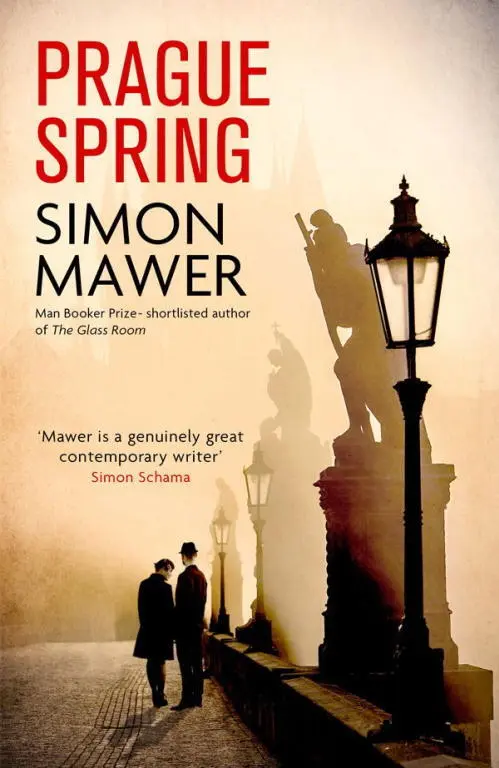
- Название:Prague Spring
- Автор:
- Издательство:Little, Brown Book Group
- Жанр:
- Год:2018
- Город:London
- ISBN:978-1-4087-1113-2
- Рейтинг книги:3 / 5. Голосов: 1
-
Избранное:Добавить в избранное
- Отзывы:
-
Ваша оценка:
Prague Spring: краткое содержание, описание и аннотация
Предлагаем к чтению аннотацию, описание, краткое содержание или предисловие (зависит от того, что написал сам автор книги «Prague Spring»). Если вы не нашли необходимую информацию о книге — напишите в комментариях, мы постараемся отыскать её.
In the summer of 1968, the year of Prague Spring with a Cold War winter, Oxford students James Borthwick and Eleanor Pike set out to hitchhike across Europe, complicating a budding friendship that could be something more. Having reached southern Germany, they decide on a whim to visit Czechoslovakia, where Alexander Dubček’s “socialism with a human face” is smiling on the world.
Meanwhile, Sam Wareham, First Secretary at the British embassy in Prague, observes developments in the country with a diplomat’s cynicism and a young man’s passion. In the company of Czech student Lenka Konečková, he finds a way into the world of Czechoslovak youth, with all its hopes and new ideas; now, nothing seems off-limits behind the Iron Curtain. But the great wheels of politics are grinding in the background; Soviet leader Leonid Brezhnev is making demands of Dubček, and the Red Army is massing on the borders.
This shrewd, engrossing, and sensual novel once again proves Simon Mawer is one of today’s most talented writers of historical spy fiction.
Prague Spring — читать онлайн бесплатно полную книгу (весь текст) целиком
Ниже представлен текст книги, разбитый по страницам. Система сохранения места последней прочитанной страницы, позволяет с удобством читать онлайн бесплатно книгу «Prague Spring», без необходимости каждый раз заново искать на чём Вы остановились. Поставьте закладку, и сможете в любой момент перейти на страницу, на которой закончили чтение.
Интервал:
Закладка:
‘What the fuck were you doing?’
‘I was doing whatever I please.’
‘You were with him in the van.’
‘And if I was, what’s it got to do with you?’
‘I just want to know.’
‘You mean you have some kind of rights over my body?’
‘Of course I don’t.’
‘Well, then.’
It’s the kind of argument that goes nowhere, just turns round and round with only occasional forays into a dangerous world outside the circle. ‘So what do you want to do? Go off with him?’
‘He’s a hell of a lot more interesting than you.’
They make their way back to the flat, walking through the ancient empty streets that might belong to any European city. Jitka went earlier – something about Zdeněk expecting her. She reminded him of the address and how to get there. ‘Half an hour to walk,’ she said. ‘It’s easy. Or maybe you can find a taxi. But beware – they cheat foreigners.’
Still arguing in a desultory fashion, James and Ellie walk back across the river, past the now shuttered café where they met Lenka, through streets he does not know to an address he can barely understand. There are few pedestrians around and less traffic. Shops shuttered, bars closed. At one point a police car slows down beside them and a pallid face looks them over before deciding that they are what they seem to be, just a couple walking home. No threat to the Socialist Republic, at least not for the moment. At first Ellie is acquiescent, but later, as the walking goes on, as they wander back and forth through streets already visited, she begins to complain. Complaint is a relief. He can tell her to shut up and not care whether she is offended or not. So, snapping at each other exactly as in the play, Fando and Lis walk on, unobstructed and unchallenged, turning past corners they maybe recognise, and buildings perhaps they’ve seen before, until James finally identifies the one they have been searching for and manages to open the street door with the key that Jitka gave him. Together, his arm round Ellie, they climb the stairs to reach the crouched landing on the fifth floor. As silently as he can he opens the door to the flat and they creep inside. But still they have to pass the tiny room where Jitka and her husband sleep, where a figure with Jitka’s dimensions emerges from the shadows, saying something in Czech. ‘It’s just us,’ James whispers. ‘Sorry we’re late, we got lost.’
There’s a murmured acknowledgement, some further whispering, a collision with a piece of unseen furniture and a suppressed oath from Ellie before they gain the sanctuary of the bedroom. He feels for the switch. The light, when it comes on, is the colour of piss. Ellie is a ragged, morose figure standing resentfully at the foot of their bed. ‘Turn that fucking thing off.’
He kills the light and plunges them back into a deeper darkness than before. It’s easier in the darkness, easier to creep to the bathroom and back, easier to undress in total darkness not knowing what will happen when they come together in the bed, easier to slide beneath the sheet from opposite sides and lie on their backs in the dark.
He wants to touch her but doesn’t dare. ‘Ellie?’ he says softly.
‘What do you want?’
‘Were you with Elliot?’
‘Elliot’s a creep. Why the hell would you think that?’
‘Were you with him?’
There’s a little breath of sarcastic laughter in the darkness. ‘You’re jealous.’
He remembers her words, snapped at him impatiently: you’re jealous of what you already possess; envious of what someone else has. ‘Of course I’m jealous.’
‘That’s very bourgeois of you. But sweet.’
‘But were you? There was someone in the van with him.’
‘How do you know that? Were you spying? How pervy. What did you see?’
‘Never mind what I saw—’
‘Well you obviously do.’
He thinks of her father, the barrister, cross-examining a witness to expose the truth. ‘I saw him with a woman, in the van. Fucking.’
‘And you think it might have been me?’
‘You weren’t around anywhere. Someone said you were in the van.’
‘Someone said,’ she repeats, her tone laden with sarcasm. There is a silence. And then her voice in the darkness: ‘Anyway, if it was me, what would you do?’
It’s a good question. What would he do? ‘I just need to know, that’s all.’
‘I don’t think need has anything to do with it. You want to know. You want to know what I do with my body.’
‘Don’t be daft.’
‘It’s ownership, isn’t it? You want to own my body, and the thought of my sharing it with other men – Elliot or whoever – makes you think you’ve been robbed of something that’s yours. But it’s my body, to do with what I like.’
‘You’re putting words into my mouth.’
‘I don’t think I am. I think you are a typical bourgeois male chauvinist.’
And with that she turns away from him and goes to sleep. James lies beside her in the narrow bed. Still he doesn’t know. Was that her in the van with Elliot, or not?
In the morning she claims to remember little of the evening before. ‘What happened?’ she asks, sitting up in bed, her hair in chaos, her face pale and drawn. As she looks round the cramped room she gives strange glimpses of her mother. ‘God, I feel awful. Did I behave badly?’
‘You weren’t at your most charming.’
‘You say that just to get your own back.’ The sheet has slipped from her shoulders. Her small breasts look limp, like discarded balloons after the party. ‘The music was good. I remember the music.’ A sudden, sideways glance. ‘Did I do things I have to apologise for?’
‘If you don’t remember them, I don’t think they count.’
‘How very Jesuitical of you. Did we…?’
‘No.’
‘I thought not. I remember a long walk, going round and round in circles.’ She slips out of bed and roots around amidst the mess for a T-shirt. ‘God, I feel awful.’
Watching her, James feels intimacy alloyed with indifference. It’s how he imagines a marriage might be after many years, when love has died and familiarity has taken its place. While she goes to the bathroom he gets dressed and finds Jitka in the tiny kitchen making coffee. Her husband has gone out early. Something to do with his work. She looks at James with quiet, thoughtful eyes. ‘Did you have a good time last evening?’
He smiles at her and wonders, thinking of how he danced with her, pressed up hard against her for a moment, touching his lips on hers.
‘It was fun. The music was good, wasn’t it?’
She laughs. ‘The music was bad. But it was still fun.’ She pushes past him in the narrow space, resting her hand on his waist for a fraction of a second longer than one might expect.
28
That evening there is the Birgit Eckstein concert, in a nineteenth-century auditorium named after a prince of an empire that no longer exists. The orchestra – the sharp figure of Jitka is there in the first violins – is flanked by gilded columns and backed by the façade of a Greek temple. Overhead is a ceiling of plasterwork in blue and gold, while all around are fluted pillars and pilasters. Into the focus of this comes first the conductor, the Russian Gennady Egorkin, a sharp, anxious man with a receding hairline that makes him look older than he is. He stands on his little podium and faces the applause with something like apprehension. Then the fragile figure of Birgit Eckstein appears in the wings, looking a little like a cleaning lady who has just found a cello lying round the place, picked it up and wandered onto the stage to find the owner. But she is the owner, and Egorkin holds her hand aloft to display the fact while she gazes round with faint bemusement at the audience. The applause engulfs the pair of them. It echoes from the nymphs and satyrs, thunders on the boards, resonates in the instruments. As it slowly dies away Frau Eckstein takes her seat, hitches up her skirts and pulls the cello to her. Her Guadagnini, an Italian gigolo clutched between her legs.
Читать дальшеИнтервал:
Закладка:
Похожие книги на «Prague Spring»
Представляем Вашему вниманию похожие книги на «Prague Spring» списком для выбора. Мы отобрали схожую по названию и смыслу литературу в надежде предоставить читателям больше вариантов отыскать новые, интересные, ещё непрочитанные произведения.




Обсуждение, отзывы о книге «Prague Spring» и просто собственные мнения читателей. Оставьте ваши комментарии, напишите, что Вы думаете о произведении, его смысле или главных героях. Укажите что конкретно понравилось, а что нет, и почему Вы так считаете.