Саймон Моуэр - Prague Spring
Здесь есть возможность читать онлайн «Саймон Моуэр - Prague Spring» весь текст электронной книги совершенно бесплатно (целиком полную версию без сокращений). В некоторых случаях можно слушать аудио, скачать через торрент в формате fb2 и присутствует краткое содержание. Город: London, Год выпуска: 2018, ISBN: 2018, Издательство: Little, Brown Book Group, Жанр: Историческая проза, на английском языке. Описание произведения, (предисловие) а так же отзывы посетителей доступны на портале библиотеки ЛибКат.
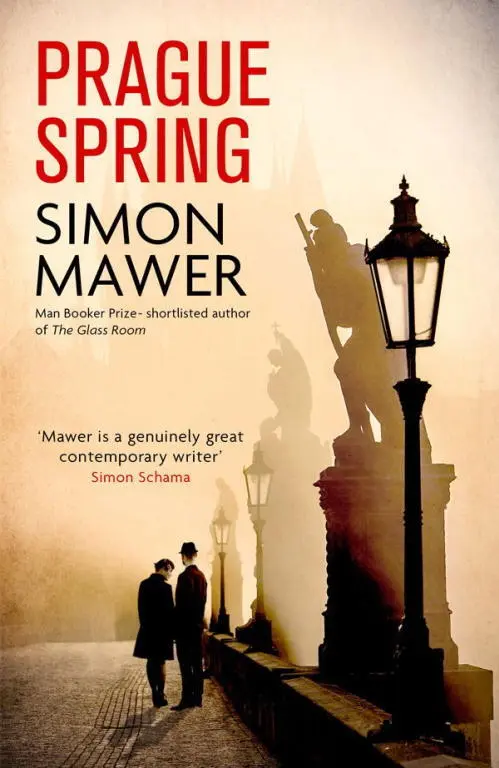
- Название:Prague Spring
- Автор:
- Издательство:Little, Brown Book Group
- Жанр:
- Год:2018
- Город:London
- ISBN:978-1-4087-1113-2
- Рейтинг книги:3 / 5. Голосов: 1
-
Избранное:Добавить в избранное
- Отзывы:
-
Ваша оценка:
Prague Spring: краткое содержание, описание и аннотация
Предлагаем к чтению аннотацию, описание, краткое содержание или предисловие (зависит от того, что написал сам автор книги «Prague Spring»). Если вы не нашли необходимую информацию о книге — напишите в комментариях, мы постараемся отыскать её.
In the summer of 1968, the year of Prague Spring with a Cold War winter, Oxford students James Borthwick and Eleanor Pike set out to hitchhike across Europe, complicating a budding friendship that could be something more. Having reached southern Germany, they decide on a whim to visit Czechoslovakia, where Alexander Dubček’s “socialism with a human face” is smiling on the world.
Meanwhile, Sam Wareham, First Secretary at the British embassy in Prague, observes developments in the country with a diplomat’s cynicism and a young man’s passion. In the company of Czech student Lenka Konečková, he finds a way into the world of Czechoslovak youth, with all its hopes and new ideas; now, nothing seems off-limits behind the Iron Curtain. But the great wheels of politics are grinding in the background; Soviet leader Leonid Brezhnev is making demands of Dubček, and the Red Army is massing on the borders.
This shrewd, engrossing, and sensual novel once again proves Simon Mawer is one of today’s most talented writers of historical spy fiction.
Prague Spring — читать онлайн бесплатно полную книгу (весь текст) целиком
Ниже представлен текст книги, разбитый по страницам. Система сохранения места последней прочитанной страницы, позволяет с удобством читать онлайн бесплатно книгу «Prague Spring», без необходимости каждый раз заново искать на чём Вы остановились. Поставьте закладку, и сможете в любой момент перейти на страницу, на которой закончили чтение.
Интервал:
Закладка:
How does she know these things? Physiology is more in James’s line than hers, and yet he hasn’t made the connection. He feels stupid and naive, possessed only of limited knowledge that is useful to no one. Then, as they watch the proceedings on stage, the focus of the whole theatre shifts, rotates, swirls giddily round in a vortex until, absurdly, they have become the centre of attention.
‘Representatives from English University of Oxford,’ Jitka’s husband cries over the loudspeakers, pointing at them. Lenka is telling them to stand up and take a bow. Voices in broken English are all around, urging them on. Zdeněk, that’s his name, is calling them to come up on stage, to speak on behalf of the famous University of Oxford.
‘I can’t speak on behalf of anyone but myself,’ James protests. People laugh. People applaud. People stamp their feet and cheer. Lenka has him by the hand and is pulling him down the aisle. Ellie is quite happy with the whole thing, as though this is some ridiculous revolutionary drama put on by the Oxford Revolutionary Socialist Students. But for James they are Fando and Lis, clambering onto the stage, finally arriving in the fantasy city of Tar. They are bathed in light. Zdeněk is showing them where to stand.
‘Greetings from Oxford!’ Ellie yells into the microphone. Her voice is edged with nerves but the audience cheer appreciatively. ‘Greetings from the students of Oxford and greetings from the workers of Oxford.’ More cheers. She’s growing in confidence, standing small and indomitable before the crowd. ‘Socialism has a human face!’ she shouts, and those that do understand explain to those that don’t. The cheering grows. ‘Nothing,’ she cries, ‘is more powerful than an idea whose time has come! You can resist the invasion of armies but no one can resist the invasion of an idea!’
James has never seen her like this, doing her Pasionaria thing. The audience cheer and he stands there reflected in the light that falls on Ellie. They both smile and wave. In the wings Lenka is there to congratulate them and lead them back to their seats with the audience watching and still applauding and the English guy, Sam Whatever, smiling wryly at them and saying ‘quite a rabble-rouser’, in that nasty, sarcastic manner that people like him possess. Schoolmasterly. It gives James the shivers.
27
The building is close to the river, close to Kampa with its ancient waterwheels and historic flour mills. With conscious reference to the club in Liverpool this place is called Kaverna . It consists of brick-lined storerooms, like an ancient vaulted church of three naves with arches leading from one to the other. Each nave is packed with worshippers heaving and gyrating as though in the throes of religious ecstasy. The walls are painted black, so illumination is limited to small pools of light. The air is rank with sweat and smoke. At one end of the central nave is a wooden stage raised two feet from the floor. On it, bathed in the uncertain light from three spots and flanked by speakers, are the musicians. Their name is blazoned on the bass drum: THE IDES OF MARCH.
The leader, John, stands centre stage like a preacher in a revivalist meeting, his mouth almost enveloping the microphone, his voice booming round the vaulted ceiling: ‘I don’t understand what the fuck anyone is saying!’
His audience cheer.
‘Y’all off your heads!’
They cheer some more.
‘Just a couple a days ago we crossed our own Rubicon – the Iron fucking Curtain!’
Laughter from those who have understood.
‘That’s’ – he glances at a scrap of paper in his hand – ‘ Shelezna-shoustani-opona to you.’
More laughter. Cheering and laughter.
‘An’ we find you cats all spaced out here on the far side, just like the kids back home. So now we gonna sing about it.’
More cheers. Those who understand make some kind of translation for those who don’t. The drummer – it’s Archer, isn’t it? – begins a thumping beat, the bass guitar adds a grating undercurrent of threat and they launch into their signature song, adapted for the occasion:
‘We’re gonna cross the Rubicon,
We’re going to be free.
We’re gonna cross the Rubicon
And choose democracy.
The audience cheer like a football crowd, singing along with the chorus. Democracy they understand. Rubicon, as well. Free, they comprehend free. There is a guitar solo with Elliot, all teeth, long hair and ragged beard, playing his instrument as though it’s a girl’s body laid out across his hips.
‘Let me cross your Rubicon,
Let me hold you tight,
Let me cross your Rubicon,
Girl, it’s gonna be all right.’
Ellie is dancing, smoking and dancing, her arms above her head, her hair loose, eyes glazed, mouth pulled into some kind of smile. From the small stage Elliot points her out and ejects new words into the microphone:
‘I went down to her Rubicon,
I bent to taste it fine,
I crouched beside her Rubicon,
It had the taste of wine.’
People circle Ellie, clapping in time with the beat, while James watches from the sidelines, nursing a beer. He feels trapped, by circumstance, by language, by the girl even now gyrating in the midst of her little circuit of admirers. The temperature of the place rises. Jitka is there – they persuaded her to come, although, thank God, her husband refused the invitation. She is spiky and angular and strangely awkward with the tempo, but at least she is enjoying the gig, laughing with Ellie, circling round her while beyond them the music thunders on.
James goes over to the bar, where the beer is cheap and if you like you can chase it down with hard, white plum brandy. He finishes a beer and rejoins the crowd, feeling detached as he always does in this kind of setting, wondering where the ecstasy lies. Ellie grins at him out of her mop of unruly hair but barely seems to recognise him. They’re playing an Animals number now – ‘We gotta get outta this place,’ John screams into the mike – followed by something slow, a piece of blues with the guitarist, Elliot, wringing pain out of his guitar and John bemoaning the fact that she, whoever she is, has been gone fourteen long days and he’s praying to the Lord not to take his love away.
Later, James is out in the cool night, wandering along the water’s edge. The sound of the concert comes to him dulled by heavy walls – a drumbeat from the bowels of the earth. Beside him the river flows past, a great dark weight of water shining like obsidian. Lights from the other side reflect off the surface, but the impression is that they are immersed deep within the liquid, gleaming from the depths, shimmering with the passage of waves overhead.
Someone, a mere silhouette, approaches and says something in Czech. ‘ Prominyte ,’ James replies helplessly. ‘ Anglitzky .’ I’m sorry. English. That’s almost all he knows, along with a few other stock phrases that Lenka has taught him. He’s sure the pronunciation is wrong but he doesn’t really care. And anyway, why the fuck is he apologising for being English and not being able to get his tongue round this impossible language?
The figure – a male of indeterminate age – stands looking out across the river. There’s the glow of a cigarette. ‘Where you from?’ he asks.
‘You speak English?’
‘Little.’
‘Sheffield.’
‘Ah.’ The man smokes, one can imagine thoughtfully. Perhaps he’s trying to marshal his knowledge of English geography. ‘Student?’
‘Yes.’
‘I work three years in London.’
‘Really?’
‘Czechoslovak embassy. Kensington Palace Gardens. You know Kensington Palace Gardens?’
Читать дальшеИнтервал:
Закладка:
Похожие книги на «Prague Spring»
Представляем Вашему вниманию похожие книги на «Prague Spring» списком для выбора. Мы отобрали схожую по названию и смыслу литературу в надежде предоставить читателям больше вариантов отыскать новые, интересные, ещё непрочитанные произведения.




Обсуждение, отзывы о книге «Prague Spring» и просто собственные мнения читателей. Оставьте ваши комментарии, напишите, что Вы думаете о произведении, его смысле или главных героях. Укажите что конкретно понравилось, а что нет, и почему Вы так считаете.