Саймон Моуэр - Prague Spring
Здесь есть возможность читать онлайн «Саймон Моуэр - Prague Spring» весь текст электронной книги совершенно бесплатно (целиком полную версию без сокращений). В некоторых случаях можно слушать аудио, скачать через торрент в формате fb2 и присутствует краткое содержание. Город: London, Год выпуска: 2018, ISBN: 2018, Издательство: Little, Brown Book Group, Жанр: Историческая проза, на английском языке. Описание произведения, (предисловие) а так же отзывы посетителей доступны на портале библиотеки ЛибКат.
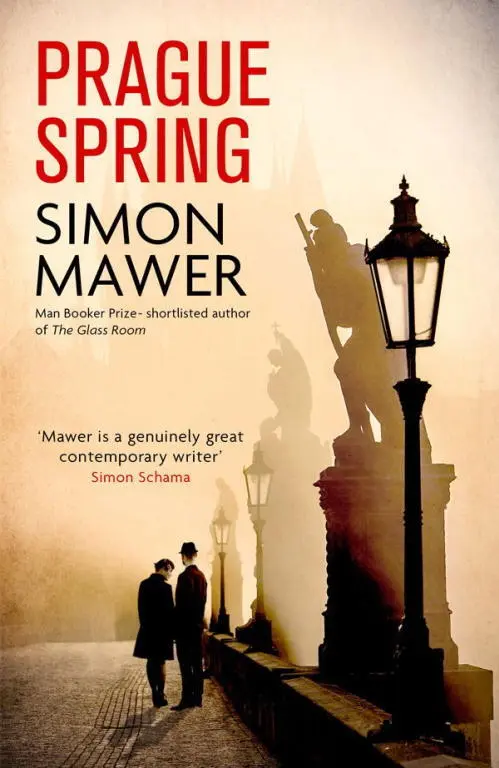
- Название:Prague Spring
- Автор:
- Издательство:Little, Brown Book Group
- Жанр:
- Год:2018
- Город:London
- ISBN:978-1-4087-1113-2
- Рейтинг книги:3 / 5. Голосов: 1
-
Избранное:Добавить в избранное
- Отзывы:
-
Ваша оценка:
Prague Spring: краткое содержание, описание и аннотация
Предлагаем к чтению аннотацию, описание, краткое содержание или предисловие (зависит от того, что написал сам автор книги «Prague Spring»). Если вы не нашли необходимую информацию о книге — напишите в комментариях, мы постараемся отыскать её.
In the summer of 1968, the year of Prague Spring with a Cold War winter, Oxford students James Borthwick and Eleanor Pike set out to hitchhike across Europe, complicating a budding friendship that could be something more. Having reached southern Germany, they decide on a whim to visit Czechoslovakia, where Alexander Dubček’s “socialism with a human face” is smiling on the world.
Meanwhile, Sam Wareham, First Secretary at the British embassy in Prague, observes developments in the country with a diplomat’s cynicism and a young man’s passion. In the company of Czech student Lenka Konečková, he finds a way into the world of Czechoslovak youth, with all its hopes and new ideas; now, nothing seems off-limits behind the Iron Curtain. But the great wheels of politics are grinding in the background; Soviet leader Leonid Brezhnev is making demands of Dubček, and the Red Army is massing on the borders.
This shrewd, engrossing, and sensual novel once again proves Simon Mawer is one of today’s most talented writers of historical spy fiction.
Prague Spring — читать онлайн бесплатно полную книгу (весь текст) целиком
Ниже представлен текст книги, разбитый по страницам. Система сохранения места последней прочитанной страницы, позволяет с удобством читать онлайн бесплатно книгу «Prague Spring», без необходимости каждый раз заново искать на чём Вы остановились. Поставьте закладку, и сможете в любой момент перейти на страницу, на которой закончили чтение.
Интервал:
Закладка:
Her husband smokes, thin, dark cigarettes with a powerful smell that seems to have been absorbed into the fabric of the flat. He works in the living room at the upright piano on which he plays figures while scribbling the spidery signs of musical notation on sheets of manuscript paper. His wish is to compose symphonies and concertos; his job is to write jingles for television. Ellie and James try to talk music with them. Ellie is better at this of course, but they both have the connection with Frau Eckstein to relate. Does Jitka know Birgit Eckstein?
A squeal of delight. Of course! Birgit Eckstein is giving a concert. Jitka plays in the orchestra. She can get tickets if they want. ‘Here in Prague there is much music. More than in New York or London, I think. The government puts money into music because you cannot see the politics in music.’
James asks how much the tickets will be and Jitka laughs, embarrassed. ‘No, a gift from me to you.’
At night James and Ellie can hear Jitka and her husband through the thin partition walls making love in the next room. ‘Making love’ seems a misnomer: it is an urgent, painful sound, like people at manual labour of some repetitive kind, working in a factory making useless products for a socialist command economy.
Next morning they venture out into the city, with an agreement to meet Lenka for coffee at the Kavárna Slavia. ‘It is where all writers get together,’ she explained when they made the arrangement. ‘Everyone argues. It will be interesting.’
So James and Ellie wander the streets of Nové Město, the New Town, finding them drab and dusty. The few shops have plain windows and sparsely packed shelves. The buildings, nineteenth-century most of them, appear tarnished and battered, like pieces of forgotten family silver found behind a locked door. Advertisements seem half-hearted, as though there is little point in making much impact because no one’s really buying. Trams packed with people clang and grind along the wider roads. In Wenceslas Square there’s some kind of public meeting: a speaker harangues a small crowd. Flags fly. Perhaps it’s a celebration of some kind, but it’s impossible to tell. As they walk away a man darts out of a side street and tries to sell them something. James assumes it’s sex of some kind; Ellie imagines stolen goods. But it’s just money he wants to sell, Czech crowns for hard currency. ‘Good rate,’ he says, presumably the only English he knows.
The café where they are to meet Lenka is on the corner of National Street, overlooking the river and immediately opposite the proud but grimy bulk of the National Theatre. Inside there is noise and the smell of coffee and cigarettes. People come and go, greeting, talking, arguing, ordering against the shrill percussion of china against metal. Waiters patrol between the tables with trays held high. Surreptitiously Lenka points out one particular table that is full of discussion or argument, it is hard to tell which. ‘There they are,’ she whispers, as though they are specimens – rare birds, perhaps – that might be frightened away by any sudden movement on the part of observers. She mentions names that mean nothing – Collage, Herschel, Cherney – while James and Ellie watch discreetly but uncomprehending. ‘It is like Paris,’ Lenka explains, without admitting that she has never been there. ‘Writers and philosophers discussing in the cafés.’
The idea appeals to Ellie. She wants to know all about it, about the writers and the philosophy, about the demonstration in Wenceslas Square and the arguments all around them. There’s the frustration of not being able to decipher a single word. Shop fronts, newspaper headlines, protest banners, all equally opaque. ‘What’s going on? What’s happening?’ she asks.
Lenka looks helpless. ‘The Russians want one thing, we want another, and so there are meetings to talk. Meetings, meetings. Words, words, words. They speak of fraternal comrades and all kinds of kec . What’s kec ? Rubbish, nonsense. But everyone knows that Brezhnev holds a gun to Dubček’s head and Dubček dares him to pull the trigger.’
‘Russian roulette.’
Lenka manages a dry laugh. ‘ Ruská ruleta . You see it is not so difficult – we say the same thing. But this is true, that Dubček understands Russians – he lived many years in Russia, he speaks perfect Russian – but Brezhnev understands nothing of us. So, you see Dubček wins. That, at least, is what we hope.’
Jitka joins them at their table. Both women seem excited by the presence of these visitors from the West. There are things to discuss – what Ellie and James should see, what they should do. There are so many sights in this city. An English guidebook has been found. Plans have to be made. It is so exciting. Even Ellie is excited. If she has been in a bad mood in the last few days, all is now changed with this experience of her first socialist country, the one with the human face.
When James asks why they are being so helpful neither woman is the least bit disconcerted by his question. ‘Because we want to make you love our city,’ Jitka says. ‘We want to make the whole world love our city.’
Lenka interrupts. ‘In the West no one knows anything about Prague. They try to forget Prague after they betrayed us in 1938. Do you know about 1938?’
‘The Munich accord?’
‘ Accord ? Does accord mean agreement? But we did not agree to anything. Mnichovská zrada , that is what we call it. The Munich betrayal . And because of this betrayal we are forgotten, our country is forgotten, Prague is forgotten, and who cares that it is most beautiful city in Europe? So we need people like you to help the world rediscover our city and our country. And to protect it against the Russians.’
One of the writers, a short, gingery man in a leather jacket, gets up and walks past their table. He gives a toothy smile, pausing to greet Lenka in the way that you do when you’re not certain whether you recognise someone or not. There’s a brief exchange in Czech, a blizzard of consonants. Lenka agrees with something said, laughs and offers a comment that clearly refers to English students rescued from the streets.
‘ Ahoj ,’ he says to them, sounding bizarrely nautical in this landlocked country. ‘Here is good,’ he tells them and they agree, it is good. ‘Very interesting.’
But he has to go. Clearly something calls him. ‘ Čau ,’ he says, the Italian ciao borrowed just to show how bright and carefree Czechoslovakia has become. They watch him leave, going out through the door into the street and glancing back at the last minute to give a jaunty little wave. ‘He is a writer of plays,’ Lenka explains. ‘Very important.’
Ghosts
That writer of plays is a ghost now, just another of the city’s many ghosts, for Prague is a truly haunted place. You can feel them around you. Some of them are just that, mundane ghosts that the tourist trade loves – golems, headless knights, wronged women, all that kind of thing – but there are others, there are others. The ghosts of the tens of thousands of Prague Jews killed by the Nazis, for example. Or the ghost of Franz Kafka, that anxiety-ridden man with the beady eyes and the sharp, inquisitive features (a rodent? a bird?) who pinned humanity to the pages of his fiction like so many insect specimens.
Although he was a Jew, Kafka escaped being murdered by the Nazis by dying of TB in 1924 (his three sisters were not so lucky) but his ghost still haunts the city, along with the spirit of his greatest novel, the one he never finished and never wanted published, the one he called Das Schloss , The Castle . But when people here refer to the Castle, they are not talking of Kafka’s masterpiece, which in Czech goes by the title Zámek , ‘Château’, but rather the seat of the president, as one might talk of the White House in the USA. And there it is, on the far side of the river as seen beyond the arguing writers through the windows of the Café Slavia: Hrad , Das Schloss , The Castle, dominating the town beneath, whose resigned inhabitants accept every complex, tortuous, irrational, absurd edict generated by the various organs of bureaucratic power – Federal Assembly, Party apparatus, Ministry – but signed off by the principal inhabitant of the Castle. Indeed, in his novel Kafka might almost have been prophesying the state that has come to pass in his home city less than three decades after his death, where fear is integral and endemic, where bureaucracy shuffles the cards and then loses them, where you are what the files say you are, where all is happy because it is decreed to be happy, and all is successful because that is what success is.
Читать дальшеИнтервал:
Закладка:
Похожие книги на «Prague Spring»
Представляем Вашему вниманию похожие книги на «Prague Spring» списком для выбора. Мы отобрали схожую по названию и смыслу литературу в надежде предоставить читателям больше вариантов отыскать новые, интересные, ещё непрочитанные произведения.

Обсуждение, отзывы о книге «Prague Spring» и просто собственные мнения читателей. Оставьте ваши комментарии, напишите, что Вы думаете о произведении, его смысле или главных героях. Укажите что конкретно понравилось, а что нет, и почему Вы так считаете.