Саймон Моуэр - Prague Spring
Здесь есть возможность читать онлайн «Саймон Моуэр - Prague Spring» весь текст электронной книги совершенно бесплатно (целиком полную версию без сокращений). В некоторых случаях можно слушать аудио, скачать через торрент в формате fb2 и присутствует краткое содержание. Город: London, Год выпуска: 2018, ISBN: 2018, Издательство: Little, Brown Book Group, Жанр: Историческая проза, на английском языке. Описание произведения, (предисловие) а так же отзывы посетителей доступны на портале библиотеки ЛибКат.
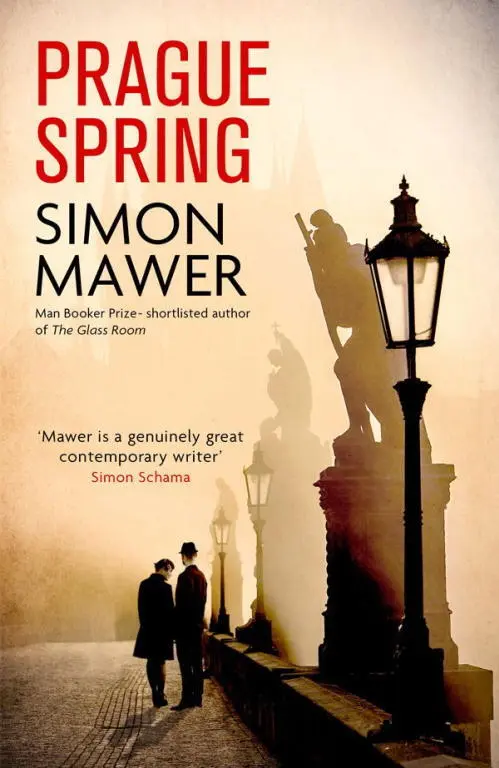
- Название:Prague Spring
- Автор:
- Издательство:Little, Brown Book Group
- Жанр:
- Год:2018
- Город:London
- ISBN:978-1-4087-1113-2
- Рейтинг книги:3 / 5. Голосов: 1
-
Избранное:Добавить в избранное
- Отзывы:
-
Ваша оценка:
Prague Spring: краткое содержание, описание и аннотация
Предлагаем к чтению аннотацию, описание, краткое содержание или предисловие (зависит от того, что написал сам автор книги «Prague Spring»). Если вы не нашли необходимую информацию о книге — напишите в комментариях, мы постараемся отыскать её.
In the summer of 1968, the year of Prague Spring with a Cold War winter, Oxford students James Borthwick and Eleanor Pike set out to hitchhike across Europe, complicating a budding friendship that could be something more. Having reached southern Germany, they decide on a whim to visit Czechoslovakia, where Alexander Dubček’s “socialism with a human face” is smiling on the world.
Meanwhile, Sam Wareham, First Secretary at the British embassy in Prague, observes developments in the country with a diplomat’s cynicism and a young man’s passion. In the company of Czech student Lenka Konečková, he finds a way into the world of Czechoslovak youth, with all its hopes and new ideas; now, nothing seems off-limits behind the Iron Curtain. But the great wheels of politics are grinding in the background; Soviet leader Leonid Brezhnev is making demands of Dubček, and the Red Army is massing on the borders.
This shrewd, engrossing, and sensual novel once again proves Simon Mawer is one of today’s most talented writers of historical spy fiction.
Prague Spring — читать онлайн бесплатно полную книгу (весь текст) целиком
Ниже представлен текст книги, разбитый по страницам. Система сохранения места последней прочитанной страницы, позволяет с удобством читать онлайн бесплатно книгу «Prague Spring», без необходимости каждый раз заново искать на чём Вы остановились. Поставьте закладку, и сможете в любой момент перейти на страницу, на которой закончили чтение.
Интервал:
Закладка:
The guard smiles. This is a real smile, displaying a graveyard of teeth. ‘Přenosilová,’ he says. ‘Loutka.’
‘Sandie Shaw,’ Ellie responds, guessing.
A second guard joins in. ‘Foots. Naked foots.’ And then adds something in Czech – a tripping, splintered sound like the snapping of bones – which makes his colleague laugh out loud. ‘No vísum,’ the first guard points out, handing the passports back with something like a hint of regret. He gestures towards the customs house where already people are crowding.
They join a queue. German is spoken all around. Someone tries to explain in English and they hear a story of displacement and desolation that they only half-understand. ‘Once we live here,’ the man tells them. ‘Now we are as tourists coming.’
They edge forward along the pathways of bureaucracy. Inside the building is the smell of old concrete and stale sweat, and perhaps, lurking in the background, a hint of urine. Glum men sit at desks and administer the stamps of acceptance and authenticity with a device like a miniature guillotine. The mechanism descends, and there, on the page marked ‘visas’, is a new imprimatur: čESKOSLOVENSKÉ VÍSUM. A few endorsements, a flash of a pen, a date stamp against VSTUPNÍ and all is done. Money changes hands through a metal grille. For their traveller’s cheques they receive bundles of used notes denominated in Czechoslovak koruny . Questions are waved away. They move on, through further passageways and out into the afternoon sunshine on the inside of the Iron Curtain.
Border
It is interesting to contemplate the border they have just crossed. A curtain of iron – well, chain-link fencing, barbed wire and free-fire zones – but at the same time a mere line on a map between forest and forest, between mountain and mountain, between farmland and farmland. Between states, yes, the old kingdom of Bavaria, once ruled by mad King Ludwig, and the Austrian Empire, but a border between German and German, created during wars of religion and wars of politics and power, and culminating in the final border to end all borders, drawn on a map at the château of Saint-Germain-en-Laye near Paris in the year of peace, 1919, when the state of Czechoslovakia, mainly an amalgam of Czechs and Slovaks (who almost shared a language but little else), was created out of bits and pieces of the Austria-Hungary Empire. But here, with brilliant historical irony, the border meandered down stream valleys and along watersheds and failed entirely to take into account the language on the ground, neatly separating German speaker from German speaker and thereby planting the seeds of the next war which would bring the whole of the continent, indeed much of the whole world, to its knees in the bloodiest and nastiest conflict of all time.
Shortly after the end of that war, in the month of October 1945, in what President Beneš of the newly liberated Czechoslovakia called, with fantastic insensitivity, ‘the final solution to the German question’, the German speakers on the eastern side of the border (approximately two million of them) were systematically driven over this border to join their cousins on the western side. Thus, in the last sixty years of its effective life, the border became a linguistic barrier as well as a political one.
In the autumn of 1989, with the collapse of the Soviet empire, the watchtowers were dismantled and the barbed-wire fences uprooted. Finally in December 2007 the Czech Republic signed the Schengen Agreement and the border entirely disappeared, one hopes for ever. No barbed wire, no customs posts, nothing more than an almost forgotten line drawn on the map. More than that, the crossing point where James and Eleanor entered Czechoslovakia in 1968 was, by 1997, bypassed by a new motorway a mile to the south, so that road traffic now flows back and forth with only a ritual road sign to tell the driver that he has moved from one country to another. And yet… Czech and German biologists have discovered that the red deer that roam the Bohemian forest are still keeping to their respective sides of the border, Czech deer on the east, Bavarian deer on the west. These deer cannot have been alive during the period of the Iron Curtain, so it seems that they have been taught by their parents, perhaps their grandparents. Thus the last trace of the Cold War division lies only within the brains of Cervus elaphus , the red deer.
23
James and Ellie walk away from this border, into the world beyond. Emptiness strikes them. They see woods, and fields, some cultivated, some derelict, but no people. A scatter of abandoned houses. Little traffic except for the West German cars that have been queuing at the border and are now driving past, indifferent to the lonely plod of Fando and Lis towards an unknown Tar.
Finally a tractor stops for them. The driver is dark, weather-beaten, more like a sailor than a farmer. ‘Rom,’ he says, beating his chest. They have no means of communication with him but they presume that’s his name. Frowning, talking volubly, Rom takes them as far as a hamlet where there are more abandoned houses and a few modern concrete ones, where loudspeakers on telegraph poles play music to no one at all. The tractor goes off up a track running through the fields, leaving them on the tarmac road with nothing to do but walk. Along the roadside are fruit trees laden with fruit – cherries, plums, apples. They walk, eating ripe plums. It’s late afternoon and there’s the matter of where to spend the night. No hotels, no pubs, no campsites in this desolate corner of Europe. The space around them seems to grow larger, vast and empty. ‘Plenty of places to put the tent up,’ James observes. ‘Only danger will be being eaten by bears.’
‘Is that a joke? I presume it is a joke. Anyway, I’ve had it with your bloody tent.’
He ignores her and keeps on walking. Perhaps one of those abandoned houses which they passed a while back? Perhaps the ditch beside the road? Perhaps that line of forest away to the right? They plod onwards…
24
Afternoon sunshine on the forests and fields of Bohemia. The embassy car reversed the route of the day before, passing through the West German border post without let or hindrance, crossing the bridge over the stream and climbing the slope through no-man’s-land towards the Czech customs post. The car slowed to a crawl. There was a queue of cars at the normal channel, a jaunty wave of recognition as the Humber moved towards the reserved lane. The barrier went up. Lenka relaxed her grip.
‘Not even a carton of cigarettes,’ Sam said. ‘But a pint for Derrick.’
‘Two, you said. And none of that fizzy Czech stuff. Watneys.’
The car cruised on. Ahead two figures appeared at the edge of the road. Long hair and jeans. The usual uniform. ‘Hitchhikers,’ Derrick said. His policeman’s mind came into play. Regulations were regulations no matter where you were. ‘Shouldn’t be hitchhiking in the border zone. Could find themselves inside.’ He slowed and pulled out to pass them. Sam glanced out of the side window. GB.
‘Better stop, Derrick. Otherwise the police will pick them up and the consular department will have to deal with it. No end of a fuss.’
The car came to a slow and reluctant halt. Lenka looked round. The two hitchers were shuffling forward under the weight of their rucksacks, looking bedraggled and grimy. A boy with a fledgling beard. A girl with chaotic hair.
‘Bloody kids,’ said Derrick.
Sam opened the door and climbed out as the couple approached. ‘Going to Prague?’
They came to a panting halt beside the car. ‘You’re English,’ the boy said. ‘I wondered what a Humber was doing here.’
Читать дальшеИнтервал:
Закладка:
Похожие книги на «Prague Spring»
Представляем Вашему вниманию похожие книги на «Prague Spring» списком для выбора. Мы отобрали схожую по названию и смыслу литературу в надежде предоставить читателям больше вариантов отыскать новые, интересные, ещё непрочитанные произведения.



Обсуждение, отзывы о книге «Prague Spring» и просто собственные мнения читателей. Оставьте ваши комментарии, напишите, что Вы думаете о произведении, его смысле или главных героях. Укажите что конкретно понравилось, а что нет, и почему Вы так считаете.