Саймон Моуэр - Prague Spring
Здесь есть возможность читать онлайн «Саймон Моуэр - Prague Spring» весь текст электронной книги совершенно бесплатно (целиком полную версию без сокращений). В некоторых случаях можно слушать аудио, скачать через торрент в формате fb2 и присутствует краткое содержание. Город: London, Год выпуска: 2018, ISBN: 2018, Издательство: Little, Brown Book Group, Жанр: Историческая проза, на английском языке. Описание произведения, (предисловие) а так же отзывы посетителей доступны на портале библиотеки ЛибКат.
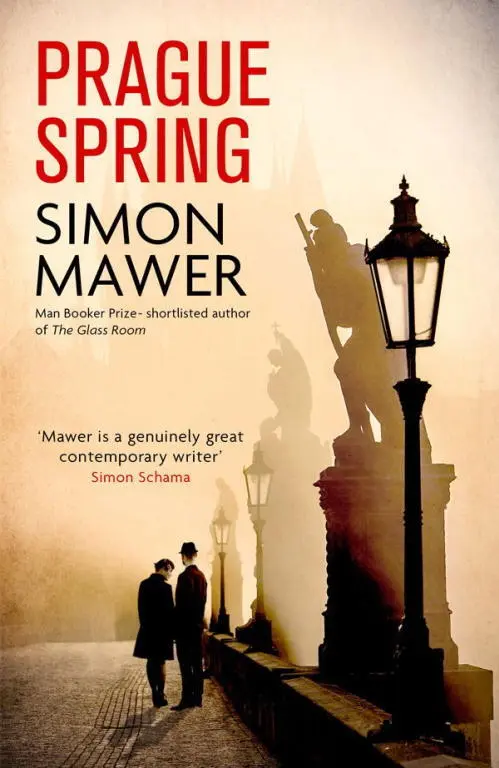
- Название:Prague Spring
- Автор:
- Издательство:Little, Brown Book Group
- Жанр:
- Год:2018
- Город:London
- ISBN:978-1-4087-1113-2
- Рейтинг книги:3 / 5. Голосов: 1
-
Избранное:Добавить в избранное
- Отзывы:
-
Ваша оценка:
Prague Spring: краткое содержание, описание и аннотация
Предлагаем к чтению аннотацию, описание, краткое содержание или предисловие (зависит от того, что написал сам автор книги «Prague Spring»). Если вы не нашли необходимую информацию о книге — напишите в комментариях, мы постараемся отыскать её.
In the summer of 1968, the year of Prague Spring with a Cold War winter, Oxford students James Borthwick and Eleanor Pike set out to hitchhike across Europe, complicating a budding friendship that could be something more. Having reached southern Germany, they decide on a whim to visit Czechoslovakia, where Alexander Dubček’s “socialism with a human face” is smiling on the world.
Meanwhile, Sam Wareham, First Secretary at the British embassy in Prague, observes developments in the country with a diplomat’s cynicism and a young man’s passion. In the company of Czech student Lenka Konečková, he finds a way into the world of Czechoslovak youth, with all its hopes and new ideas; now, nothing seems off-limits behind the Iron Curtain. But the great wheels of politics are grinding in the background; Soviet leader Leonid Brezhnev is making demands of Dubček, and the Red Army is massing on the borders.
This shrewd, engrossing, and sensual novel once again proves Simon Mawer is one of today’s most talented writers of historical spy fiction.
Prague Spring — читать онлайн бесплатно полную книгу (весь текст) целиком
Ниже представлен текст книги, разбитый по страницам. Система сохранения места последней прочитанной страницы, позволяет с удобством читать онлайн бесплатно книгу «Prague Spring», без необходимости каждый раз заново искать на чём Вы остановились. Поставьте закладку, и сможете в любой момент перейти на страницу, на которой закончили чтение.
Интервал:
Закладка:
Other ghosts in the shadow of The Castle? Jaroslav Hašek for one, father of the Good Soldier Švejk. Hašek’s lifespan coincided almost exactly with Kafka’s (both were born in 1883; Hašek died one year before Kafka), but in every other way, both literary and personal, they occupy the opposite ends of any spectrum you care to invent. Drunk against teetotal, riotous extrovert against diffident introvert, bigamist against celibate, hilarious against sombre. Czech against German. Gentile against Jew.
But now all has changed. It is the summer of 1968 and the man in the high castle is a genial and white-haired war hero who goes by the name of Svoboda, which, in one of those coincidences of meaning that make one sure there is an ironist in heaven, means ‘Freedom’. And the man more or less in charge of the Party and therefore holding the reins of power in the country as a whole is some kind of interloper, a tall and gangling Slovak with a long nose and a warm smile and a tendency, dangerous amongst rulers, to consider the true feelings of the man and woman in the street. So now the writers and philosophers are talking at the café tables, writing freely at their desks, publishing in Literární listy and Reportér . A mere Two Thousand Words – the journalist Ludvík Vaculík’s famous June manifesto – has shaken the foundations of the socialist state. People can say what the hell they please and there is tacit concordance between the Party and the Castle because the Švejks are, for the moment, no longer in the ascendancy. Instead it’s socialismus s lidskou tváří , socialism with a human face, while the Soviet Union gathers the fraternal parties together on the banks of the Danube, in Bratislava, for a conference where they all swear that, while claiming ‘unwavering loyalty to Marxism-Leninism, each fraternal party may decide questions of further socialist development in a creative way, taking into account specific national features and conditions’.
It was during this Bratislava conference that a letter from five anti-reformist members of the Presidium of the Czechoslovak Communist Party was passed to a member of the Soviet Politburo to be handed directly to Leonid Brezhnev. This letter, the so-called ‘letter of invitation’, implored Brezhnev to intervene in Czechoslovakia ‘with all means at your disposal’ in order to save the country from the ‘imminent danger of counter-revolution’. So that there would be no misunderstanding, this invitation was written in Russian, with a plea to treat it with the utmost secrecy (prior to 1992, when it was released from the Russian State Archives, its existence was no more than a rumour). This treacherous missive, the excuse that the Soviets needed to give an aura of legality to their invasion, was passed to the intermediary in exactly the place where shit and piss is always passed, in the gents’ lavatory of the conference building.
What, I wonder, do the ghosts of Kafka and Hasěk say to each other about all this as they meet on the ghostly Prague streets? Or do they merely nod and pass by on the other side, the one off to haunt his favourite brothel, the other to the pub?
26
Things to see, places that live on in postcards sent to parents and friends – Tyn Square with the stiletto spires of the church of Our Lady standing over it, the Charles Bridge where musicians busk until moved on by the police, the Art Nouveau marvels of the Municipal House just near the medieval Powder Tower which has Gothic needles at the brim of its tall, pointed hat. Even the building and the room where Vladimir Ilyich Lenin founded the Bolshevik Party of Russia. Lenka will write about their visit, a piece for Student on how the Prague Spring is perceived by two students from the famous University of Oxford.
‘You will be famous in Czechoslovakia,’ Lenka tells them. It’s unclear whether her tone is ironic or not.
Another place that she wants to show them is something unique to her city. ‘You must take the memory of this back with you to England,’ she says. ‘This is very special.’
The building is a squat, secretive place hunched below the level of the pavement as though endeavouring to sit out the harsh storm of the twentieth century. A synagogue. They follow her inside only to discover that the storm is within, a blizzard that stings the eyes and batters on the mind. Not snow or sleet but names. Names everywhere, names on the walls, names on the arches and the alcoves, ranks of names like figures drawn up on some featureless Appellplatz . Names and dates: given names and dates in black, surnames in blood. Dates of birth and dates of death. Seventy-seven thousand seven hundred and ninety-seven of them, names so crowded that they appear to merge one into the other and become just one name, which is the name of an entire people – all the Jews of Bohemia and Moravia who died in the camps.
Lenka speaks very quietly, looking up at the rows and rows of careful lettering. Ellie and James stand beside her, neither of them understanding what to do with this. They have both read about the camps in books, seen them in photographs, watched the horror on film, of course they have. They know the facts and the figures. But this is none of those things – this is just a list of names.
Lenka peers upwards, pointing. ‘My grandparents are there.’
There’s a shock of the unexpected, like a physical blow. ‘Your grandparents ?’
‘Vadinský Elias and Vadinská Sára.’
They try to follow her finger and make them out, as though the sight of the names will somehow mean a sight of the couple itself, her father’s parents, who stare out of the photo frame on the dressing table in her room in Jitka’s flat.
‘Yes, I can see them,’ James says, but he can’t. It’s just that he doesn’t want to disappoint her. He tries some mental calculation, guessing at her age. ‘How did your father…?’ The question fades away but, of course, Lenka understands what he intends.
‘How did he survive? He was part of the communist underground. For the first years of the war he was in hiding, then things got too difficult and he escaped to Moscow.’ She’s still staring up, perhaps so they cannot see her expression. ‘My mother was already pregnant with me by then, but she was a Christian so she was as safe as anyone could be. But the rest of my father’s family stayed in Prague and they were not safe. His sister, my cousins, all of them’ – looking hopelessly round the white space and the myriad of names – ‘they are all here somewhere.’
Here and not here. The fleeting nature of presence marked only by shadows on photographic paper and names inked onto the wall of a synagogue.
‘Perhaps he always had – what do you call it? The guilt of the survivor.’
Later they make their way outside, into the old cemetery where a narrow pathway leads through a chaos of tombs and headstones to nowhere in particular. The air is ripe with the smell of earth and mould and weathered stone. ‘This is just a historical cemetery. There is also a very big modern Jewish cemetery in Žižkov.’ A pause. The sound of birds in the trees, traffic in the street beyond the walls. ‘But of course now there are no Jews.’
No Germans in the border areas, no Jews in Prague, dissidents dead or in prison or relegated to menial work out of the public eye; a country defined by its absences. Until the last few months, that is, and these moments of strange, frenetic freedoms.
That afternoon, after the synagogue, she takes them to a political meeting in one of the many theatres of the city. The auditorium – black stage, black curtains and backdrop – is packed with an audience as vocal as the people up on the stage. Jitka’s husband is there behind the microphone, his voice as sharp as a blade, while Jitka herself is in the audience. Lenka provides some kind of summary translation of the speeches. There is argument, debate, laughter as well as shouting. Her boyfriend from the embassy is there as well. James has forgotten the man’s name. ‘Samuel Wareham,’ Ellie whispers. ‘His father’s at New College. A physiologist.’
Читать дальшеИнтервал:
Закладка:
Похожие книги на «Prague Spring»
Представляем Вашему вниманию похожие книги на «Prague Spring» списком для выбора. Мы отобрали схожую по названию и смыслу литературу в надежде предоставить читателям больше вариантов отыскать новые, интересные, ещё непрочитанные произведения.


Обсуждение, отзывы о книге «Prague Spring» и просто собственные мнения читателей. Оставьте ваши комментарии, напишите, что Вы думаете о произведении, его смысле или главных героях. Укажите что конкретно понравилось, а что нет, и почему Вы так считаете.