Derek Robinson - Damned Good Show
Здесь есть возможность читать онлайн «Derek Robinson - Damned Good Show» весь текст электронной книги совершенно бесплатно (целиком полную версию без сокращений). В некоторых случаях можно слушать аудио, скачать через торрент в формате fb2 и присутствует краткое содержание. Город: New York, Год выпуска: 2013, ISBN: 2013, Издательство: MacLehose Press, Жанр: Историческая проза, prose_military, на английском языке. Описание произведения, (предисловие) а так же отзывы посетителей доступны на портале библиотеки ЛибКат.
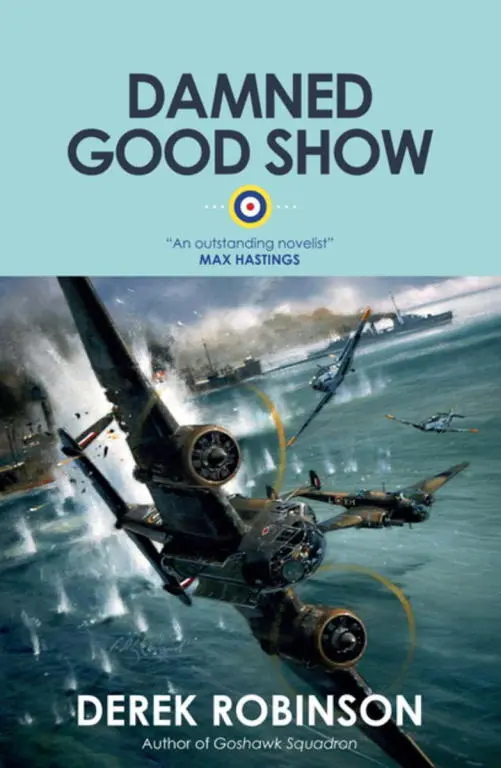
- Название:Damned Good Show
- Автор:
- Издательство:MacLehose Press
- Жанр:
- Год:2013
- Город:New York
- ISBN:978-1-62365-322-4
- Рейтинг книги:3 / 5. Голосов: 1
-
Избранное:Добавить в избранное
- Отзывы:
-
Ваша оценка:
Damned Good Show: краткое содержание, описание и аннотация
Предлагаем к чтению аннотацию, описание, краткое содержание или предисловие (зависит от того, что написал сам автор книги «Damned Good Show»). Если вы не нашли необходимую информацию о книге — напишите в комментариях, мы постараемся отыскать её.
Robinson’s crooked salute to the dogged heroes of the R.A.F.’s early bombing campaign is a wickedly humourous portrait of men doing their duty in flying death traps, fully aware, in those dark days of war, there was nothing else to do but dig in and hang on.
Damned Good Show — читать онлайн бесплатно полную книгу (весь текст) целиком
Ниже представлен текст книги, разбитый по страницам. Система сохранения места последней прочитанной страницы, позволяет с удобством читать онлайн бесплатно книгу «Damned Good Show», без необходимости каждый раз заново искать на чём Вы остановились. Поставьте закладку, и сможете в любой момент перейти на страницу, на которой закончили чтение.
Интервал:
Закладка:
“Only one thing that I can think of, Minister,” Gunnery said, “and that’s knowing that the RAF is bombing the living daylights out of Berlin.”
Timothy Delahaye picked up a phone. “Get me the Air Ministry,” he said. “Air Commodore Russell in Press and Public Relations.”
“The RAF isn’t bombing the daylights out of Berlin, sir,” Frobisher said.
“It will be,” Delahaye said. “By the time you’ve finished with it.”
Tim Delahaye and Charlie Russell were distant cousins and old friends. Each knew what the other’s job involved, and neither felt any need to be especially sympathetic. They met in the Minister’s office, which on that particular morning had a fine view of heavy rain.
“One good thing,” the Air Commodore said. “It helps to lay the dust.”
“Yes. Last night’s raid. We had a few bombs, didn’t we? A few incendiaries?”
“A few hundred. And if you’ve got me here to complain that the RAF can’t shoot down Jerry bombers, I don’t want to hear it. We do our best.”
“I know you do, Charlie. But look here. The Blitz has been going on for seven or eight months, and people are fed up with it. We need a victory.”
“Try the Army and Navy Stores. Try Harrods. Try prayer.”
“Bomber Command is a kind of a victory.”
Russell sniffed.
A man brought in coffee on a tray, and left. Delahaye poured. Russell stroked the coffeepot with his finger. “Solid silver,” he said.
“My father bequeathed it. Damned if I’ll leave it at home to be bombed.”
“I’m lucky to get a chipped china mug, in my office.”
“Don’t take this amiss, Charlie, but you don’t seem frightfully bullish about the Royal Air Force today.”
“Don’t I? Well, I’ll back it to the hilt. What I won’t do is embarrass anyone—from the CO to the erk who sweeps out the hangar—with a lot of overblown propaganda.”
“Has that happened?”
“The Battle of Britain. Not your fault, Tim, but by the time it was over, the public thought every RAF fighter pilot was a Greek god who went up before breakfast, knocked down a brace of Dorniers, did a victory roll and said it was a piece of cake.”
“With a modest smile.”
“The chaps didn’t like it, Tim. Didn’t like being called ‘Glory Boys.’ They knew it was all balls.”
“Yes.”
“So no more glory boys. Flak and fighters are bad enough without coming back to bullshit.”
“Quite agree. That’s why I want my chaps to make an absolutely honest, accurate film about your best Wellington squadron.”
Russell made a sour face. “C-in-C Bomber Command doesn’t like film crews wandering around his bases. They jeopardize security. One bloody cameraman filmed a Guest Night in the Mess. You can imagine how the boys reacted. They debagged the adjutant. I had hell’s own job getting the negative.”
“It won’t be that kind of film.”
Russell shook his head. “Bomber Command can be very sticky. Believe me, they won’t budge.”
“Let me pass on a piece of news,” the Minister said. “The Royal Navy has given permission for a major feature film about the exploits of one of its destroyers.”
“Oh?” Russell became very alert. “Which one?”
“HMS Kelly , commanded by—”
“Mountbatten. The king’s cousin.”
“Noel Coward is directing and starring. The film will be a great hit. The navy will look very good.”
“The bloody Kelly sank. ”
“Amid scenes of the most tremendous pluck. The Admiralty are very excited about it.”
“Trust the navy to blow its own bugle. They hate the RAF, you know. They wouldn’t rest until they got the Fleet Air Arm away from us. And now their damn ships fire at our chaps all the time. Utter bastards.”
“The army is planning a big film too, set in North Africa.” Delahaye brushed biscuit crumbs from his fingers.
“That’s crazy,” Russell said. “The army is losing , for God’s sake.”
“Laurence Olivier is a Commando officer. Rex Harrison is an expert in Intelligence. Margaret Lockwood plays a fearless nurse. Good cast.”
“Good at what? Running backward? Rommel’s twenty miles inside Egypt.”
“Backs-to-the-wall stuff, Charlie. The army’s always been good at that.”
“The army hates us too. After Dunkirk it wasn’t safe for an airman to go into an army pub. The brown jobs reckon we let them down. All balls, of course.”
“I know, I know. But please think about it. Did you see Olivier in Wuthering Heights? Quite brilliant. And I know the navy are very serious about HMS Kelly. Just imagine. Mountbatten. Noel Coward.”
“The fellow’s a pansy.”
“He’ll be a very gallant pansy. All the nice girls love a sailor.”
“Enemies everywhere,” Russell said bitterly. “And I don’t mean Hitler.”
That afternoon, Russell phoned Delahaye and said Air Ministry was fully in favor of a film about Bomber Command. 409 Squadron, based at RAF Coney Garth in Suffolk, had the best record of any Wellington squadron.
“Fine.”
“I can get you David Niven. He was excellent in Dawn Patrol . He’s in the army, but they’ll lend him to us. David Niven’s better than Noel Coward, don’t you think?”
“It’s not that sort of film, Charlie. This is a documentary. Real men, real action. Crown Films will make it. They’re part of my little empire.”
“We’ll need to see the script.”
“Of course you shall. You can have a bit part. Bring your own brush and you can be the erk who sweeps out the hangar.”
“Ha bloody ha,” Russell said. He had set his heart on getting David Niven to play a bomber pilot: skillful, ambitious, charming, unafraid. Another disappointment. War was all disappointment.
Rain made everything worse.
When Rollo was a boy, summer holidays were always in Cornwall. It always rained. That couldn’t be true, but it was how he remembered it. Bad enough being small: no money, no power, no freedom to go anywhere without adult permission, and no money to do anything when you got there. And then it rained. Cornwall turned granite-gray. The sky seemed to sulk, dragging itself heavily and gloomily out of the Atlantic. A day of rain was a slow death in wet sandals.
When he became a cameraman, the first thing Blazer reacted to when he awoke each day was the light. Good light meant a good day’s shoot, if they were shooting outdoors. Rain was the most depressing sound. That nibbling, speckling patter on the windows put him in a bad temper, whether he was filming or not.
Now the rain was the second sound he heard when he awoke.
He had been up all night, driving all over London with Kate, searching for something different to film and finding the same old smoking craters and shattered buildings. To make it worse, rain kept spotting the lens. A wasted night.
He fell into bed at seven. A shrill bell drilled into his brain. He hated waking up. He saw the clock and detested the time: eleven twenty. He loathed the rattle of rain on the window. The bell stopped. Whoever tried to phone him had quit. Thank God. He dragged the covers over his head and Fucking belli the bastard hadn’t quit and it wasn’t the phone, it was the door. He stumbled through the flat and opened it. His wife was there. Ex-wife. Miriam. Weeping. No, not weeping. That was rain dripping down her face. “I was afraid you were out,” she said.
“I was out.” He plucked at his pajamas. “This is my outerwear.”
“I’m sorry.” Maybe she was crying a bit, too.
“Not half as sorry as me.” She had a suitcase. “Oh, shit,” he said.
“I couldn’t think where else to go.”
Читать дальшеИнтервал:
Закладка:
Похожие книги на «Damned Good Show»
Представляем Вашему вниманию похожие книги на «Damned Good Show» списком для выбора. Мы отобрали схожую по названию и смыслу литературу в надежде предоставить читателям больше вариантов отыскать новые, интересные, ещё непрочитанные произведения.






Обсуждение, отзывы о книге «Damned Good Show» и просто собственные мнения читателей. Оставьте ваши комментарии, напишите, что Вы думаете о произведении, его смысле или главных героях. Укажите что конкретно понравилось, а что нет, и почему Вы так считаете.