Derek Robinson - Damned Good Show
Здесь есть возможность читать онлайн «Derek Robinson - Damned Good Show» весь текст электронной книги совершенно бесплатно (целиком полную версию без сокращений). В некоторых случаях можно слушать аудио, скачать через торрент в формате fb2 и присутствует краткое содержание. Город: New York, Год выпуска: 2013, ISBN: 2013, Издательство: MacLehose Press, Жанр: Историческая проза, prose_military, на английском языке. Описание произведения, (предисловие) а так же отзывы посетителей доступны на портале библиотеки ЛибКат.
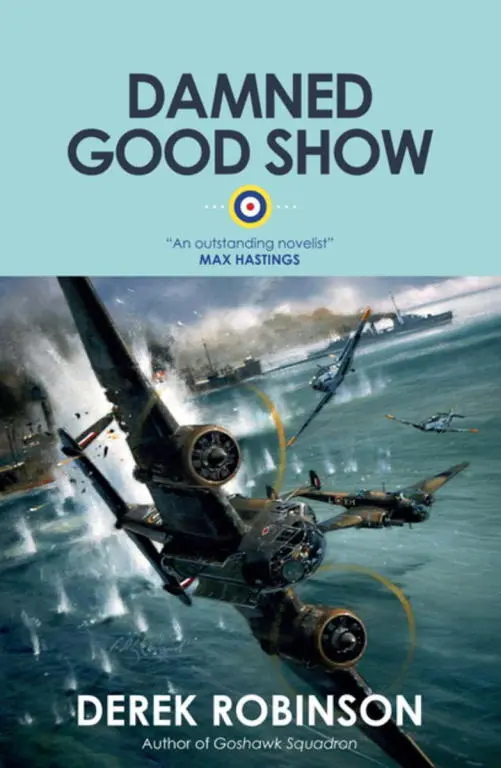
- Название:Damned Good Show
- Автор:
- Издательство:MacLehose Press
- Жанр:
- Год:2013
- Город:New York
- ISBN:978-1-62365-322-4
- Рейтинг книги:3 / 5. Голосов: 1
-
Избранное:Добавить в избранное
- Отзывы:
-
Ваша оценка:
Damned Good Show: краткое содержание, описание и аннотация
Предлагаем к чтению аннотацию, описание, краткое содержание или предисловие (зависит от того, что написал сам автор книги «Damned Good Show»). Если вы не нашли необходимую информацию о книге — напишите в комментариях, мы постараемся отыскать её.
Robinson’s crooked salute to the dogged heroes of the R.A.F.’s early bombing campaign is a wickedly humourous portrait of men doing their duty in flying death traps, fully aware, in those dark days of war, there was nothing else to do but dig in and hang on.
Damned Good Show — читать онлайн бесплатно полную книгу (весь текст) целиком
Ниже представлен текст книги, разбитый по страницам. Система сохранения места последней прочитанной страницы, позволяет с удобством читать онлайн бесплатно книгу «Damned Good Show», без необходимости каждый раз заново искать на чём Вы остановились. Поставьте закладку, и сможете в любой момент перейти на страницу, на которой закончили чтение.
Интервал:
Закладка:
“Did you get that?” he asked
“I got the oil fire,” she said. “Sounded like an express going through a station.”
Smoke was coming down like a rich black fog. Soon it blotted out the fire-float.
Rollo and Kate were not callous, nor greedy for sensation; too much sensation came their way, unsought. The Blitz was a thing of terror, shot through with agony and heartbreak and the obscenity of casual maiming and killing. They saw this. They saw things that sickened them so much that they couldn’t film any of it. On the other hand, it was all happening and therefore, nausea permitting, it deserved to be filmed. They were ready every night. As soon as the first rusty groan of the first air-raid siren began to climb toward its roller-coastering wail, they felt what everyone felt: a gut-tightening dread. Here comes death. But they also felt a keen professional interest. Rollo was right: death made great movies.
They filmed fires and explosions, and the people who fought them and survived them. They got stories from a policeman wearing a cape that had been stiffened by a shower of molten lead; from a woman saved after two days under the rubble of her home; from ambulance drivers who drove on tires shredded by broken glass; from rescue workers, and wardens, and sappers who dug out and defused unexploded bombs. The Blitz went on and on. Many people who took shelter saw no point in coming to the surface: they lived in caves and cellars and disused tunnels. Rollo and Kate filmed them too. Perhaps such people were right, for toward the end of spring the raids grew heavier. After the night of March 19, 1941, Germany Calling said that more than four hundred bombers raided London. Nobody argued. On April 16 it was over six hundred; three nights later, over seven hundred. One bomber, a Heinkel 111, made a mess of some deer in Richmond Park, but not before it had killed its own crew. Rollo and Kate were lucky that night; doubly lucky. They filmed it, and it missed them.
Kate saw it first. “Look up there,” she said. The Heinkel was lazily spiraling down a searchlight beam as though each was hypnotized by the other. Rollo filmed, and tried not to breathe. He knew this was one of the classic shots of war. A wing spun away, and the bomber exploded. Pieces fled into the night. Each piece trailed flame. A man said, “Jesus Christ Almighty.”
The searchlight was nearby; and when, after a few seconds, the beam vanished, the night seemed huge and the burning bits looked tiny. Soon they too disappeared. Rollo lowered the camera. “Did you get that voice?”
“Yes.”
“Sounded as if he’d seen a miracle.”
“Yes.”
“You can’t script stuff like that. You can script the words but not the voice. It makes that shot universal. You could watch it in China or Brazil and still get the same kick.”
The raid was fading away, the guns giving up as the bombers turned south and droned toward home. The clouds above parts of London were as red as dawn, but dawn was still two hours away.
They stowed their equipment in the car. Rollo started the engine.
“If that fellow saying ‘Jesus Christ Almighty’ isn’t on the soundtrack I’m going to kill you,” he said.
“You kill me, I’ll tell the union and they’ll get your name taken off the credits.”
“Credits?” he said. “Credits. I never thought about credits.” Filmed by Rollo Blazer. The idea kept him quiet for several minutes.
London was huge; it could afford to lose several hundred acres. It could even afford to lose its great buildings. The House of Commons was wrecked: seven bombs had blown it apart. Westminster Abbey was hit. So was Buckingham Palace, and the Tower of London, and the British Museum, and every railway terminus, and five hospitals, and all the churches in the City, and more. It was a long and gloomy list.
Everywhere Londoners looked they saw the ruins of landmarks in their everyday lives. What the Luftwaffe had done yesterday it could repeat tomorrow, and the next night, and go on repeating until the long-threatened invasion came. In the shattered shopfronts, handwritten signs said Business as usual-London can take it. The tired faces of the customers told a different story. To make matters worse, there were precious few luxuries in the shops. Rationing hurt.
For about a year now, in all of Europe, only Britain had stood against Germany and Italy. Defiance was a noble attitude, but it was lonely and painful and tiring, and many people wondered how it was going to win the war.
The Heinkel corkscrewed lazily down the searchlight beam, as if the light were winding it in. Abruptly it flung its little wings away and then it exploded. Bits of airplane fluttered, trailing flames. Noise of the explosion arrived, like a door slamming. The searchlight went out. The flames made bright scratches in the night.
The tail of the film flapped through the projector, the screen went blank white, the overhead lights came on.
“What did that man say?” Gunnery asked. “Right at the end?”
“He said ‘Jesus Christ Almighty,’” Harry Frobisher said.
Delahaye yawned; it was stuffy in the viewing room. “Might run into trouble with the Church over that,” he said.
“People swear in the Blitz,” Gunnery said.
“Of course they do,” Delahaye said. “They say worse things than ‘Jesus Christ Almighty.’ But we’re not going to repeat them in the cinema, are we?”
Timothy Delahaye was Minister of Information. The Crown Film Unit was one of his responsibilities. Normally he was happy to leave the running of Crown to its head, Blake Gunnery, who knew all about film. Gunnery’s mother, widowed in the First War, had married an American film producer and raised Blake in California. At twenty-five he came back to England, made a string of successful B-movies, and then rashly invested all his money in an avant-garde production, a dark political thriller full of revolutionary camera-angles, exactly what Thirties audiences didn’t want to see. Gunnery went bust. He still had one asset: the baronetcy which he had inherited from his father. When the top job at Crown Films became vacant, Timothy Delahaye was among those who interviewed him. The baronetcy clinched it. Gunnery never used the title, but he could obviously be depended upon to serve the State.
“Leaving blasphemy aside,” Delahaye said to Gunnery, “this Blitz stuff is quite brilliant. How much is there?”
“Forty-seven reels.”
“Golly. The man deserves a medal. Some of his shots made me want to run for my life.”
“Those poor devils couldn’t run,” Gunnery said. “Firemen and so on. Had to stand and fight. Stand and die, some of them.”
“Well, there it is.” Delahaye made an it’s-all-over-now gesture. “We can’t use any of it. Not a foot.”
“I’ll have it locked in the vault. Double-locked.”
“Very wise. How will your man Blazer react?”
“He’ll throw a fit, Minister,” Frobisher said. “Come at me with the paperknife, I expect. He believes he’s shot an epic. London, bloody but unbowed. That sort of thing.”
“So he has,” Delahaye said. “It’ll be a masterpiece one day. When we’ve won the war, and we can look back with pride at this ordeal by fire, that will be the time to let our people see Blazer’s film. Not now.”
“Sir, the Blitz is a victory of a sort,” Frobisher argued.
“No, it’s not, Harry,” Gunnery said. “It’s a kick in the teeth.”
“Yes.” Frobisher remembered images from Blazer’s footage. “Yes, I suppose you’re right.”
“So where do we stand?” the Minister said briskly. “The nation’s morale has taken a pounding. First Dunkirk, then the Blitz. We need a damn good morale-booster. Something to make people feel good about the war. Good about democracy. What would cheer up the average man in the typical air raid shelter?”
Читать дальшеИнтервал:
Закладка:
Похожие книги на «Damned Good Show»
Представляем Вашему вниманию похожие книги на «Damned Good Show» списком для выбора. Мы отобрали схожую по названию и смыслу литературу в надежде предоставить читателям больше вариантов отыскать новые, интересные, ещё непрочитанные произведения.






Обсуждение, отзывы о книге «Damned Good Show» и просто собственные мнения читателей. Оставьте ваши комментарии, напишите, что Вы думаете о произведении, его смысле или главных героях. Укажите что конкретно понравилось, а что нет, и почему Вы так считаете.