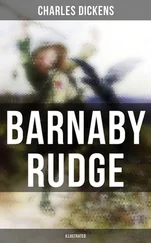
Charles Dickens - Barnaby Rudge
Здесь есть возможность читать онлайн «Charles Dickens - Barnaby Rudge» весь текст электронной книги совершенно бесплатно (целиком полную версию без сокращений). В некоторых случаях можно слушать аудио, скачать через торрент в формате fb2 и присутствует краткое содержание. Год выпуска: 2014, Издательство: epubBooks Classics, Жанр: Историческая проза, на английском языке. Описание произведения, (предисловие) а так же отзывы посетителей доступны на портале библиотеки ЛибКат.
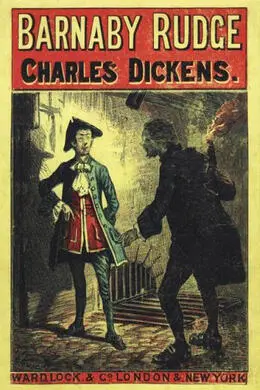
- Название:Barnaby Rudge
- Автор:
- Издательство:epubBooks Classics
- Жанр:
- Год:2014
- ISBN:нет данных
- Рейтинг книги:4 / 5. Голосов: 1
-
Избранное:Добавить в избранное
- Отзывы:
-
Ваша оценка:
Barnaby Rudge: краткое содержание, описание и аннотация
Предлагаем к чтению аннотацию, описание, краткое содержание или предисловие (зависит от того, что написал сам автор книги «Barnaby Rudge»). Если вы не нашли необходимую информацию о книге — напишите в комментариях, мы постараемся отыскать её.
Barnaby Rudge — читать онлайн бесплатно полную книгу (весь текст) целиком
Ниже представлен текст книги, разбитый по страницам. Система сохранения места последней прочитанной страницы, позволяет с удобством читать онлайн бесплатно книгу «Barnaby Rudge», без необходимости каждый раз заново искать на чём Вы остановились. Поставьте закладку, и сможете в любой момент перейти на страницу, на которой закончили чтение.
Интервал:
Закладка:
'Have you no guide?' asked the widow, after a moment's pause.
'None but that,' he answered, pointing with his staff towards the sun; 'and sometimes a milder one at night, but she is idle now.'
'Have you travelled far?'
'A weary way and long,' rejoined the traveller as he shook his head. 'A weary, weary, way. I struck my stick just now upon the bucket of your well—be pleased to let me have a draught of water, lady.'
'Why do you call me lady?' she returned. 'I am as poor as you.'
'Your speech is soft and gentle, and I judge by that,' replied the man. 'The coarsest stuffs and finest silks, are—apart from the sense of touch—alike to me. I cannot judge you by your dress.'
'Come round this way,' said Barnaby, who had passed out at the garden–gate and now stood close beside him. 'Put your hand in mine. You're blind and always in the dark, eh? Are you frightened in the dark? Do you see great crowds of faces, now? Do they grin and chatter?'
'Alas!' returned the other, 'I see nothing. Waking or sleeping, nothing.'
Barnaby looked curiously at his eyes, and touching them with his fingers, as an inquisitive child might, led him towards the house.
'You have come a long distance, 'said the widow, meeting him at the door. 'How have you found your way so far?'
'Use and necessity are good teachers, as I have heard—the best of any,' said the blind man, sitting down upon the chair to which Barnaby had led him, and putting his hat and stick upon the red–tiled floor. 'May neither you nor your son ever learn under them. They are rough masters.'
'You have wandered from the road, too,' said the widow, in a tone of pity.
'Maybe, maybe,' returned the blind man with a sigh, and yet with something of a smile upon his face, 'that's likely. Handposts and milestones are dumb, indeed, to me. Thank you the more for this rest, and this refreshing drink!'
As he spoke, he raised the mug of water to his mouth. It was clear, and cold, and sparkling, but not to his taste nevertheless, or his thirst was not very great, for he only wetted his lips and put it down again.
He wore, hanging with a long strap round his neck, a kind of scrip or wallet, in which to carry food. The widow set some bread and cheese before him, but he thanked her, and said that through the kindness of the charitable he had broken his fast once since morning, and was not hungry. When he had made her this reply, he opened his wallet, and took out a few pence, which was all it appeared to contain.
'Might I make bold to ask,' he said, turning towards where Barnaby stood looking on, 'that one who has the gift of sight, would lay this out for me in bread to keep me on my way? Heaven's blessing on the young feet that will bestir themselves in aid of one so helpless as a sightless man!'
Barnaby looked at his mother, who nodded assent; in another moment he was gone upon his charitable errand. The blind man sat listening with an attentive face, until long after the sound of his retreating footsteps was inaudible to the widow, and then said, suddenly, and in a very altered tone:
'There are various degrees and kinds of blindness, widow. There is the connubial blindness, ma'am, which perhaps you may have observed in the course of your own experience, and which is a kind of wilful and self–bandaging blindness. There is the blindness of party, ma'am, and public men, which is the blindness of a mad bull in the midst of a regiment of soldiers clothed in red. There is the blind confidence of youth, which is the blindness of young kittens, whose eyes have not yet opened on the world; and there is that physical blindness, ma'am, of which I am, contrairy to my own desire, a most illustrious example. Added to these, ma'am, is that blindness of the intellect, of which we have a specimen in your interesting son, and which, having sometimes glimmerings and dawnings of the light, is scarcely to be trusted as a total darkness. Therefore, ma'am, I have taken the liberty to get him out of the way for a short time, while you and I confer together, and this precaution arising out of the delicacy of my sentiments towards yourself, you will excuse me, ma'am, I know.'
Having delivered himself of this speech with many flourishes of manner, he drew from beneath his coat a flat stone bottle, and holding the cork between his teeth, qualified his mug of water with a plentiful infusion of the liquor it contained. He politely drained the bumper to her health, and the ladies, and setting it down empty, smacked his lips with infinite relish.
'I am a citizen of the world, ma'am,' said the blind man, corking his bottle, 'and if I seem to conduct myself with freedom, it is therefore. You wonder who I am, ma'am, and what has brought me here. Such experience of human nature as I have, leads me to that conclusion, without the aid of eyes by which to read the movements of your soul as depicted in your feminine features. I will satisfy your curiosity immediately, ma'am; immediately.' With that he slapped his bottle on its broad back, and having put it under his garment as before, crossed his legs and folded his hands, and settled himself in his chair, previous to proceeding any further.
The change in his manner was so unexpected, the craft and wickedness of his deportment were so much aggravated by his condition—for we are accustomed to see in those who have lost a human sense, something in its place almost divine—and this alteration bred so many fears in her whom he addressed, that she could not pronounce one word. After waiting, as it seemed, for some remark or answer, and waiting in vain, the visitor resumed:
'Madam, my name is Stagg. A friend of mine who has desired the honour of meeting with you any time these five years past, has commissioned me to call upon you. I should be glad to whisper that gentleman's name in your ear.—Zounds, ma'am, are you deaf? Do you hear me say that I should be glad to whisper my friend's name in your ear?'
'You need not repeat it,' said the widow, with a stifled groan; 'I see too well from whom you come.'
'But as a man of honour, ma'am,' said the blind man, striking himself on the breast, 'whose credentials must not be disputed, I take leave to say that I WILL mention that gentleman's name. Ay, ay,' he added, seeming to catch with his quick ear the very motion of her hand, 'but not aloud. With your leave, ma'am, I desire the favour of a whisper.'
She moved towards him, and stooped down. He muttered a word in her ear; and, wringing her hands, she paced up and down the room like one distracted. The blind man, with perfect composure, produced his bottle again, mixed another glassful; put it up as before; and, drinking from time to time, followed her with his face in silence.
'You are slow in conversation, widow,' he said after a time, pausing in his draught. 'We shall have to talk before your son.'
'What would you have me do?' she answered. 'What do you want?'
'We are poor, widow, we are poor,' he retorted, stretching out his right hand, and rubbing his thumb upon its palm.
'Poor!' she cried. 'And what am I?'
'Comparisons are odious,' said the blind man. 'I don't know, I don't care. I say that we are poor. My friend's circumstances are indifferent, and so are mine. We must have our rights, widow, or we must be bought off. But you know that, as well as I, so where is the use of talking?'
She still walked wildly to and fro. At length, stopping abruptly before him, she said:
'Is he near here?'
'He is. Close at hand.'
'Then I am lost!'
'Not lost, widow,' said the blind man, calmly; 'only found. Shall I call him?'
'Not for the world,' she answered, with a shudder.
'Very good,' he replied, crossing his legs again, for he had made as though he would rise and walk to the door. 'As you please, widow. His presence is not necessary that I know of. But both he and I must live; to live, we must eat and drink; to eat and drink, we must have money:—I say no more.'
Читать дальшеИнтервал:
Закладка:
Похожие книги на «Barnaby Rudge»
Представляем Вашему вниманию похожие книги на «Barnaby Rudge» списком для выбора. Мы отобрали схожую по названию и смыслу литературу в надежде предоставить читателям больше вариантов отыскать новые, интересные, ещё непрочитанные произведения.



Обсуждение, отзывы о книге «Barnaby Rudge» и просто собственные мнения читателей. Оставьте ваши комментарии, напишите, что Вы думаете о произведении, его смысле или главных героях. Укажите что конкретно понравилось, а что нет, и почему Вы так считаете.