Джеймс Кейн - Mignon
Здесь есть возможность читать онлайн «Джеймс Кейн - Mignon» весь текст электронной книги совершенно бесплатно (целиком полную версию без сокращений). В некоторых случаях можно слушать аудио, скачать через торрент в формате fb2 и присутствует краткое содержание. Город: New York, Год выпуска: 1962, Издательство: Dial Press, Жанр: Историческая проза, на английском языке. Описание произведения, (предисловие) а так же отзывы посетителей доступны на портале библиотеки ЛибКат.
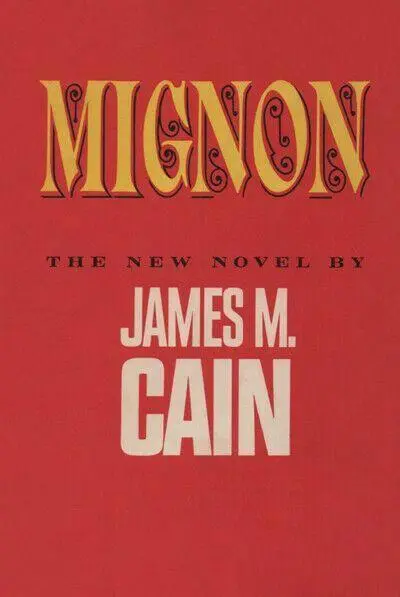
- Название:Mignon
- Автор:
- Издательство:Dial Press
- Жанр:
- Год:1962
- Город:New York
- ISBN:нет данных
- Рейтинг книги:3 / 5. Голосов: 1
-
Избранное:Добавить в избранное
- Отзывы:
-
Ваша оценка:
Mignon: краткое содержание, описание и аннотация
Предлагаем к чтению аннотацию, описание, краткое содержание или предисловие (зависит от того, что написал сам автор книги «Mignon»). Если вы не нашли необходимую информацию о книге — напишите в комментариях, мы постараемся отыскать её.
Mignon is a beautiful young widow who, with her father, has come to New Orleans at the close of the Civil War in the hopes of improving their war-reduced fortunes. But the risky trade in contraband cotton has landed her father in jail and Mignon at the hotel room door of Bill Cresap. Cresap, recently discharged from the Union Army for wounds received in battle, has arrived in New Orleans to start a business with a friend. Reluctantly, but irrevocably, Cresap is drawn into the intrigues and dangers which engulf the irresistible Mignon.
Also moving among the dark events of those tough, troubled times is a fascinating variety of richly drawn characters. There is Adolphe Landry, Mignon’s enigmatic father; Frank Burke, Landry’s unscrupulous partner; Gippo, Burke’s henchman, more animal than human; and Marie Tremaine, the beautiful, rich, and powerful chatelaine of a notorious New Orleans gambling house.
From gaudy New Orleans, the scene shifts up-river to the bloody Red River battle. There, the personal and military dramas are joined. Cresap, in the turbulent actions which follow, finds himself not only involved in the intrigues of desperate men, but the passions of two beautiful women. In an explosion of violence and tragedy, the novel reaches its inevitable climax.
Of MIGNON, Mr. Cain says: It is a continuation, in theme, of a previous book, Past All Dishonor, in which the hero is tempted, by his love for a girl, so slight his duty — not much, just a little bit. In MIGNON, Mr. Cain depicts the bafflement of large numbers of men, even in high places, who must wrestle the rules of war and slight them — not much, but a little bit. “Treason,” says Mr. Cain, “doesn’t invite my interest, at least as a narrative theme, being so stark it defies exploration. But its close relative, cheating just little bit, fascinates me. Sometimes, as in Mignon, it even manages to seem quite praiseworthy, which is where the trouble really starts.”
Mignon — читать онлайн бесплатно полную книгу (весь текст) целиком
Ниже представлен текст книги, разбитый по страницам. Система сохранения места последней прочитанной страницы, позволяет с удобством читать онлайн бесплатно книгу «Mignon», без необходимости каждый раз заново искать на чём Вы остановились. Поставьте закладку, и сможете в любой момент перейти на страницу, на которой закончили чтение.
Интервал:
Закладка:
“And if you tell me no lies.”
“But — what lies have I been telling?”
“That you’re taking this trip to make money.”
“Well, what other reason could I have?”
“That girl. She left for Red River last week.”
“But listen: I need twenty-five thousand dollars.”
“I know you do, Bill — I know all about it.”
“Then where does the lie come in?”
“Bill, ever hear of a man named Dumont?”
“... The banker? I know him, yes.”
“He was in, asking about you — said Miss Tremaine, the lady you brought to the ball, was fixing to marry you, then sell her business out and back you in another with the money you needed. He was for it, if you were an honest man — but if you already have the twenty-five thousand promised it proves you’re lying, doesn’t it?”
“What did you say about me?”
“Nice stuff — he went away quite happy.”
“Could be I’d rather make that tin myself.”
“And could be you’d rather have Mrs. Fournet.”
But I clung to my story, and when he interrupted to know how I could make any tin, knowing nothing about cotton at all, I said: “What’s to know, Dan? I go on your boat as a trader, I pile off at Alexandria along with the other traders, I buy stock off a Reb, which I still have money to do, I write up my receipt, listing bales by mark, number, and weight, I present it to the Q.M. officer making the seizure for him to sign. The rest is up to the lawyers. Is any of that beyond my comprehension?”
“Bill, I’ve told you that cotton is hooded.”
“Hoodooed? This is not Hallowe’en.”
“I’m not talking about Hallowe’en, or anything superstitious. All right, call it attaindered. But I’m telling you, it’ll ruin whoever touches it, including you, including Burke, including Landry, including Mrs. Fournet — who’s a damned pretty girl mixed up in a damned ugly business. Bill, we’re trying — the Union is trying, this Army is trying — to buy a piece of this war to pay for our invasion by taking traders along, by letting them put out tin for the cotton the Rebs have in storage. I’m telling you, it can’t be done! There’s one piece of land that’s never yet been up for sale, and that’s the half-acre you need to plant a flagpole on. That you have to take! It’s a people’s maidenhead — it won’t give in by itself, and its price is blood. It’s what we’re forgetting, but we’ll pay the price, that price, or I’m badly mistaken. Oh, our motives are good — why the hell wouldn’t they be, what motive’s not better than war? The idea, Washington thinks, is to kill three birds with one stone: Block the Reb government from shipping the cotton abroad and buying guns with it, give some individual Rebs a lick at the sugar pot and win them back to their allegiance, get the Northern mills some stock to make shirts with for our soldiers. All right, but the only time I ever let go at three birds on a limb, I broke the dining-room window, cut my grandfather’s head, and landed a rock in my mother’s soup. But this will be worse: it’s treason. Why? It takes two to make a sale, and in a war that means dealing with the enemy. The Reb army, if they let that cotton lay, if they fail to burn it when they evacuate Alexandria, have already heard the word as it’s been passed up the line. And we, if we pass the wink to the owners, those Rebs licking up sugar as we make the confiscation — we’re dealing with the enemy too. But, you say, not much — just a little bit. But I say, remember that maidenhead: there’s no such thing as one that’s been slightly took. And there’s going to be trouble, I promise you... Do you understand now why I say that cotton is hooded? Do I have to say more?”
“I thought you were my friend, Dan.”
“I’m talking as your friend.”
“You don’t sound much like it.”
“I’ll prove it. My orders are to pass you.”
“Pass me? You mean to go on that boat?”
“Yes, that’s what I mean.”
“Well, why don’t you?”
“Bill, do you know what impressed Mr. Dumont? Not your Annapolis life — which I didn’t know too much about, if I have to tell you the truth. But what you did right here, that brought him out of his chair.”
“For Landry, are you talking about?”
“That’s right — and it impressed us, too.”
“Who is us? ”
“This whole headquarters. They hated it, of course, but they respected you for it. And they feared you, as the one man who could and unfortunately might, blow this whole ship out of water. So the word came to me, pass this man in if he wants.”
“Well? If I’m supposed to be rewarded—”
“I didn’t say rewarded .”
“Well what’s the point of it, then?”
“As a way of shutting you up.”
I saw at last what he was driving at, and some time went by without either of us speaking. Then he said: “Bill, I’ve hacked at you, and — fact of the matter — you made me sore. Just the same, I knew an honest man was in town. Now, though, if you make a grab for that cotton, I have to let you on the boat — but I won’t feel the same. Bill, don ’ t make me change! ”
After a long time I said: “I want on.”
“So be it.”
I took Marie everywhere — to dinner, to church the following Sunday, to drive in the park with the smell of spring in the air. I helped address the wedding announcements, as soon as they came from the engraver. When my pass for the boat came to the hotel one day, I told myself it meant nothing, that I had no intention of using it, that I’d just been blowing off steam. But the following Monday night we went to see Richard III at the St. Charles Theatre. The actor was John Wilkes Booth. He’s from Maryland too, and maybe he’s kind to dogs, and drops coins in the blind man’s cup. But in that play he has death in his eyes, and watching him I knew I meant to go, and knew what I meant to do. I had death in my heart — that was the real answer. Whose death I didn’t yet know, but the following day, March 22, 1864, for the second time I ran out on a woman who loved me.
Chapter 15
Alexandria was just like the pictures except for the rain drizzling down, the invasion fleet of steamers tied up at the bank, and the hoodoo on top of the courthouse — which I hadn’t believed in before, but now was beginning to, on account of something that happened on the boat coming up. We’d left from the foot of Canal Street, twelve noon two days before, on a sidewheeler called the Black Hawk . We carried on the boiler deck General, staff, headquarters noncoms, and headquarters orderlies; on the main deck horses, Louisiana volunteers, newspapermen, and traders; wherever they could fit waiters, hostlers, and hangers-on. It was kind of a tight squeeze, but I made out all right since I’d brought what the trip called for. After kissing Marie good night with the Judas taste on my mouth, I’d spent the small hours packing, and divided my stuff in two bags. One I checked with the hotel, the other I filled with field stuff, including sandwiches I had the hotel put up and my gun. I wore my corduroys, and with the blankets I’d bought for the sea voyage plus a canteen at my belt I figured to do all right, and did.
I bunked in, or wedged in, with the traders, aft of the shaft, in the passage leading back to the fantail. They were a strange bunch, half of them sharpshooter businessmen, the rest politicians, all full of windy guff, like the pair holding Lincoln passes, those two slips of paper that muxed everything up, causing headquarters, as it did, to accept them as a tip-off of what Washington really wanted — unlimited trade in cotton as a matter of public policy. Some had brought bagging, rope, and gear on board the boat, and piled it up so there was hardly room to step; they were so hungry for cotton they expected to bale the loose stuff on plantations after the regular stock in storage had all been bought up. But nobody made complaint, and we all shook down very friendly, standing around in the afternoon, pitching banana skins in the wake, watching the swamps go by, or crossing to the other side of the engine room to visit the newspapermen. But as dark was settling down and the crew was lighting lamps, Dan showed up to ask me how things were going. By then, bottles were being passed and jokes were being cracked, so he took a look and beckoned me forward. We ducked under the shaft and went up into the bow, where the horses were, and the hostlers had rigged a tarp to shield them from the breeze. We stood by the rail, and after Dan had done his manners with me, he stared at the shore, very gloomy. When I asked what the trouble was, he answered: “Nothing, Bill — and everything. This damned invasion, mainly.”
Читать дальшеИнтервал:
Закладка:
Похожие книги на «Mignon»
Представляем Вашему вниманию похожие книги на «Mignon» списком для выбора. Мы отобрали схожую по названию и смыслу литературу в надежде предоставить читателям больше вариантов отыскать новые, интересные, ещё непрочитанные произведения.






![Джеймс Кейн - Root of His Evil [= Shameless]](/books/399871/dzhejms-kejn-root-of-his-evil-shameless-thumb.webp)
![Джеймс Кейн - Почтальон всегда звонит дважды [сборник litres]](/books/412339/dzhejms-kejn-pochtalon-vsegda-zvonit-dvazhdy-sborni-thumb.webp)
Обсуждение, отзывы о книге «Mignon» и просто собственные мнения читателей. Оставьте ваши комментарии, напишите, что Вы думаете о произведении, его смысле или главных героях. Укажите что конкретно понравилось, а что нет, и почему Вы так считаете.