Ken Follett - World Without End
Здесь есть возможность читать онлайн «Ken Follett - World Without End» весь текст электронной книги совершенно бесплатно (целиком полную версию без сокращений). В некоторых случаях можно слушать аудио, скачать через торрент в формате fb2 и присутствует краткое содержание. Жанр: Историческая проза, на английском языке. Описание произведения, (предисловие) а так же отзывы посетителей доступны на портале библиотеки ЛибКат.
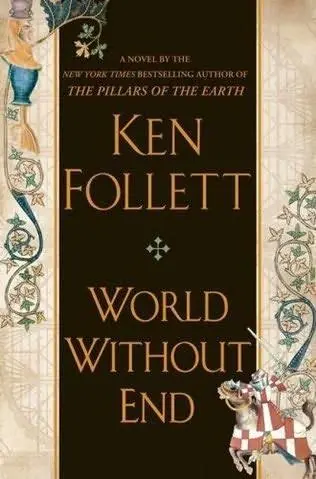
- Название:World Without End
- Автор:
- Жанр:
- Год:неизвестен
- ISBN:нет данных
- Рейтинг книги:5 / 5. Голосов: 1
-
Избранное:Добавить в избранное
- Отзывы:
-
Ваша оценка:
World Without End: краткое содержание, описание и аннотация
Предлагаем к чтению аннотацию, описание, краткое содержание или предисловие (зависит от того, что написал сам автор книги «World Without End»). Если вы не нашли необходимую информацию о книге — напишите в комментариях, мы постараемся отыскать её.
Ken Follett has 90 million readers worldwide. The Pillars of the Earth is his bestselling book of all time. Now, eighteen years after the publication of The Pillars of the Earth, Ken Follett has written the most-anticipated sequel of the year, World Without End.
In 1989 Ken Follett astonished the literary world with The Pillars of the Earth, a sweeping epic novel set in twelfth-century England centered on the building of a cathedral and many of the hundreds of lives it affected. Critics were overwhelmed-"it will hold you, fascinate you, surround you" (Chicago Tribune)-and readers everywhere hoped for a sequel.
World Without End takes place in the same town of Kingsbridge, two centuries after the townspeople finished building the exquisite Gothic cathedral that was at the heart of The Pillars of the Earth. The cathedral and the priory are again at the center of a web of love and hate, greed and pride, ambition and revenge, but this sequel stands on its own. This time the men and women of an extraordinary cast of characters find themselves at a crossroad of new ideas-about medicine, commerce, architecture, and justice. In a world where proponents of the old ways fiercely battle those with progressive minds, the intrigue and tension quickly reach a boiling point against the devastating backdrop of the greatest natural disaster ever to strike the human race-the Black Death.
Three years in the writing, and nearly eighteen years since its predecessor, World Without End breathes new life into the epic historical novel and once again shows that Ken Follett is a masterful author writing at the top of his craft.
World Without End — читать онлайн бесплатно полную книгу (весь текст) целиком
Ниже представлен текст книги, разбитый по страницам. Система сохранения места последней прочитанной страницы, позволяет с удобством читать онлайн бесплатно книгу «World Without End», без необходимости каждый раз заново искать на чём Вы остановились. Поставьте закладку, и сможете в любой момент перейти на страницу, на которой закончили чтение.
Интервал:
Закладка:
Wulfric reaped his barley in the driving rain, scything the wet stalks while Gwenda followed behind binding the sheaves. On the first sunny day of September they started to harvest the wheat, the most valuable crop, in the hope that the fine weather would last long enough to dry it.
At some point Gwenda realized that Wulfric was powered by fury. The sudden loss of his entire family had enraged him. He would have blamed someone for his bereavement, if he could; but the collapse of the bridge seemed a random event, an act of evil spirits or a punishment by God; so he had no outlet for his passion except work. She herself was driven by love, which was just as potent.
They were in the fields before the crack of dawn, and they did not stop until it was too dark to see. Gwenda went to sleep with an aching back every night and woke when she heard Wulfric bang the kitchen door before dawn. Still they lagged behind everyone else.
Gradually, she sensed a change in the attitude of the village towards her and Wulfric. All her life, she had been looked down upon as the daughter of the disreputable Joby; and the women had disapproved of her even more when they realized she wanted to snatch Wulfric away from Annet. Wulfric was hard to dislike, but some felt that his desire to inherit such a big landholding was greedy and impractical. However, people could hardly fail to be impressed by their efforts to get the harvest in. A boy and a girl were trying to do the work of three men, and they were getting on better than anyone had expected. Men began to look at Wulfric with admiration, and women at Gwenda with sympathy.
In the end the villagers rallied around to help them. The priest, Father Gaspard, turned a blind eye to their working on Sundays. When Annet’s family had got their harvest in, her father, Perkin, and her brother, Rob, joined Gwenda on Wulfric’s land. Even Gwenda’s mother, Ethna, showed up. As they carted the last of the sheaves to Wulfric’s barn, there was a hint of the traditional harvest spirit, with everyone singing the old songs as they walked home behind the cart.
Annet was there, in violation of the saying that you should first follow the plough if you want to dance the harvest jig. She walked by Wulfric’s side, as was her right, being his acknowledged fiancee. Gwenda watched her from behind, noting sourly how she swayed her hips, tossed her head and laughed prettily at everything he said. How could he be so stupid as to fall for that? Had he not noticed that Annet had done no work on his land?
No day had yet been fixed for the wedding. Perkin was nothing if not shrewd, and he would not let his daughter commit herself until the question of the inheritance was settled.
Wulfric had proved his ability to farm the land. No one would question that now. His age had come to seem irrelevant. The only remaining obstacle was the heriot. Would he be able to raise the money to pay the inheritance tax? It would depend how much he got for his cash crops. The harvest was poor but, if the bad weather had been widespread, the price of wheat would probably be high. In normal circumstances, a prosperous peasant family would have money saved up for the heriot; but Wulfric’s family’s savings were at the bottom of the river in Kingsbridge. So nothing was settled. And Gwenda could continue to dream that Wulfric would inherit the land and, somehow, transfer his affections to her. Anything was possible.
As they were unloading the cart into the barn, Nathan Reeve arrived. The hunchbacked bailiff was in a state of high excitement. “Come to the church, quickly,” he said. “Everybody! Stop what you’re doing.”
Wulfric said: “I’m not leaving my crops out in the open – it might rain.”
Gwenda said: “We’ll just drag the cart inside. What’s the emergency, Nate?”
The bailiff was already hurrying to the next house. “The new lord is arriving!” he said.
“Wait!” Wulfric ran after him. “Will you recommend that I inherit?”
Everyone stood still, watching, waiting for the answer.
Nathan turned reluctantly and faced Wulfric. He had to look up, for Wulfric was taller by a foot. “I don’t know,” he said slowly.
“I’ve proved I can farm the land – you can see that. Just look in the barn!”
“You’ve done well, no question. But can you pay the heriot?”
“It depends on the price of wheat.”
Annet spoke. “Father?” she said.
Gwenda wondered what was coming.
Perkin looked hesitant.
Annet prompted him again. “You remember what you promised me.”
“Yes, I remember,” Perkin said at last.
“Tell Nate, then.”
Perkin turned to the bailiff. “I’ll guarantee the heriot, if the lord will let Wulfric inherit.”
Gwenda’s hand flew to her mouth.
Nathan said: “You’ll pay it for him? It’s two pounds and ten shillings.”
“If he’s short, I’ll lend him what he needs. Of course, they’ll have to be married first.”
Nathan lowered his voice. “And, in addition…?”
Perkin said something so quietly that Gwenda could not hear it, but she could guess what it was. Perkin was offering Nathan a bribe, probably a tenth of the tax, which would be five shillings.
“Very well,” Nathan said. “I’ll make the recommendation. Now get yourselves to the church, quickly!” He ran off.
Wulfric smiled broadly and kissed Annet. Everyone shook his hand.
Gwenda was heartsick. Her hopes were dashed. Annet had been too clever. She had persuaded her father to lend Wulfric the money he needed. He would inherit his land – and he would marry Annet.
Gwenda forced herself to help push the cart into the barn. Then she followed the happy couple as they walked through the village to the church. It was all over. A new lord, not knowing the village or the people, was unlikely to go against his bailiff’s advice on a question such as this. The fact that Nathan had gone to the trouble of negotiating a bribe indicated his confidence.
It was partly her fault, of course. She had broken her back to make sure Wulfric got his harvest in, in the vain hope that somehow he would realize how much better a wife she would make than Annet. All summer long she had been digging her own grave, she thought as she walked through the cemetery to the church door. But she would do the same again. She could not have borne to see him struggle alone. Whatever happens, she thought, he’ll always know I was the one who stuck it out with him. It was small consolation.
Most of the villagers were already in the church. They had not needed much urging from Nathan. They were eager to be among the first to pay their respects to their new lord, and curious to see what he was like: young or old, ugly or handsome, cheerful or dyspeptic, clever or stupid, and – most important of all – cruel or kind. Everything about him would affect their lives for as long as he remained lord, which might be years or decades. If he were reasonable, he could do a lot to make Wigleigh a happy and prosperous village. If he were a fool, they would have unwise decisions and unjust rulings, oppressive taxes and harsh punishments. And one of his first decisions would be whether to let Wulfric inherit.
The rumble of conversation died away, and a jingle of harness was heard. Gwenda heard Nathan’s voice, low and obsequious, then the authoritative tone of a lord – a big man, she thought, confident, but young. Everyone looked at the church door. It flew open.
Gwenda gasped with shock.
The man who strode in was no more than twenty. He was well dressed in an expensive wool surcoat, and armed with sword and dagger. He was tall, and his expression was proud. He seemed pleased to be lord of Wigleigh, though there was a hint of insecurity in the haughty look. He had wavy dark hair and a handsome face disfigured by a broken nose.
Читать дальшеИнтервал:
Закладка:
Похожие книги на «World Without End»
Представляем Вашему вниманию похожие книги на «World Without End» списком для выбора. Мы отобрали схожую по названию и смыслу литературу в надежде предоставить читателям больше вариантов отыскать новые, интересные, ещё непрочитанные произведения.

Обсуждение, отзывы о книге «World Without End» и просто собственные мнения читателей. Оставьте ваши комментарии, напишите, что Вы думаете о произведении, его смысле или главных героях. Укажите что конкретно понравилось, а что нет, и почему Вы так считаете.