Ken Follett - World Without End
Здесь есть возможность читать онлайн «Ken Follett - World Without End» весь текст электронной книги совершенно бесплатно (целиком полную версию без сокращений). В некоторых случаях можно слушать аудио, скачать через торрент в формате fb2 и присутствует краткое содержание. Жанр: Историческая проза, на английском языке. Описание произведения, (предисловие) а так же отзывы посетителей доступны на портале библиотеки ЛибКат.
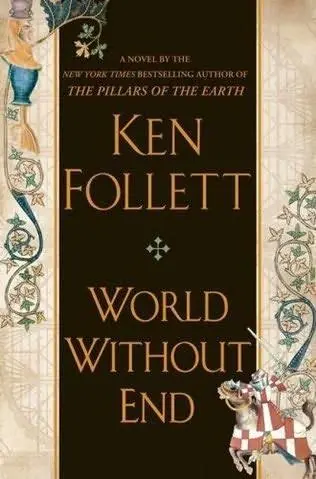
- Название:World Without End
- Автор:
- Жанр:
- Год:неизвестен
- ISBN:нет данных
- Рейтинг книги:5 / 5. Голосов: 1
-
Избранное:Добавить в избранное
- Отзывы:
-
Ваша оценка:
World Without End: краткое содержание, описание и аннотация
Предлагаем к чтению аннотацию, описание, краткое содержание или предисловие (зависит от того, что написал сам автор книги «World Without End»). Если вы не нашли необходимую информацию о книге — напишите в комментариях, мы постараемся отыскать её.
Ken Follett has 90 million readers worldwide. The Pillars of the Earth is his bestselling book of all time. Now, eighteen years after the publication of The Pillars of the Earth, Ken Follett has written the most-anticipated sequel of the year, World Without End.
In 1989 Ken Follett astonished the literary world with The Pillars of the Earth, a sweeping epic novel set in twelfth-century England centered on the building of a cathedral and many of the hundreds of lives it affected. Critics were overwhelmed-"it will hold you, fascinate you, surround you" (Chicago Tribune)-and readers everywhere hoped for a sequel.
World Without End takes place in the same town of Kingsbridge, two centuries after the townspeople finished building the exquisite Gothic cathedral that was at the heart of The Pillars of the Earth. The cathedral and the priory are again at the center of a web of love and hate, greed and pride, ambition and revenge, but this sequel stands on its own. This time the men and women of an extraordinary cast of characters find themselves at a crossroad of new ideas-about medicine, commerce, architecture, and justice. In a world where proponents of the old ways fiercely battle those with progressive minds, the intrigue and tension quickly reach a boiling point against the devastating backdrop of the greatest natural disaster ever to strike the human race-the Black Death.
Three years in the writing, and nearly eighteen years since its predecessor, World Without End breathes new life into the epic historical novel and once again shows that Ken Follett is a masterful author writing at the top of his craft.
World Without End — читать онлайн бесплатно полную книгу (весь текст) целиком
Ниже представлен текст книги, разбитый по страницам. Система сохранения места последней прочитанной страницы, позволяет с удобством читать онлайн бесплатно книгу «World Without End», без необходимости каждый раз заново искать на чём Вы остановились. Поставьте закладку, и сможете в любой момент перейти на страницу, на которой закончили чтение.
Интервал:
Закладка:
“And your neighbours? The people of Kingsbridge, among whom you’ve lived for ten years? They need the bridge – it’s their lifeline.”
“We are of the nobility,” his father said. “We’re not required to take into account the needs of mere merchants.”
Merthin nodded. “You may feel that way, but as a mere carpenter I can’t share your view.”
“This isn’t just about you!” Ralph burst out. He had to come clean, he realized. “The earl has given me a mission. If I succeed, he may make me a knight, or at least a minor lord. If I fail, I could remain a squire.”
Maud said: “It’s very important that we all try to please the earl.”
Merthin looked troubled. He was always willing to go head-to-head with their father, but he did not like to argue with Mother. “I’ve agreed to build the bridge,” he said. “The town is counting on me. I can’t give it up.”
“Of course you can,” Maud said.
“I don’t want to get a reputation for unreliability.”
“Everyone would understand if you gave the earl precedence.”
“They might understand, but they wouldn’t respect me for it.”
“You should put your family first.”
“I fought for this bridge, Mother,” Merthin said stubbornly. “I made a beautiful design, and I persuaded the whole town to have faith in me. No one else can build it – not the way it should be done.”
“If you defy the earl, it will affect Ralph’s whole life!” she said. “Don’t you see that?”
“His whole life shouldn’t depend on something like this.”
“But it does. Are you willing to sacrifice your brother, just for the sake of a bridge?”
Merthin said: “I suppose it’s a bit like my asking him to save men’s lives by not going to war.”
Gerald said: “Come, now, you can’t compare a carpenter to a soldier.”
That was tactless, Ralph thought. It showed Gerald’s preference for the younger son. Merthin felt the sting, Ralph could tell. His brother’s faced reddened and he bit his lip as if to restrain himself from a combative reply.
After a pause, Merthin spoke in a quiet voice that Ralph knew to be a sign that he had made up his mind irrevocably. “I didn’t ask to be a carpenter,” he said. “Like Ralph, I wanted to be a knight. A foolish aspiration for me, I know that now. All the same, it was your decision that I should be what I am. As things have turned out, I’m good at it. I’m going to make a success of what you forced me into. One day I’d like to build the tallest building in England. This is what you made me – so you’d better learn to live with it.”
Before Ralph went back to Earlscastle with the bad news, he racked his brains for a way to turn defeat into victory. If he could not talk his brother into abandoning the bridge, was there some other way he could get the project cancelled or delayed?
There was no point talking to Prior Godwyn or Edmund Wooler, he was sure. They would be more committed to the bridge even than Merthin, and anyway they would not be persuaded by a mere squire. What could the earl do? He might send a troop of knights to kill the construction workers, but that could cause more problems than it solved.
It was Merthin who gave him the idea. He had said that Jake Chepstow, the timber merchant who was using Leper Island as a store yard, was buying trees from Wales to avoid the taxes charged by the earl of Shaftesbury.
“My brother feels he must accept the authority of the prior of Kingsbridge,” Ralph said to Earl Roland on his return. Before the earl had time to get angry, he added: “But there may be a better way to delay the building of the bridge. The priory’s quarry is in the heart of your earldom, between Shiring and Earlscastle.”
“But it belongs to the monks,” Roland growled. “The king gave it to them centuries ago. We can’t stop them taking stone.”
“You could tax them, though,” Ralph said. He felt guilty: he was sabotaging a project dear to his brother’s heart. But it had to be done, and he quelled his conscience. They will be transporting their stone through your earldom. Their heavy carts will wear away your roads and churn up your river fords. They ought to pay.”
“They’ll squeal like pigs. They’ll go to the king.”
“Let them,” Ralph said, sounding more confident than he felt. “It will take time. There are only two months left of this year’s building season – they have to stop work before the first frost. With luck, you could delay the start of the bridge until next year.”
Roland gave Ralph a hard look. “I may have underestimated you,” he said. “Perhaps you’re good for more than pulling drowning earls out of rivers.”
Ralph concealed a triumphant smile. “Thank you, my lord.”
“But how shall we enforce this tax? Usually there’s a crossroads, a ford in a river, some place every cart has to pass through.”
“Since we’re only interested in blocks of stone, we could simply camp a troop of men outside the quarry.”
“Excellent,” said the earl. “And you can lead them.”
Two days later Ralph was approaching the quarry with four men-at-arms on horseback and two boys leading a string of packhorses carrying tents and food for a week. He was pleased with himself, so far. He had been given an impossible task and turned it around. The earl thought he was good for more than river rescue work. Things were looking up.
He was deeply uncomfortable about what he was doing to Merthin. He had lain awake much of the night recalling their childhood together. He had always revered his clever older brother. They had often fought, and Ralph had felt worse when he won than when he lost. They had always made friends afterwards, in those days. But grown-up fights were harder to forget.
He was not very anxious about the coming confrontation with the monks’ quarrymen. It should not prove too challenging for a group oi military men. He had no knights with him – such work was beneath their dignity – but he had Joseph Woodstock, whom he knew to be a hard man, and three others. All the same, he would be glad when it was over and he had achieved his aim.
It was just after dawn. They had camped the night before in the forest a few miles from the quarry. Ralph planned to get there in time to challenge the first cart that attempted to leave this morning.
The horses stepped daintily along a road muddied by the hooves of oxen and deeply rutted by the wheels of heavy carts. The sun rose into a sky of rain clouds broken by scraps of blue. Ralph’s group were in a good mood, looking forward to exercising their power over unarmed men, with no serious risk to themselves.
Ralph smelled wood burning, then saw the smoke of several fires rising over the trees. A few moments later, the road widened into a muddy clearing in front of the largest hole in the ground he had ever seen. It was a hundred yards wide and stretched for at least a quarter of a mile. A mud ramp led down to the tents and wooden huts of the quarrymen, who were clustered around their fires cooking breakfast. A few were already at work, farther along the site, and Ralph could hear the dull thud of hammers driving wedges into cracks in the rock, splitting great slabs from the mass of stone.
The quarry was a day’s journey from Kingsbridge, so most carters arrived in the evening and left the following morning. Ralph could see several carts dotted about the quarry, some being loaded with stone, and one already making its slow way along the track through the diggings towards the exit ramp.
The men in the quarry looked up, alerted by the sound of horses, but no one approached. Workers were never in a hurry to converse with men-at-arms. Ralph waited patiently. There appeared to be only one way out of the quarry, the long slope of mud that led to where he was.
Читать дальшеИнтервал:
Закладка:
Похожие книги на «World Without End»
Представляем Вашему вниманию похожие книги на «World Without End» списком для выбора. Мы отобрали схожую по названию и смыслу литературу в надежде предоставить читателям больше вариантов отыскать новые, интересные, ещё непрочитанные произведения.

Обсуждение, отзывы о книге «World Without End» и просто собственные мнения читателей. Оставьте ваши комментарии, напишите, что Вы думаете о произведении, его смысле или главных героях. Укажите что конкретно понравилось, а что нет, и почему Вы так считаете.