Ken Follett - World Without End
Здесь есть возможность читать онлайн «Ken Follett - World Without End» весь текст электронной книги совершенно бесплатно (целиком полную версию без сокращений). В некоторых случаях можно слушать аудио, скачать через торрент в формате fb2 и присутствует краткое содержание. Жанр: Историческая проза, на английском языке. Описание произведения, (предисловие) а так же отзывы посетителей доступны на портале библиотеки ЛибКат.
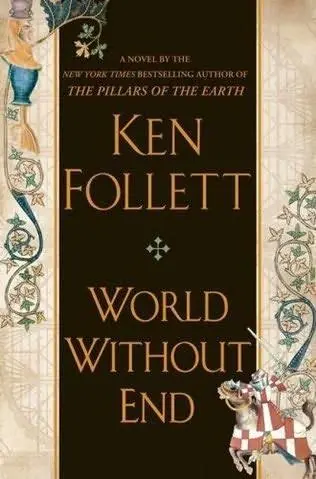
- Название:World Without End
- Автор:
- Жанр:
- Год:неизвестен
- ISBN:нет данных
- Рейтинг книги:5 / 5. Голосов: 1
-
Избранное:Добавить в избранное
- Отзывы:
-
Ваша оценка:
World Without End: краткое содержание, описание и аннотация
Предлагаем к чтению аннотацию, описание, краткое содержание или предисловие (зависит от того, что написал сам автор книги «World Without End»). Если вы не нашли необходимую информацию о книге — напишите в комментариях, мы постараемся отыскать её.
Ken Follett has 90 million readers worldwide. The Pillars of the Earth is his bestselling book of all time. Now, eighteen years after the publication of The Pillars of the Earth, Ken Follett has written the most-anticipated sequel of the year, World Without End.
In 1989 Ken Follett astonished the literary world with The Pillars of the Earth, a sweeping epic novel set in twelfth-century England centered on the building of a cathedral and many of the hundreds of lives it affected. Critics were overwhelmed-"it will hold you, fascinate you, surround you" (Chicago Tribune)-and readers everywhere hoped for a sequel.
World Without End takes place in the same town of Kingsbridge, two centuries after the townspeople finished building the exquisite Gothic cathedral that was at the heart of The Pillars of the Earth. The cathedral and the priory are again at the center of a web of love and hate, greed and pride, ambition and revenge, but this sequel stands on its own. This time the men and women of an extraordinary cast of characters find themselves at a crossroad of new ideas-about medicine, commerce, architecture, and justice. In a world where proponents of the old ways fiercely battle those with progressive minds, the intrigue and tension quickly reach a boiling point against the devastating backdrop of the greatest natural disaster ever to strike the human race-the Black Death.
Three years in the writing, and nearly eighteen years since its predecessor, World Without End breathes new life into the epic historical novel and once again shows that Ken Follett is a masterful author writing at the top of his craft.
World Without End — читать онлайн бесплатно полную книгу (весь текст) целиком
Ниже представлен текст книги, разбитый по страницам. Система сохранения места последней прочитанной страницы, позволяет с удобством читать онлайн бесплатно книгу «World Without End», без необходимости каждый раз заново искать на чём Вы остановились. Поставьте закладку, и сможете в любой момент перейти на страницу, на которой закончили чтение.
Интервал:
Закладка:
It appeared an unpretentious building, made of the materials used in the humblest dwellings, glorifying nobody. But, as Edmund often said, the money made by the people here paid for the limestone-and-stained-glass majesty of the cathedral. And the guild hall was comfortable in its unostentatious way. There were tapestries on the walls and glass in the windows, and two huge fireplaces kept it warm in winter. When business was booming, the food served here was fit for royalty.
The parish guild had been formed hundreds of years ago, when Kingsbridge was a small town. A few merchants had got together to raise money to buy ornaments for the cathedral. But when wealthy men eat and drink in a group they inevitably discuss their common concerns, and fund-raising soon became secondary to politics. From the start the guild was dominated by wool merchants, which was why a huge pair of scales and a standard weight for a woolsack – 364 pounds – stood at one end of the hall. As Kingsbridge grew, other guilds had been formed, representing crafts – carpenters, masons, brewers, goldsmiths – but their leading members also belonged to the parish guild, which retained its primacy. It was a less powerful version of the guild merchant that ruled most English towns, but was prohibited here by the town’s landlord, Kingsbridge Priory.
Merthin had never attended a meeting or banquet here, but he had been inside several times on more mundane business. He liked to crane back his neck and study the complex geometry of the roof timbers, a lesson in how the weight of a broad expanse of roof could be funnelled down to a few slender wooden pillars. Most of the elements made sense, but one or two pieces of wood seemed to him to be superfluous, or even detrimental, transferring weight to weaker zones. That was because no one really knew what made buildings stand up. Builders went by instinct and experience, and sometimes got it wrong.
This evening Merthin was in a state of high anxiety, too nervous to really appreciate the woodwork. The guild was about to pass judgement on his bridge design. It was far superior to Elfric’s – but would they see that?
Elfric had had the benefit of the tracing floor. Merthin might have asked Godwyn for permission to use it, but he had been afraid of further sabotage by Elfric, so he had devised an alternative. He had stretched a large piece of parchment across a wooden frame, and had drawn his design on the skin with a pen and ink. Tonight this might work to his advantage, for he had brought his design with him to the guild hall, so that members would have it in front of them, whereas Elfric’s would only be in their memories.
He placed his framed drawing at the front of the hall on a three-legged stand he had devised for the purpose. Everyone came and looked at it as they arrived, although they had all seen it at least once over the last few days. They had also climbed the spiral staircase to the loft and looked at Elfric’s drawings. Merthin thought most people preferred his design, but some were wary of backing a youngster against an experienced man. Many had kept their opinions to themselves.
The noise level rose as the hall filled up with men and a few women. They dressed up for the guild, as they did for church, the men in expensive wool coats despite the mild summer weather, the women in elaborate headdresses. Although everyone paid lip service to the untrustworthiness and general inferiority of women, in practice several of the town’s wealthiest and most important citizens were female. There was Mother Cecilia, sitting now at the front with her personal assistant, the nun known as Old Julie. Caris was here – everyone acknowledged that she was Edmund’s right hand. Merthin experienced a jolt of desire as she sat on the bench next to him, her thigh warm against his own. Anyone carrying on a trade in the town had to belong to a guild – outsiders could do business only on market days. Even monks and priests were compelled to join if they wanted to trade, which they often did. When a man died, it was common for his widow to continue his enterprise. Betty Baxter was the town’s most prosperous baker; Sarah Taverner kept the Holly Bush inn. It would have been difficult and cruel to prevent such women earning a living. Much easier to include them in the guild.
Edmund normally chaired these meetings, sitting on a big wooden throne on a raised platform at the front. Today, however, there were two chairs on the platform. Edmund sat in one and, when Prior Godwyn arrived, Edmund invited him to take the other. Godwyn was accompanied by all the senior monks, and Merthin was pleased to see Thomas among them. Philemon was also in the entourage, lanky and awkward, and Merthin wondered briefly what on earth Godwyn had brought him for.
Godwyn was looking pained. Opening the proceedings, Edmund was careful to acknowledge that the prior was in charge of the bridge, and the choice of design was ultimately his. But everyone knew that, in fact, Edmund had taken the decision out of Godwyn’s hands by calling this meeting. Provided there was a clear consensus tonight, Godwyn would have great difficulty in going against the expressed will of the merchants in a matter of commerce rather than religion. Edmund asked Godwyn to begin with a prayer, and Godwyn obliged, but he knew he had been outmanoeuvred, and that was why he looked as if there was a bad smell.
Edmund stood up and said: “These two designs have been costed by Elfric and Merthin, who have used the same methods of calculation.”
Elfric interjected: “Of course we have – he learned them from me.” There was a ripple of laughter from the older men.
It was true. There were formulae for calculating costs per square foot of wall, per cubic yard of infill, per foot of a roof span, and for more intricate work such as arches and vaulting. All builders used the same methods, though with their individual variations. The bridge calculations had been complex, but easier than for a building such as a church.
Edmund went on: “Each man has checked the other’s calculations, so there is no room for dispute.”
Edward Butcher called out: “Yes – all builders overcharge by the same amount!” That got a big laugh. Edward was popular with the men for his quick wit, and with the women for his good looks and brown bedroom eyes. He was not so popular with his wife, who knew about his infidelities, and had recently attacked him with one of his own heavy knives: he still had a bandage on his left arm.
“Elfric’s bridge will cost two hundred and eighty-five pounds,” Edmund said as the laughter died away. “Merthin’s comes out at three hundred and seven. The difference is twenty-two pounds, as most of you will have worked out faster than me.” There was a quiet chuckle at that: Edmund was often teased for having his daughter do his arithmetic for him. He still used the old Latin numerals, because he could not get used to the new Arabic digits that made calculation so much easier.
A new voice said: “Twenty-two pounds is a lot of money.” It was Bill Watkin, the builder who had refused to hire Merthin, looking like one of the monks with his bald dome.
Dick Brewer said: “Yes, but Merthin’s bridge is twice as wide. It ought to cost twice as much – but it doesn’t, because it’s a cleverer design.” Dick was fond of his own product, ale, and in consequence had a protruding round belly like a pregnant woman.
Bill rejoined: “How many days a year do we need a bridge wide enough for two carts?”
“Every market day and all of Fleece Fair week.”
“Not so,” said Bill. “It’s only for an hour in the morning and another in the afternoon.”
“I’ve waited two hours with a cartload of barley before now.”
“You should have the sense to bring your barley in on quiet days.”
Читать дальшеИнтервал:
Закладка:
Похожие книги на «World Without End»
Представляем Вашему вниманию похожие книги на «World Without End» списком для выбора. Мы отобрали схожую по названию и смыслу литературу в надежде предоставить читателям больше вариантов отыскать новые, интересные, ещё непрочитанные произведения.





Обсуждение, отзывы о книге «World Without End» и просто собственные мнения читателей. Оставьте ваши комментарии, напишите, что Вы думаете о произведении, его смысле или главных героях. Укажите что конкретно понравилось, а что нет, и почему Вы так считаете.