Ken Follett - World Without End
Здесь есть возможность читать онлайн «Ken Follett - World Without End» весь текст электронной книги совершенно бесплатно (целиком полную версию без сокращений). В некоторых случаях можно слушать аудио, скачать через торрент в формате fb2 и присутствует краткое содержание. Жанр: Историческая проза, на английском языке. Описание произведения, (предисловие) а так же отзывы посетителей доступны на портале библиотеки ЛибКат.
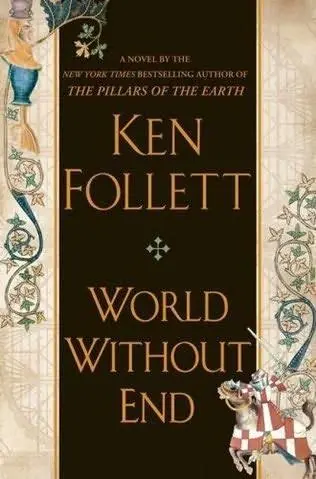
- Название:World Without End
- Автор:
- Жанр:
- Год:неизвестен
- ISBN:нет данных
- Рейтинг книги:5 / 5. Голосов: 1
-
Избранное:Добавить в избранное
- Отзывы:
-
Ваша оценка:
World Without End: краткое содержание, описание и аннотация
Предлагаем к чтению аннотацию, описание, краткое содержание или предисловие (зависит от того, что написал сам автор книги «World Without End»). Если вы не нашли необходимую информацию о книге — напишите в комментариях, мы постараемся отыскать её.
Ken Follett has 90 million readers worldwide. The Pillars of the Earth is his bestselling book of all time. Now, eighteen years after the publication of The Pillars of the Earth, Ken Follett has written the most-anticipated sequel of the year, World Without End.
In 1989 Ken Follett astonished the literary world with The Pillars of the Earth, a sweeping epic novel set in twelfth-century England centered on the building of a cathedral and many of the hundreds of lives it affected. Critics were overwhelmed-"it will hold you, fascinate you, surround you" (Chicago Tribune)-and readers everywhere hoped for a sequel.
World Without End takes place in the same town of Kingsbridge, two centuries after the townspeople finished building the exquisite Gothic cathedral that was at the heart of The Pillars of the Earth. The cathedral and the priory are again at the center of a web of love and hate, greed and pride, ambition and revenge, but this sequel stands on its own. This time the men and women of an extraordinary cast of characters find themselves at a crossroad of new ideas-about medicine, commerce, architecture, and justice. In a world where proponents of the old ways fiercely battle those with progressive minds, the intrigue and tension quickly reach a boiling point against the devastating backdrop of the greatest natural disaster ever to strike the human race-the Black Death.
Three years in the writing, and nearly eighteen years since its predecessor, World Without End breathes new life into the epic historical novel and once again shows that Ken Follett is a masterful author writing at the top of his craft.
World Without End — читать онлайн бесплатно полную книгу (весь текст) целиком
Ниже представлен текст книги, разбитый по страницам. Система сохранения места последней прочитанной страницы, позволяет с удобством читать онлайн бесплатно книгу «World Without End», без необходимости каждый раз заново искать на чём Вы остановились. Поставьте закладку, и сможете в любой момент перейти на страницу, на которой закончили чтение.
Интервал:
Закладка:
“Yes,” said Edmund. “I rather think it does.”
Caris was surprised that Godwyn had wanted Elfric to design the bridge. She understood that Elfric would seem a safer choice – but Godwyn was a reformer, not a conservative, and she had expected him to be enthusiastic about Merthin’s clever, radical design. Instead he had timidly favoured the cautious option.
Fortunately, Edmund had been able to outmanoeuvre Godwyn, and now Kingsbridge would have a well-built, beautiful bridge that would allow two carts to cross at the same time. But Godwyn’s eagerness to appoint the unimaginative sycophant rather than the bold man of talent was an ominous sign for the future.
And Godwyn had never been a good loser. When he was a boy Petranilla had taught him to play chess, letting him win to encourage him, and he had challenged his uncle Edmund; but after being beaten twice he had sulked and refused to play again. He was in the same mood after the meeting in the guild hall, she could tell. It was probably not that he was particularly attracted to Elfric’s design. But he undoubtedly resented having the decision taken out of his hands. Next day, when she and her father went to the prior’s house, she anticipated trouble.
Godwyn greeted them coolly and did not offer any refreshment. As always, Edmund pretended not to notice slights. “I want Merthin to start work on the bridge immediately,” he said as he sat down at the table in the hall. “I have pledges of money for the full amount of Merthin’s budget-”
“From whom?” Godwyn interrupted.
“The town’s wealthiest traders.”
Godwyn continued to look inquiringly at Edmund.
Edmund shrugged and said: “Fifty pounds from Betty Baxter, eighty from Dick Brewer, seventy from myself, and ten pounds each from eleven others.”
“I didn’t know our citizens possessed such riches,” Godwyn said. He seemed both awestruck and envious. “God has been kind.”
Edmund added: “Kind enough to reward people for a lifetime’s hard work and worry.”
“No doubt.”
“Which is why I need to give them reassurances about the return of their money. When the bridge is built, the tolls will come to the parish guild, which will use them to repay loans – but who will collect the pennies as the passengers cross the bridge? I think it has to be a servant of the guild.”
“I never agreed to this,” Godwyn said.
“I know, that’s why I’m raising it now.”
“I mean, I never agreed to pay the tolls to the parish guild.”
“What?”
Caris stared at Godwyn, flabbergasted. Of course he had agreed to it – what was he talking about? He had spoken to her as well as to Edmund and assured them that Brother Thomas-
“Oh,” she said. “You promised that Thomas would build the bridge, if he was elected prior. Then, when Thomas withdrew and you became the candidate, we assumed…”
“You assumed,” Godwyn said. A smirk of triumph played about his lips.
Edmund could barely contain himself. “This is not square dealing, Godwyn!” he said in a choked voice. “You knew what the understanding was!”
“I knew no such thing, and you should call me Father Prior.”
Edmund’s voice got louder. “Then we’re back where we were with Prior Anthony three months ago! Except that now, instead of an inadequate bridge, we have no bridge at all. Don’t imagine it will be built at no cost to you. Citizens may lend their life savings to the priory, on the security of income from the bridge tolls, but they will not give their money away… Father Prior.”
“Then they must manage without a bridge. I have only just become prior – how can I start by alienating a right that has belonged to my priory for hundreds of years?”
“But it’s only temporary!” Edmund exploded. “And if you don’t do this no one will gain any money from bridge tolls because there will be no cursed bridge!”
Caris was furious, but she bit her tongue and tried to figure out what Godwyn was up to. He was getting his revenge for last night, but did he really mean it? “What do you want?” she said to him.
Edmund looked surprised by the question, but he said nothing: the reason he brought Caris with him to meetings was that she often saw things he missed, and asked questions he had not thought of.
“I don’t know what you mean,” Godwyn replied.
“You’ve pulled a surprise,” she said. “You’ve caught us wrong-footed. Very well. We admit we made an assumption that may have been unwarranted. But what’s your purpose? Just to make us feel stupid?”
“You asked for this meeting, not I.”
Edmund burst out: “What kind of way is that to talk to your uncle and your cousin?”
“Just a minute, Papa,” Caris said. Godwyn did have a secret agenda, she felt sure, but he did not want to admit it. All right, she thought, I’ll have to guess it. “Give me a minute to think,” she said. Godwyn still wanted the bridge – he had to, nothing else made sense. The business about alienating the priory’s ancient rights was rhetoric, the kind of pompous prating that all students were taught at Oxford. Did he want Edmund to break down and agree to Elfric’s design? She did not think so. Godwyn clearly resented the way Edmund had appealed over his head to the citizenry, but he must see that Merthin was offering twice as much bridge for almost the same money. So what else could it be?
Perhaps he just wanted a better deal.
He had looked hard at the priory’s finances, she guessed. Having railed comfortably against Anthony’s inefficiency for many years he was now confronted with the reality of having to do the job better himself. Perhaps it was not going to be as easy as he had imagined. Perhaps he was not as clever about money and management as he had thought. In desperation, he wanted the bridge and the money from tolls. But how did he think that could happen?
She said: “What could we offer you that would make you change your mind?”
“Build the bridge without keeping the tolls,” he said instantly.
So that was his agenda. You always were a bit sneaky, Godwyn, she thought.
A flash of inspiration struck her, and she said: “How much money are we talking about?”
Godwyn looked suspicious. “Why do you want to know that?”
Edmund said: “We can work it out. Not counting citizens, who don’t pay the toll, about a hundred people cross the bridge every market day, and carts pay two pence. It’s much less now, with the ferry, of course.”
Caris said: “Say a hundred and twenty pennies a week, or ten shillings, which comes to twenty-six pounds a year.”
Edmund said: “Then, during Fleece Fair week, about a thousand on the first day, and another two hundred each subsequent day.”
“That’s two thousand two hundred, plus carts, call it two thousand four hundred pennies, which is ten pounds. Total, thirty-six pounds a year.” Caris looked at Godwyn. “Is that about right?”
“Yes,” he acknowledged grudgingly.
“So, what you want from us is thirty-six pounds a year.”
“Yes.”
“Impossible!” said Edmund.
“Not necessarily,” Caris said. “Suppose the priory were to grant the parish guild a lease on the bridge.” Thinking on her feet, she added: “Plus an acre of ground at either end, and the island in the middle – for thirty-six pounds a year, in perpetuity.” Once the bridge was built, that land would be priceless, she knew. “Would that give you what you want, Father Prior?”
“Yes.”
Godwyn clearly thought he was getting thirty-six pounds a year for something worthless. He had no idea how much rent could be charged for a plot of land at the end of a bridge. The worst negotiator in the world is a man who believes he’s clever, Caris thought.
Читать дальшеИнтервал:
Закладка:
Похожие книги на «World Without End»
Представляем Вашему вниманию похожие книги на «World Without End» списком для выбора. Мы отобрали схожую по названию и смыслу литературу в надежде предоставить читателям больше вариантов отыскать новые, интересные, ещё непрочитанные произведения.
Обсуждение, отзывы о книге «World Without End» и просто собственные мнения читателей. Оставьте ваши комментарии, напишите, что Вы думаете о произведении, его смысле или главных героях. Укажите что конкретно понравилось, а что нет, и почему Вы так считаете.