Ken Follett - World Without End
Здесь есть возможность читать онлайн «Ken Follett - World Without End» весь текст электронной книги совершенно бесплатно (целиком полную версию без сокращений). В некоторых случаях можно слушать аудио, скачать через торрент в формате fb2 и присутствует краткое содержание. Жанр: Историческая проза, на английском языке. Описание произведения, (предисловие) а так же отзывы посетителей доступны на портале библиотеки ЛибКат.
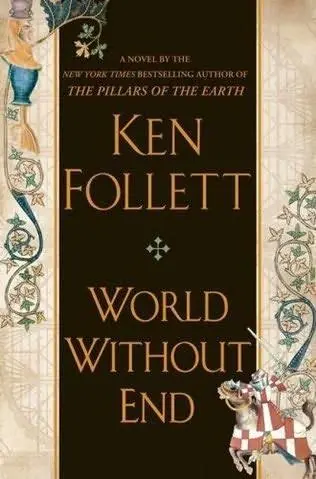
- Название:World Without End
- Автор:
- Жанр:
- Год:неизвестен
- ISBN:нет данных
- Рейтинг книги:5 / 5. Голосов: 1
-
Избранное:Добавить в избранное
- Отзывы:
-
Ваша оценка:
World Without End: краткое содержание, описание и аннотация
Предлагаем к чтению аннотацию, описание, краткое содержание или предисловие (зависит от того, что написал сам автор книги «World Without End»). Если вы не нашли необходимую информацию о книге — напишите в комментариях, мы постараемся отыскать её.
Ken Follett has 90 million readers worldwide. The Pillars of the Earth is his bestselling book of all time. Now, eighteen years after the publication of The Pillars of the Earth, Ken Follett has written the most-anticipated sequel of the year, World Without End.
In 1989 Ken Follett astonished the literary world with The Pillars of the Earth, a sweeping epic novel set in twelfth-century England centered on the building of a cathedral and many of the hundreds of lives it affected. Critics were overwhelmed-"it will hold you, fascinate you, surround you" (Chicago Tribune)-and readers everywhere hoped for a sequel.
World Without End takes place in the same town of Kingsbridge, two centuries after the townspeople finished building the exquisite Gothic cathedral that was at the heart of The Pillars of the Earth. The cathedral and the priory are again at the center of a web of love and hate, greed and pride, ambition and revenge, but this sequel stands on its own. This time the men and women of an extraordinary cast of characters find themselves at a crossroad of new ideas-about medicine, commerce, architecture, and justice. In a world where proponents of the old ways fiercely battle those with progressive minds, the intrigue and tension quickly reach a boiling point against the devastating backdrop of the greatest natural disaster ever to strike the human race-the Black Death.
Three years in the writing, and nearly eighteen years since its predecessor, World Without End breathes new life into the epic historical novel and once again shows that Ken Follett is a masterful author writing at the top of his craft.
World Without End — читать онлайн бесплатно полную книгу (весь текст) целиком
Ниже представлен текст книги, разбитый по страницам. Система сохранения места последней прочитанной страницы, позволяет с удобством читать онлайн бесплатно книгу «World Without End», без необходимости каждый раз заново искать на чём Вы остановились. Поставьте закладку, и сможете в любой момент перейти на страницу, на которой закончили чтение.
Интервал:
Закладка:
“Now, Gerald, no need to exaggerate,” Maud said crisply.
“Then she disappeared into the crowd, and I couldn’t find her! I didn’t know her name. I asked people who was the pretty girl with the fair hair, and they said all the girls were pretty and fair.”
Maud said: “I hurried away after the service. We were staying at the Holly Bush inn, and my mother was unwell, so I went back to take care of her.”
Gerald said: “I looked all over town, but I couldn’t find her. After Easter, everyone went home. I was living in Shiring, and she in Casterham, though I didn’t know that. I thought I’d never see her again. I imagined she might have been an angel, come to earth to make sure everyone was attending the service.”
She said: “Gerald, please.”
“But my heart was lost. I took no interest in other women. I expected to spend my life longing for the Angel of Kingsbridge. This went on for two years. Then I saw her at a tournament in Winchester.”
She said: “This complete stranger came up to me and said: ‘It’s you I after all this time! You must marry me before you disappear again.’ I thought he was mad.”
“Amazing,” said Edmund.
Merthin thought Edmund’s goodwill had been stretched far enough. “Anyway,” he said, “I’ve drawn some designs on the tracing floor in the mason’s loft at the cathedral.”
Edmund nodded. “A stone bridge wide enough for two carts?”
“As you specified – and ramped at both ends. And I’ve found a way to reduce the price by about a third.”
“That’s astonishing! How?”
“I’ll show you, as soon as you’ve finished eating.”
Edmund spooned up the last of the pottage and stood. “I’m done. Let’s go.” He turned to Gerald and inclined his head in a slight bow. “Thank you for your hospitality.”
“It’s a pleasure to have you here, alderman.”
Merthin and Edmund stepped out into a light drizzle. Instead of heading for the cathedral, Merthin led Edmund towards the river. Edmund’s lopsided stride was instantly recognizable, and every second person on the street greeted him with a friendly word or a respectful bow.
Merthin suddenly felt nervous. He had been thinking about the bridge design for months. While he worked at St Mark’s, supervising the carpenters who were constructing the new roof as the old was demolished, he mulled over the greater challenge of the bridge. Now for the first time his ideas would come under scrutiny by someone else.
As yet, Edmund had no idea how radical Merthin’s plan was.
The muddy street wound downhill through houses and workshops. The city ramparts had fallen into disrepair during two centuries of civil peace, and in some places all that remained were humps of earth that now formed parts of garden walls. At the river’s edge were industries that used large quantities of water, especially wool dyers and leather tanners.
Merthin and Edmund emerged on to the muddy foreshore between a slaughterhouse that gave off a strong smell of blood and a smithy where hammers clanged on iron. Directly in front of them, across a narrow stretch of water, was Leper Island. Edmund said: “Why are we here? The bridge is a quarter of a mile upstream.”
“It was,” said Merthin. He took a breath and said: “I think we should build the new one here.”
“A bridge to the island?”
“And another from the island to the far shore. Two small bridges instead of one big one. Much cheaper.”
“But people will have to walk across the island from one bridge to the other.”
“Why not?”
“Because it’s a leper colony!”
“There’s only one leper left. He can be moved elsewhere. The disease seems to be dying out.”
Edmund looked thoughtful. “So everyone who comes to Kingsbridge will arrive at this spot, where we’re standing.”
“We’ll have to build a new street, and knock down some of these buildings – but the cost will be small by comparison with the money saved on the bridge.”
“And on the other side…”
“A pasture that belongs to the priory. I can see the whole layout when I’m on the roof of St Mark’s. That’s how come I thought of it.”
Edmund was impressed. “That’s very clever. I wonder why the bridge wasn’t put here originally.”
“The first bridge was erected hundreds of years ago. The river probably had a different shape then. River banks must move their position as the centuries go by. The channel between the island and the pasture could have been wider at one time. Then there would have been no advantage in building here.”
Edmund peered across the water, and Merthin followed his gaze. The leper colony was a scatter of tumbledown wooden buildings spread over three or four acres. The island was too rocky for cultivation, but there were some trees and scrubby grass. The place was infested with rabbits, which the townspeople would not eat because of a superstition that they were the souls of dead lepers. At one time the ostracized inhabitants had kept their own chickens and pigs. Now, however, it was simpler for the priory to supply food to the last remaining inhabitant. “You’re right,” Edmund said. “There hasn’t been a new case of leprosy in the town for at least ten years.”
“I’ve never seen a leper,” Merthin said. “As a child, I thought people were saying ‘leopard’. I imagined that island to be occupied by spotted lions.”
Edmund laughed. Turning his back on the river, he looked at the buildings around. “There will be some political work to do,” he mused. “The people whose homes must be demolished will have to be convinced that they’re the lucky ones, being moved to new and better houses while their neighbours missed out. And the island may have to be cleansed with holy water to convince people that it’s safe. But we can handle all that.”
“I’ve drawn both bridges with pointed arches, like the cathedral,” Merthin said. “They will be beautiful.”
“Show me.”
They left the riverside and walked uphill through the town to the priory. The cathedral dripped with rain under a layer of low cloud like smoke from a damp fire. Merthin was looking forward to seeing his drawings again – he had not been to the loft for a week or so – and to explaining them to Edmund. He had thought a great deal about the way the current had undermined the old bridge, and how he could protect the new one from the same fate.
He led Edmund through the north porch and up the spiral staircase. His wet shoes slipped on the worn stone steps. Edmund energetically hauled his withered leg up behind him.
Several lamps were burning in the mason’s loft. At first Merthin was pleased, for that meant they would be able to see his drawings more clearly. Then he saw Elfric working on the tracing floor.
He felt momentarily frustrated. The enmity between himself and his former master was as great as ever. Elfric had failed to prevent townspeople from employing Merthin, but he continued to block Merthin’s application to join the carpenters’ guild – leaving Merthin in an anomalous position, illegitimate but accepted. Elfric’s attitude was pointless, but spiteful.
Elfric’s presence here would put a damper on Merthin’s conversation with Edmund. He told himself not to be so sensitive. Why should it not be Elfric who was made uncomfortable?
He held the door for Edmund, and together they crossed the room to the tracing floor. Then he suffered a shock.
Elfric was bent over the tracing floor, drawing with a pair of compasses – on a fresh layer of plaster. He had re-covered the floor, totally obliterating Merthin’s drawings.
Merthin said incredulously: “What have you done?”
Elfric looked contemptuously at him and went on with his drawing, saying nothing.
Читать дальшеИнтервал:
Закладка:
Похожие книги на «World Without End»
Представляем Вашему вниманию похожие книги на «World Without End» списком для выбора. Мы отобрали схожую по названию и смыслу литературу в надежде предоставить читателям больше вариантов отыскать новые, интересные, ещё непрочитанные произведения.


Обсуждение, отзывы о книге «World Without End» и просто собственные мнения читателей. Оставьте ваши комментарии, напишите, что Вы думаете о произведении, его смысле или главных героях. Укажите что конкретно понравилось, а что нет, и почему Вы так считаете.