Ken Follett - World Without End
Здесь есть возможность читать онлайн «Ken Follett - World Without End» весь текст электронной книги совершенно бесплатно (целиком полную версию без сокращений). В некоторых случаях можно слушать аудио, скачать через торрент в формате fb2 и присутствует краткое содержание. Жанр: Историческая проза, на английском языке. Описание произведения, (предисловие) а так же отзывы посетителей доступны на портале библиотеки ЛибКат.
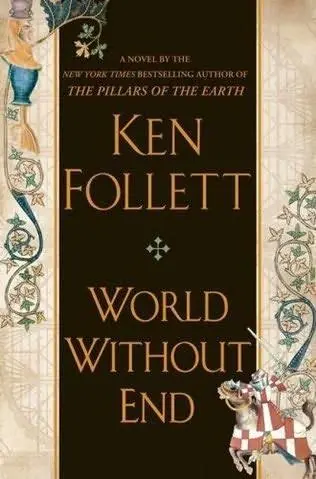
- Название:World Without End
- Автор:
- Жанр:
- Год:неизвестен
- ISBN:нет данных
- Рейтинг книги:5 / 5. Голосов: 1
-
Избранное:Добавить в избранное
- Отзывы:
-
Ваша оценка:
World Without End: краткое содержание, описание и аннотация
Предлагаем к чтению аннотацию, описание, краткое содержание или предисловие (зависит от того, что написал сам автор книги «World Without End»). Если вы не нашли необходимую информацию о книге — напишите в комментариях, мы постараемся отыскать её.
Ken Follett has 90 million readers worldwide. The Pillars of the Earth is his bestselling book of all time. Now, eighteen years after the publication of The Pillars of the Earth, Ken Follett has written the most-anticipated sequel of the year, World Without End.
In 1989 Ken Follett astonished the literary world with The Pillars of the Earth, a sweeping epic novel set in twelfth-century England centered on the building of a cathedral and many of the hundreds of lives it affected. Critics were overwhelmed-"it will hold you, fascinate you, surround you" (Chicago Tribune)-and readers everywhere hoped for a sequel.
World Without End takes place in the same town of Kingsbridge, two centuries after the townspeople finished building the exquisite Gothic cathedral that was at the heart of The Pillars of the Earth. The cathedral and the priory are again at the center of a web of love and hate, greed and pride, ambition and revenge, but this sequel stands on its own. This time the men and women of an extraordinary cast of characters find themselves at a crossroad of new ideas-about medicine, commerce, architecture, and justice. In a world where proponents of the old ways fiercely battle those with progressive minds, the intrigue and tension quickly reach a boiling point against the devastating backdrop of the greatest natural disaster ever to strike the human race-the Black Death.
Three years in the writing, and nearly eighteen years since its predecessor, World Without End breathes new life into the epic historical novel and once again shows that Ken Follett is a masterful author writing at the top of his craft.
World Without End — читать онлайн бесплатно полную книгу (весь текст) целиком
Ниже представлен текст книги, разбитый по страницам. Система сохранения места последней прочитанной страницы, позволяет с удобством читать онлайн бесплатно книгу «World Without End», без необходимости каждый раз заново искать на чём Вы остановились. Поставьте закладку, и сможете в любой момент перейти на страницу, на которой закончили чтение.
Интервал:
Закладка:
Eventually he drifted into a troubled sleep.
Lolla woke him early, as usual, and they went down to the parlour tor porridge. He repressed the impulse to go straight to the hospital and speak to Caris again. She had asked for time, and it would do his cause no good to pester her. It occurred to him that there might be more shocks in store for him, and that he had better try to catch up with what had been happening in Kingsbridge. So after breakfast he went to see Mark Webber.
The Webber family lived on the main street in a large house they had bought soon after Caris got them started in the cloth business. Merthin remembered the days when they and their four children had lived in one room that was not much bigger than the loom on which Mark worked. Their new house had a large stone-built ground floor used as a storeroom and shop. The living quarters were in the timber-built upper storey. Merthin found Madge in the shop, checking a cartload of scarlet cloth that had just arrived from one of their out-of-town mills. She was almost forty now, with strands of grey in her dark hair. A short woman, she had become quite plump, with a prominent bosom and a vast behind. She made Merthin think of a pigeon, but an aggressive one, because of her jutting chin and assertive manner.
With her were two youngsters, a beautiful girl of about seventeen and a strapping boy a couple of years older. Merthin recalled her two older children – Dora, a thin girl in a ragged dress, and John, a shy boy – and realized that these were the same, grown up. Now John was effortlessly lifting the heavy bales of cloth while Dora counted them by notching a stick. It made Merthin feel old. I’m only thirty-two, he thought; but that seemed old when he looked at John.
Madge gave a cry of surprise and pleasure when she saw him. She hugged him and kissed his bearded cheeks, then made a fuss of Lolla. “I thought she could come and play with your children,” Merthin said ruefully. “Of course they’re much too old.”
“Dennis and Noah are at the priory school,” she said. “They’re thirteen and eleven. But Dora will entertain Lolla – she loves children.”
The young woman picked Lolla up. “The cat next door has kittens,” she said. “Do you want to see them?”
Lolla replied with a stream of Italian, which Dora took for assent, and they went off.
Madge left John to finish unloading the cart and took Merthin upstairs. “Mark has gone to Melcombe,” she said. “We export some of our cloth to Brittany and Gascony. He should be back today or tomorrow.”
Merthin sat in her parlour and accepted a cup of ale. “Kingsbridge seems to be prospering,” he said.
“The trade in fleeces has declined,” she said. “It’s because of war taxes. Everything has to be sold through a handful of large traders so that the king can collect his share. There are still a few dealers here in Kingsbridge – Petranilla carries on the business Edmund left – but it’s nothing like it used to be. Luckily, the trade in finished cloth has grown to replace it, in this town at least.”
“Is Godwyn still prior?”
“Unfortunately, yes.”
“Is he still making difficulties?”
“He’s so conservative. He objects to any change and vetoes all progress. For example, Mark proposed opening the market on Saturday as well as Sunday, as an experiment.”
“What possible objection could Godwyn have to that?”
“He said it would enable people to come to market without going to church, which would be a bad thing.”
“Some of them might have gone to church on Saturday too.”
“Godwyn’s cup is always half empty, never half full.”
“Surely the parish guild opposes him?”
“Not very often. Elfric is alderman now. He and Alice got almost everything Edmund left.”
“The alderman doesn’t have to be the richest man in town.”
“But he usually is. Remember, Elfric employs lots of craftsmen – carpenters, stonemasons, mortar makers, scaffolders – and buys from everyone who trades in building materials. The town is full of people who are more or less bound to support him.”
“And Elfric has always been close to Godwyn.”
“Exactly. He gets all the priory’s building work – which means every public project.”
“And he’s such a shoddy builder!”
“Strange, isn’t it?” Madge said in a musing tone. “You’d think Godwyn would want the best man for the job. But he doesn’t. For him, it’s all about who will be compliant, who will obey his wishes unquestioningly.”
Merthin felt a bit depressed. Nothing had changed: his enemies were still in power. It might prove difficult for him to resume his old life. “No good news for me there, then.” He stood up. “I’d better take a look at my island.”
“I’m sure Mark will seek you out as soon as he returns from Melcombe.”
Merthin went next door for Lolla, but she was having such a good time that he left her with Dora, and strolled through the town to the riverside. He took another look at the cracks in his bridge, but he did not need to study them long: the cause was obvious. He made a tour of Leper Island. Little had changed: there were a few wharves and storehouses at the west end and just one house, the one he had lent to Jimmie, at the east end, beside the road that led from one span of the bridge to the other.
When he first took possession of the island, he had had ambitious plans for developing it. Nothing had happened, of course, during his exile. Now he thought he could do something. He paced the ground, making rough measurements and visualizing buildings and even streets, until it was time for the midday meal.
He picked Lolla up and returned to the Bell. Bessie served a tasty pork stew thickened with barley. The tavern was quiet, and Bessie joined them for dinner, bringing a jug of her best red wine. When they had eaten, she poured him another cup, and he told her about his ideas. “The road across the island, from one bridge to the other, is an ideal place to put shops,” he said.
“And taverns,” she pointed out. “This place and the Holly Bush are the busiest inns in town simply because they are close to the cathedral. Any place where people are continually passing by is a good location for a tavern.”
“If I built a tavern on Leper Island, you could run it.”
She gave him a direct look. “We could run it together.”
He smiled at her. He was full of her good food and wine, and any man would have loved to tumble into bed with her and enjoy her soft, round body; but it was not to be. “I was very fond of my wife, Silvia,” he said. “But, all the time we were married, I kept thinking about Caris. And Silvia knew it.”
Betty looked away. “That’s sad.”
“I know. And I’ll never do it to another woman. I won’t get married again, unless it’s to Caris. I’m not a good man, but I’m not that bad.”
“Caris may never marry you.”
“I know.”
She stood up, picking up their bowls. “You are a good man,” she said. “Too good.” She returned to the kitchen.
Merthin put Lolla to bed for a nap, then sat on a bench in front of the tavern, looking down the hillside at Leper Island, sketching on a big slate, enjoying the September sunshine. He did not get much work done because every other person who walked past wanted to welcome him home and ask what he had been doing for the last nine years.
Late in the afternoon he saw the massive figure of Mark Webber coming up the hill driving a cart bearing a barrel. Mark had always been a giant but now, Merthin observed, he was a plump giant.
Merthin shook his enormous hand. “I’ve been to Melcombe,” Mark said. “I go every few weeks.”
“What’s in the barrel?”
“Wine from Bordeaux, straight off the ship – which also brought news. You know that Princess Joan was on her way to Spain?”
Читать дальшеИнтервал:
Закладка:
Похожие книги на «World Without End»
Представляем Вашему вниманию похожие книги на «World Without End» списком для выбора. Мы отобрали схожую по названию и смыслу литературу в надежде предоставить читателям больше вариантов отыскать новые, интересные, ещё непрочитанные произведения.










Обсуждение, отзывы о книге «World Without End» и просто собственные мнения читателей. Оставьте ваши комментарии, напишите, что Вы думаете о произведении, его смысле или главных героях. Укажите что конкретно понравилось, а что нет, и почему Вы так считаете.