Ken Follett - World Without End
Здесь есть возможность читать онлайн «Ken Follett - World Without End» весь текст электронной книги совершенно бесплатно (целиком полную версию без сокращений). В некоторых случаях можно слушать аудио, скачать через торрент в формате fb2 и присутствует краткое содержание. Жанр: Историческая проза, на английском языке. Описание произведения, (предисловие) а так же отзывы посетителей доступны на портале библиотеки ЛибКат.
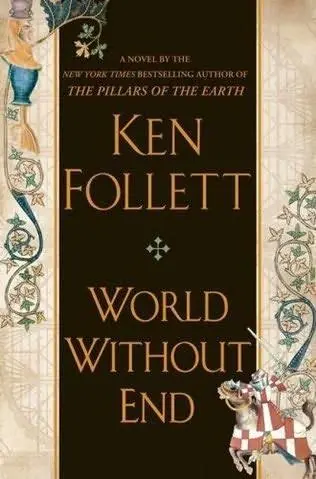
- Название:World Without End
- Автор:
- Жанр:
- Год:неизвестен
- ISBN:нет данных
- Рейтинг книги:5 / 5. Голосов: 1
-
Избранное:Добавить в избранное
- Отзывы:
-
Ваша оценка:
World Without End: краткое содержание, описание и аннотация
Предлагаем к чтению аннотацию, описание, краткое содержание или предисловие (зависит от того, что написал сам автор книги «World Without End»). Если вы не нашли необходимую информацию о книге — напишите в комментариях, мы постараемся отыскать её.
Ken Follett has 90 million readers worldwide. The Pillars of the Earth is his bestselling book of all time. Now, eighteen years after the publication of The Pillars of the Earth, Ken Follett has written the most-anticipated sequel of the year, World Without End.
In 1989 Ken Follett astonished the literary world with The Pillars of the Earth, a sweeping epic novel set in twelfth-century England centered on the building of a cathedral and many of the hundreds of lives it affected. Critics were overwhelmed-"it will hold you, fascinate you, surround you" (Chicago Tribune)-and readers everywhere hoped for a sequel.
World Without End takes place in the same town of Kingsbridge, two centuries after the townspeople finished building the exquisite Gothic cathedral that was at the heart of The Pillars of the Earth. The cathedral and the priory are again at the center of a web of love and hate, greed and pride, ambition and revenge, but this sequel stands on its own. This time the men and women of an extraordinary cast of characters find themselves at a crossroad of new ideas-about medicine, commerce, architecture, and justice. In a world where proponents of the old ways fiercely battle those with progressive minds, the intrigue and tension quickly reach a boiling point against the devastating backdrop of the greatest natural disaster ever to strike the human race-the Black Death.
Three years in the writing, and nearly eighteen years since its predecessor, World Without End breathes new life into the epic historical novel and once again shows that Ken Follett is a masterful author writing at the top of his craft.
World Without End — читать онлайн бесплатно полную книгу (весь текст) целиком
Ниже представлен текст книги, разбитый по страницам. Система сохранения места последней прочитанной страницы, позволяет с удобством читать онлайн бесплатно книгу «World Without End», без необходимости каждый раз заново искать на чём Вы остановились. Поставьте закладку, и сможете в любой момент перейти на страницу, на которой закончили чтение.
Интервал:
Закладка:
“No!” said Dennis. “No mud – just water.”
Noah put in: “There’s a hole you could climb into – easily! That big pillar is just hanging in the water, with nothing under it.”
Merthin tried not to look relieved.
Elfric blustered: “There’s still no authority for saying a pile of loose stones would have solved the problem.” But no one was listening to him. In the eyes of the crowd, Merthin had proved his point. They gathered around him, commenting and questioning. After a few moments, Elfric walked away alone.
Merthin felt a momentary pang of compassion. Then he recalled how, when he was an apprentice, Elfric had hit him across the face with a length of timber; and his pity evaporated into the cold morning air.
56
The following morning, a monk came to see Merthin at the Bell. When he pulled back his hood, Menhin did not at first recognize him. Then he saw that the monk’s left arm was cut off at the elbow, and he realized it was Brother Thomas, now in his forties, with a grey beard and deep-set lines around his eyes and mouth. Was his secret still dangerous after all these years, Merthin wondered? Would Thomas’s life be in danger, even now, if the truth came out?
But Thomas had not come to talk about that. “You were right about the bridge,” he said.
Merthin nodded. There was a sour satisfaction in it. He had been right, but Prior Godwyn had fired him, and in consequence his bridge would never be perfect. “I wanted to explain the importance of the rough stones, back then,” he said. “But I knew Elfric and Godwyn would never listen to me. So I told Edmund Wooler, then he died.”
“You should have told me.”
“I wish I had.”
“Come with me to the church,” Thomas said. “Since you can read so much from a few cracks, I’d like to show you something, if I may.”
He led Merthin to the south transept. Here and in the south aisle of the choir Elfric had rebuilt the arches, following the partial collapse eleven years ago. Merthin saw immediately what Thomas was worrying about: the cracks had reappeared.
“You said they would come back,” Thomas said.
“Unless you discovered the root cause of the problem, yes.”
“You were right. Elfric was wrong twice.”
Merthin felt a spark of excitement. If the tower needed rebuilding… “You understand that, but does Godwyn?”
Thomas did not answer the question. “What do you think the root cause might be?”
Menhin concentrated on the immediate problem. He had thought about this, on and off, for years. “This is not the original tower, is it?” he said. “According to Timothy’s Book, it has been rebuilt, and made higher.”
“About a hundred years ago, yes – when the raw wool business was booming. Do you think they made it too high?”
“It depends on the foundations.” The site of the cathedral sloped gently to the south, towards the river, and that might be a factor. He walked through the crossing, under the tower, to the north transept. He stood at the foot of the massive pillar at the north-east corner of the crossing and looked up at the arch that stretched over his head, across the north aisle of the choir, to the wall.
“It’s the south aisle I’m worried about,” Thomas said, slightly peevishly. “There are no problems here.”
Merthin pointed up. “There’s a crack on the underside of the arch – the intrados – at the crown,” he said. “You get that in a bridge, when the piers are inadequately grounded and start to splay apart.”
“What are you saying – that the tower is moving away from the north transept?”
Merthin went back through the crossing and looked at the matching arch on the south side. “This one is cracked, too, but on the upper side, the extrados, do you see? The wall above it is cracked, too.”
“They aren’t very big cracks.”
“But they tell us what is happening. On the north side, the arch is being stretched; on the south side, it’s being pinched. That means the tower is moving south.”
Thomas looked up warily. “It seems straight.”
“You can’t see it with the eye. But if you climb up into the tower, and drop a plumb line from the top of one of the columns of the crossing, just below the springing of the arch, you will see that by the time the line touches the floor it will be adrift of the column to the south by several inches. And, as the tower leans, it’s separating from the wall of the choir, which is where the damage shows worst.”
“What can be done?”
Merthin wanted to say: You have to commission me to build a new tower. But that would have been premature. “A lot more investigation, before any building,” he said, suppressing his excitement. “We have established that the cracks have appeared because the tower is moving – but why is it moving?”
“And how will we learn that?”
“Dig a hole,” Merthin said.
In the end Jeremiah dug the hole. Thomas did not want to employ Merthin directly. It was difficult enough as it was, he said, to get the money for the investigation out of Godwyn, who seemed never to have any money to spare. But he could not give the job to Elfric, who would have said there was nothing to investigate. So the compromise was Merthin’s old apprentice.
Jeremiah had learned from his master and liked to work fast. On the first day, he lifted the paving stones in the south transept. Next day, his men started excavating the earth around the huge south-east pier of the crossing.
As the hole got deeper, Jeremiah built a timber hoist for lifting out loads of earth. By the second week he had to build wooden ladders down the sides of the hole so that the labourers could get to the bottom.
Meanwhile, the parish guild gave Merthin the contract for the repair of the bridge. Elfric was against the decision, of course, but he was in no position to claim that he was the best man for the job, and he hardly bothered to argue.
Merthin went to work with speed and energy. He built cofferdams around the two problem piers, drained the dams and began to fill the holes under the piers with rubble and mortar. Next he would surround the piers with the piles of large rough stones he had envisaged from the start. Finally, he would remove Elfric’s ugly iron braces and fill the cracks with mortar. Provided the repaired foundations were sound, the cracks would not reopen.
But the job he really wanted was the rebuilding of the tower.
It would not be easy. He would have to get his design accepted by the priory and the parish guild, currently run by his two worst enemies, Godwyn and Elfric. And Godwyn would have to find the money.
As a first step, Merthin encouraged Mark to put himself forward for election as alderman, to replace Elfric. The alderman was elected once a year, on All Hallows’ Day, the first of November. In practice, most aldermen were re-elected unopposed until they retired or died. However, there was no doubt that a contest was permitted. Indeed, Elfric himself had put his name forward while Edmund Wooler was still in office.
Mark required little prompting. He was itching to put an end to Elfric’s rule. Elfric was so close to Godwyn that there was not much point in having a parish guild at all. The town was in effect run by the priory – narrow, conservative, mistrustful of new ideas, careless of the interests of the townspeople.
So the two candidates began drumming up support. Elfric had his followers, mainly people he either employed or bought materials from. However, he had lost face badly in the argument over the bridge, and those who took his side were downcast. Mark’s supporters, by contrast, were ebullient.
Merthin visited the cathedral every day and examined the foundations of the mighty column as they were exposed by Jeremiah’s digging. The foundations were made of the same stone as the rest of the church, laid in mortared courses, but less carefully trimmed, as they would not be visible. Each course was a little wider than the one above, in a pyramid shape. As the excavation went deeper, he examined every layer for weakness, and found none. But he felt confident that eventually he would.
Читать дальшеИнтервал:
Закладка:
Похожие книги на «World Without End»
Представляем Вашему вниманию похожие книги на «World Without End» списком для выбора. Мы отобрали схожую по названию и смыслу литературу в надежде предоставить читателям больше вариантов отыскать новые, интересные, ещё непрочитанные произведения.







Обсуждение, отзывы о книге «World Without End» и просто собственные мнения читателей. Оставьте ваши комментарии, напишите, что Вы думаете о произведении, его смысле или главных героях. Укажите что конкретно понравилось, а что нет, и почему Вы так считаете.