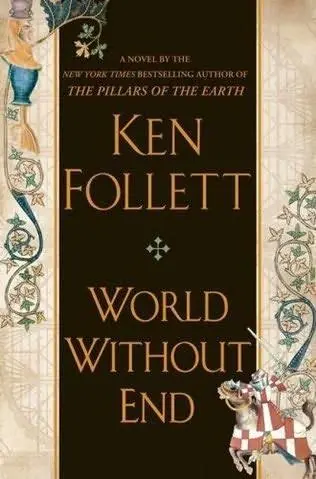
Ken Follett - World Without End
Здесь есть возможность читать онлайн «Ken Follett - World Without End» весь текст электронной книги совершенно бесплатно (целиком полную версию без сокращений). В некоторых случаях можно слушать аудио, скачать через торрент в формате fb2 и присутствует краткое содержание. Жанр: Историческая проза, на английском языке. Описание произведения, (предисловие) а так же отзывы посетителей доступны на портале библиотеки ЛибКат.
- Название:World Without End
- Автор:
- Жанр:
- Год:неизвестен
- ISBN:нет данных
- Рейтинг книги:5 / 5. Голосов: 1
-
Избранное:Добавить в избранное
- Отзывы:
-
Ваша оценка:
World Without End: краткое содержание, описание и аннотация
Предлагаем к чтению аннотацию, описание, краткое содержание или предисловие (зависит от того, что написал сам автор книги «World Without End»). Если вы не нашли необходимую информацию о книге — напишите в комментариях, мы постараемся отыскать её.
Ken Follett has 90 million readers worldwide. The Pillars of the Earth is his bestselling book of all time. Now, eighteen years after the publication of The Pillars of the Earth, Ken Follett has written the most-anticipated sequel of the year, World Without End.
In 1989 Ken Follett astonished the literary world with The Pillars of the Earth, a sweeping epic novel set in twelfth-century England centered on the building of a cathedral and many of the hundreds of lives it affected. Critics were overwhelmed-"it will hold you, fascinate you, surround you" (Chicago Tribune)-and readers everywhere hoped for a sequel.
World Without End takes place in the same town of Kingsbridge, two centuries after the townspeople finished building the exquisite Gothic cathedral that was at the heart of The Pillars of the Earth. The cathedral and the priory are again at the center of a web of love and hate, greed and pride, ambition and revenge, but this sequel stands on its own. This time the men and women of an extraordinary cast of characters find themselves at a crossroad of new ideas-about medicine, commerce, architecture, and justice. In a world where proponents of the old ways fiercely battle those with progressive minds, the intrigue and tension quickly reach a boiling point against the devastating backdrop of the greatest natural disaster ever to strike the human race-the Black Death.
Three years in the writing, and nearly eighteen years since its predecessor, World Without End breathes new life into the epic historical novel and once again shows that Ken Follett is a masterful author writing at the top of his craft.
World Without End — читать онлайн бесплатно полную книгу (весь текст) целиком
Ниже представлен текст книги, разбитый по страницам. Система сохранения места последней прочитанной страницы, позволяет с удобством читать онлайн бесплатно книгу «World Without End», без необходимости каждый раз заново искать на чём Вы остановились. Поставьте закладку, и сможете в любой момент перейти на страницу, на которой закончили чтение.
Интервал:
Закладка:
She gave him a direct look, her gold-flecked green eyes as candid as ever. “That sounds a bit like a reproach.”
“Perhaps it is. I was very angry with you. Whatever you decided to do, I felt you owed me an explanation.” He had not intended the conversation to go this way, but he found he could not help himself.
She was unapologetic. “It’s really quite simple. I could hardly bear to leave you. If I had been forced to speak to you, I think I would have killed myself.”
He was taken aback. For nine years he had thought she had been selfish on that day of parting. Now it looked as if he had been the selfish one, in making such demands on her. She had always had this ability to make him revise his attitudes, he recalled. It was an uncomfortable process, but she was often right.
They did not sit on the bench, but turned away and walked across the cathedral green. The sky had clouded over, and the sun had gone. “There is a terrible plague in Italy,” he said. “They call it la moria grande .”
“I’ve heard about it,” she said. “Isn’t it in southern France, too? It sounds dreadful.”
“I caught the disease. I recovered, which is unusual. My wife, Silvia, died.”
She looked shocked. “I’m so sorry,” she said. “You must feel terribly sad.”
“All her family died, and so did all my clients. It seemed like a good moment to come home. And you?”
“I’ve just been made cellarer,” she said with evident pride.
To Merthin that seemed somewhat trivial, especially after the slaughter he had seen. However, such things were important in the life of the nunnery. He looked up at the great church. “Florence has a magnificent cathedral,” he said. “Lots of patterns in coloured stone. But I prefer this: carved shapes, all the same shade.” As he studied the tower, grey stone against grey sky, it started to rain.
They went inside the church for shelter. A dozen or so people were scattered around the nave: visitors to the town looking at the architecture, devout locals praying, a couple of novice monks sweeping. “I remember feeling you up behind that pillar,” Merthin said with a grin.
“I remember it, too,” she said, but she did not meet his eye.
“I still feel the same about you as I did on that day. That’s the real reason I came home.”
She turned and looked at him with anger in her eyes. “But you got married.”
“And you became a nun.”
“But how could you marry her – Silvia – if you loved me?”
“I thought I could forget you. But I never did. Then, when I thought I was dying, I realized I would never get over you.”
Her anger vanished as quickly as it had appeared, and tears came to her eyes. “I know,” she said, looking away.
“You feel the same.”
“I never changed.”
“Did you try?”
She met his eye. “There’s a nun…”
“The pretty one who was with you in the hospital?”
“How did you guess?”
“She cried when she saw me. I wondered why.”
Caris looked guilty, and Merthin guessed she was feeling the way he had felt when Silvia used to say: “You’re thinking about your English girl.”
“Mair is dear to me,” Caris said. “And she loves me. But…”
“But you didn’t forget me.”
“No.”
Merthin felt triumphant, but he tried not to let it show. “In that case,” he said, “you should renounce your vows, leave the nunnery, and marry me.”
“Leave the nunnery?”
“You’ll need first to get a pardon for the witchcraft conviction, I realize that, but I’m sure it can be done – we’ll bribe the bishop and the archbishop and even the pope if necessary. I can afford it.”
She was not sure it would be as easy as he thought. But that was not her main problem. “It’s not that I’m not tempted,” she said. “But I promised Cecilia I would vindicate her faith in me… I have to help Mair take over as guest master… we need to build a new treasury… and I’m the only one who takes care of Old Julie properly…”
He was bewildered. “Is all that so important?”
“Of course it is!” she said angrily.
“I thought the nunnery was just old women saying prayers.”
“And healing the sick, and feeding the poor, and managing thousands of acres of land. It’s at least as important as building bridges and churches.”
He had not anticipated this. She had always been sceptical of religious observance. She had gone into the nunnery under duress, when it was the only way to save her own life. But now she seemed to have grown to love her punishment. “You’re like a prisoner who is reluctant to leave the dungeon, even when the door is opened wide,” he said.
“The door isn’t open wide. I would have to renounce my vows. Mother Cecilia-”
“We’ll have to work on all these problems. Let’s begin right away.”
She looked miserable. “I’m not sure.”
She was torn, he could see. It amazed him. “Is this you?” he said incredulously. “You used to hate the hypocrisy and falsehood that you saw in the priory. Lazy, greedy, dishonest, tyrannical-”
“That’s still true of Godwyn and Philemon.”
“Then leave.”
“And do what?”
“Marry me, of course.”
“Is that all?”
Once again he was bewildered. “It’s all I want.”
“No, it’s not. You want to design palaces and castles. You want to build the tallest building in England.”
“If you need someone to take care of…”
“What?”
“I’ve got a little girl. Her name is Lolla. She’s three.”
That seemed to settle Caris’s mind. She sighed. “I’m a senior official in a convent of thirty-five nuns, ten novices and twenty-five employees, with a school and a hospital and a pharmacy – and you’re asking me to throw all that up to nursemaid one little girl I’ve never met.”
He gave up arguing. “All I know is that I love you and I want to be with you.”
She laughed humourlessly. “If you had said that and nothing else, you might have talked me into it.”
“I’m confused,” he said. “Are you refusing me, or not?”
“I don’t know,” she said.
55
Merthin lay awake much of the night. He was accustomed to bedding down in taverns, and the sounds Lolla made in her sleep only soothed him; but tonight he could not stop thinking about Caris. He was shocked by her reaction to his return. He realized, now, that he had never thought logically about how she would feel when he reappeared. He had indulged in unrealistic nightmares about how she might have changed, and in his heart he had hoped for a joyous reconciliation. Of course she had not forgotten him; but he could have figured out that she would not have spent nine years moping for him: she was not the type.
All the same, he would never have guessed that she would be so committed to her work as a nun. She had always been more or less hostile to the church. Given how dangerous it was to criticize religion in any way, she might well have concealed the true depth of her scepticism even from him. So it was a terrible shock to find her reluctant to leave the nunnery. He had anticipated fear of Bishop Richard’s death sentence, or anxiety about being permitted to renounce her vows, but he had not suspected she might have found life in the priory so fulfilling that she hesitated to leave it to become his wife.
He felt angry with her. He wished he had said: “I’ve travelled a thousand miles to ask you to marry me – how can you say you’re not sure?” He thought of a lot of biting remarks he might have made. Perhaps it was a good thing they had not occurred to him then. Their conversation had ended with her asking him to give her time to get over the shock of his sudden return and think about what she wanted to do. He had consented – he had no alternative – but it had left him hanging in agony like a man crucified.
Читать дальшеИнтервал:
Закладка:
Похожие книги на «World Without End»
Представляем Вашему вниманию похожие книги на «World Without End» списком для выбора. Мы отобрали схожую по названию и смыслу литературу в надежде предоставить читателям больше вариантов отыскать новые, интересные, ещё непрочитанные произведения.






Обсуждение, отзывы о книге «World Without End» и просто собственные мнения читателей. Оставьте ваши комментарии, напишите, что Вы думаете о произведении, его смысле или главных героях. Укажите что конкретно понравилось, а что нет, и почему Вы так считаете.