Mary Russell - Doc
Здесь есть возможность читать онлайн «Mary Russell - Doc» весь текст электронной книги совершенно бесплатно (целиком полную версию без сокращений). В некоторых случаях можно слушать аудио, скачать через торрент в формате fb2 и присутствует краткое содержание. Год выпуска: 2011, ISBN: 2011, Издательство: RANDOM HOUSE, Жанр: Историческая проза, на английском языке. Описание произведения, (предисловие) а так же отзывы посетителей доступны на портале библиотеки ЛибКат.
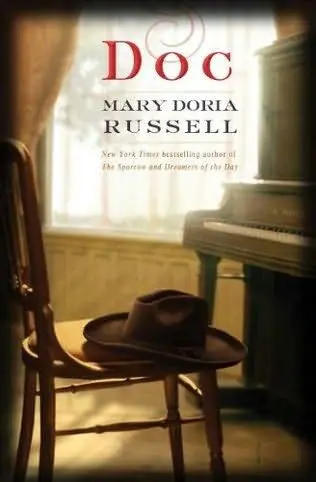
- Название:Doc
- Автор:
- Издательство:RANDOM HOUSE
- Жанр:
- Год:2011
- ISBN:978-0-679-60439-6
- Рейтинг книги:3 / 5. Голосов: 1
-
Избранное:Добавить в избранное
- Отзывы:
-
Ваша оценка:
Doc: краткое содержание, описание и аннотация
Предлагаем к чтению аннотацию, описание, краткое содержание или предисловие (зависит от того, что написал сам автор книги «Doc»). Если вы не нашли необходимую информацию о книге — напишите в комментариях, мы постараемся отыскать её.
Beautifully educated, born to the life of a Southern gentleman, Dr. John Henry Holliday is given an awful choice at the age of twenty-two: die within months in Atlanta or leave everyone and everything he loves in the hope that the dry air and sunshine of the West will restore him to health. Young, scared, lonely, and sick, he arrives on the rawest edge of the Texas frontier just as an economic crash wrecks the dreams of a nation. Soon, with few alternatives open to him, Doc Holliday is gambling professionally; he is also living with Mária Katarina Harony, a high-strung Hungarian whore with dazzling turquoise eyes, who can quote Latin classics right back at him. Kate makes it her business to find Doc the high-stakes poker games that will support them both in high style. It is Kate who insists that the couple travel to Dodge City, because 'that's where the money is.'
And that is where the unlikely friendship of Doc Holliday and Wyatt Earp really begins — before Wyatt Earp is the prototype of the square-jawed, fearless lawman; before Doc Holliday is the quintessential frontier gambler; before the gunfight at the O.K. Corral links their names forever in American frontier mythology — when neither man wanted fame or deserved notoriety.
Authentic, moving, and witty, Mary Doria Russell's fifth novel redefines these two towering figures of the American West and brings to life an extraordinary cast of historical characters, including Holliday's unforgettable companion, Kate. First and last, however, Doc is John Henry Holliday's story, written with compassion, humor, and respect by one of our greatest contemporary storytellers.
Doc — читать онлайн бесплатно полную книгу (весь текст) целиком
Ниже представлен текст книги, разбитый по страницам. Система сохранения места последней прочитанной страницы, позволяет с удобством читать онлайн бесплатно книгу «Doc», без необходимости каждый раз заново искать на чём Вы остановились. Поставьте закладку, и сможете в любой момент перейти на страницу, на которой закончили чтение.
Интервал:
Закладка:
Eyes widening seraphically, Doc poured another shot into von Angensperg’s glass. “Do tell, sir! We are agog with anticipation.”
Alexander’s own stories came first. These were matched, then topped by a variety of other tales. The laughter was raucous and good-natured, the cigars were very fine indeed, and there was no bottom to the bottle. Dressed as he was in a soft cotton shirt, without the nudge of a starched Roman collar to remind him of who and what he was, Alexander relaxed into the general conviviality. For the most part, however, he found himself talking to John Holliday, whose accent became more familiar as the evening progressed, and whose opinions were as strong and undiluted as his bourbon.
Before long, their conversation made Alexander think of two starved men falling upon a banquet table laden with richer food than either had tasted in years. The Chinese labor question, Dodge City politics, Mr. Darwin’s proposal. (“The notion explains a great deal of natural history,” in Doc’s opinion, “but considerin’ the presidency from George Washington to Rutherford B. Hayes, I believe we can dismiss the case for evolutionary progress.”) The electrical principles underlying telephony. Strategy in poker. The Schliemann excavation of Troy, and Lucian’s satires, which they both loved, especially The True History . Homer’s “Wrath” reminded Doc of Saint John’s “Logos,” and he asked if Alexander thought the beginning of that Gospel reflected the philosophy of Heraclitus. “Quite likely” was Alex’s answer, which led them on to biblical criticism and the work of Hermann Reimarus, and somehow that wandered into a discussion of German versus Italian opera.
They only noticed that the room had emptied out when the manager came to the table, asking if he could lock up. There was a short, whispered discussion. Doc counted out what must have been over three thousand dollars and made one last purchase of cigars and a final fifth of bourbon. Cane in one hand, bottle in the other, Doc led them around to the north side of the building, away from Front Street’s all-night carouse. There they sat on kegs and packing crates, smoking and drinking under the stars, and talking about home.
By that time, only four men were left: Doc himself, Morgan Earp, Eddie Foy, and the former Prince Alexander Anton Josef Maria Graf von Angensperg, who was just plain Alex by that time, drunker than he’d been in fifteen years and long past noticing how late it was or how soon he would be saying Mass.
Many hours later—when the funeral was over and Johnnie had been buried—on the train back to Wichita, Alexander should have been preparing himself to confess gluttony and public intoxication and a failed fast. Instead he found himself trying to remember everything he’d said to Doc in the deep dark before dawn when, for the first time since leaving Europe, Alexander had felt—suddenly and fully—how homesick he was, how much he missed his mother tongue, and his brothers and sisters and friends, and skiing and parties, and simply having a good time. He had the uncomfortable feeling that he’d become rather maudlin at one point, and suspected that Doc had saved him from making an ass of himself.
“Yes … Kin and conversation,” Doc had agreed before deflecting the talk delicately. “And good music—played well ,” he emphasized, for somewhere out on Front Street, a Strauss waltz was being hammered approximento . “At my last count, there are nineteen saloons in this town. Seven have pianos, not a single one of which is in tune. I cannot bear to put my hands on any of them.”
“You are a pianist, then?” Alex asked.
“ Thalberg was a pianist, sir, but I do love to play.”
“Thalberg! So you have been to Europe?”
“Regrettably: no. The maestro toured the South when I was a boy.”
“I heard Liszt in Paris,” Alex said, like a man laying aces on the table.
“They say he changed pianos the way another man might change horses,” Doc said, “to keep from wearin’ the beasts out.”
“And that he played so intensely the very keys would bleed! I can testify that he drove women to frenzy. A young lady sitting next to me wept so, she fainted during a sonata. I preferred Chopin’s performance, frankly—”
“You heard Chopin?” Doc fell back against the clapboards. “I am prostrate with envy, sir!”
“He played at a private salon one night. I was young, but the evening was unforgettable … He played the Polonaise in A-flat, and some truly magical variations on a Bellini aria. Such delicacy! His pianissimo was like angel’s breath! A selection of mazurkas—those were remarkable, as well, his left hand always in strict tempo, but the right rubato: ahead of the beat, behind it. And when we thought he had nothing left, an encore! The G-flat Waltz. It was such a demanding program, and the poor man was half dead from consumption, but somehow he got through the whole—” Alex stopped. “Forgive me. That was thoughtless.”
“Yes,” Doc said coolly, but he waved the moment off. “Apart from Miss Kate, you are the first person I have spoken to since leaving Georgia with the slightest notion of who Chopin was. We, sir, are an atoll of culture on this godforsaken ocean of grass,” he said, lifting a hand toward the vast darkness around them. “Kate loves the mountains, as you do, but my own eyes are schooled to a gentler landscape. Rollin’ hills. Curvin’ roads. No vista entirely untouched by human hands …” Doc looked at Eddie, who’d been strangely quiet all this time. “How do you stand this wilderness, after Chicago?”
“It’s a job, then, isn’t it, and that’s more than I could find at home,” Eddie snapped, his brogue deepening. “It’s a bed to sleep in and a roof over me head when the show is over, and don’t that beat a traveling carnival all hollow, now? And I don’t mind the wilderness one wee bit. It’s being trapped in a burning city gives me the cold creeps, and if any of youse so much as breathes the name O’Leary, I’ll have your guts,” he promised. “Changed my name from Fitzgerald to get out from under the curse—they blamed all us micks for that damn cow. I tell you true, Father: when I shuffle off the mortal coil, I’m going straight to heaven, for I’ve served me time in hell. Run for miles, I did, me sister’s small boy in me arms, and there was us standing in Lake Michigan, watching the whole city go up, not knowing if there was anyone left alive at home. There’s nothing worse than burning, that’s the lesson I learned from Chicago! At least in Dodge, there’s a fighting chance you could get away from a fire—”
Silence fell. They were all thinking the same thing. Finally Eddie asked the question that had gnawed at him since he’d smelled Johnnie’s charred remains as the mortician’s men carried the body out of the ruins.
“Doc, do you think he was dead, then? Before he burned, I mean.”
“No,” Doc said, “but I believe he was unconscious. He would not have felt the flames.”
“Christ,” Eddie said, holding his hand out for the bottle, and speaking for them all. “That’s a mercy, then.”
They listened to the pianos, and shouts, and drunken laughter, to the wind in the grass and to the crickets. A few yards away, a vixen’s eyes caught a bit of light from a saloon, then darkened again as she turned her head; presently, they heard the whir of wings—a prairie chicken, flushed by the fox and caught to feed her kits.
“And you, Morgan? Where is home for the Earps?” Alex asked.
“You know, I been sitting here wondering about that,” Morg said. “I don’t guess my family stayed anywheres long enough to call it home. Illinois. Iowa. Missouri. California. Pa always had some reason for moving on. New opportunities, he told us, but there were debts … And trouble with neighbors, usually. It was hard on my mother. And my two sisters hated losing their friends over and over, but there was six of us boys, and we didn’t need anybody else. We’re all grown now, even Warren, but we keep moving. Utah, Nevada. The Dakotas. Colorado. Kansas. Arizona. I guess wherever my brothers are, that’s home. When we’re scattered, like now? I guess missing them is like being homesick for you and Doc.”
Читать дальшеИнтервал:
Закладка:
Похожие книги на «Doc»
Представляем Вашему вниманию похожие книги на «Doc» списком для выбора. Мы отобрали схожую по названию и смыслу литературу в надежде предоставить читателям больше вариантов отыскать новые, интересные, ещё непрочитанные произведения.








Обсуждение, отзывы о книге «Doc» и просто собственные мнения читателей. Оставьте ваши комментарии, напишите, что Вы думаете о произведении, его смысле или главных героях. Укажите что конкретно понравилось, а что нет, и почему Вы так считаете.