Mary Russell - Doc
Здесь есть возможность читать онлайн «Mary Russell - Doc» весь текст электронной книги совершенно бесплатно (целиком полную версию без сокращений). В некоторых случаях можно слушать аудио, скачать через торрент в формате fb2 и присутствует краткое содержание. Год выпуска: 2011, ISBN: 2011, Издательство: RANDOM HOUSE, Жанр: Историческая проза, на английском языке. Описание произведения, (предисловие) а так же отзывы посетителей доступны на портале библиотеки ЛибКат.
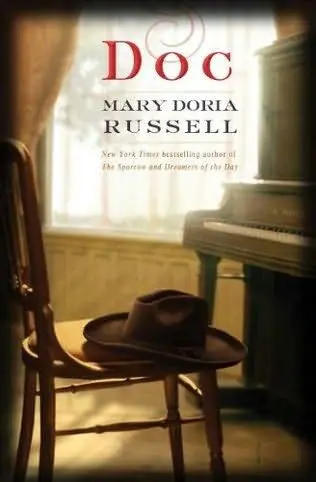
- Название:Doc
- Автор:
- Издательство:RANDOM HOUSE
- Жанр:
- Год:2011
- ISBN:978-0-679-60439-6
- Рейтинг книги:3 / 5. Голосов: 1
-
Избранное:Добавить в избранное
- Отзывы:
-
Ваша оценка:
Doc: краткое содержание, описание и аннотация
Предлагаем к чтению аннотацию, описание, краткое содержание или предисловие (зависит от того, что написал сам автор книги «Doc»). Если вы не нашли необходимую информацию о книге — напишите в комментариях, мы постараемся отыскать её.
Beautifully educated, born to the life of a Southern gentleman, Dr. John Henry Holliday is given an awful choice at the age of twenty-two: die within months in Atlanta or leave everyone and everything he loves in the hope that the dry air and sunshine of the West will restore him to health. Young, scared, lonely, and sick, he arrives on the rawest edge of the Texas frontier just as an economic crash wrecks the dreams of a nation. Soon, with few alternatives open to him, Doc Holliday is gambling professionally; he is also living with Mária Katarina Harony, a high-strung Hungarian whore with dazzling turquoise eyes, who can quote Latin classics right back at him. Kate makes it her business to find Doc the high-stakes poker games that will support them both in high style. It is Kate who insists that the couple travel to Dodge City, because 'that's where the money is.'
And that is where the unlikely friendship of Doc Holliday and Wyatt Earp really begins — before Wyatt Earp is the prototype of the square-jawed, fearless lawman; before Doc Holliday is the quintessential frontier gambler; before the gunfight at the O.K. Corral links their names forever in American frontier mythology — when neither man wanted fame or deserved notoriety.
Authentic, moving, and witty, Mary Doria Russell's fifth novel redefines these two towering figures of the American West and brings to life an extraordinary cast of historical characters, including Holliday's unforgettable companion, Kate. First and last, however, Doc is John Henry Holliday's story, written with compassion, humor, and respect by one of our greatest contemporary storytellers.
Doc — читать онлайн бесплатно полную книгу (весь текст) целиком
Ниже представлен текст книги, разбитый по страницам. Система сохранения места последней прочитанной страницы, позволяет с удобством читать онлайн бесплатно книгу «Doc», без необходимости каждый раз заново искать на чём Вы остановились. Поставьте закладку, и сможете в любой момент перейти на страницу, на которой закончили чтение.
Интервал:
Закладка:
As much to spite Kate as to please Doc, Morgan and Eddie accepted the offer, as did von Angensperg.
“You know the rules for the fast,” the priest observed with some surprise. “Are you a Catholic, Dr. Holliday? I have thought Catholicism rare among Southerners.”
“It is, outside of New Orleans. My people are Presbyterians and Methodists for the most part, but our clan does hold in its wide embrace a few lace-curtain Irish—”
“Does it now!” Eddie cried. “Is it possible we’re family, then?”
“Why, Eddie Foy, you miserable shanty bog rat,” Doc said affably, “kindly give my kin credit for some taste.”
Eddie took it for the joshing it was, but Kate said, “Even if you have none, I suppose? Is that what you’re saying?”
There were a dozen things about Doc Holliday that Morgan didn’t understand, but this was the most baffling: why did he put up with Kate? She was not bad-looking and she was nice enough when she was sober, but at least once a week, she’d tie one on and try to pick a fight with him.
“—so I am not unfamiliar with the customs of the Church of Rome,” Doc was telling von Angensperg. “My dearest cousin prays for my conversion nightly, I am given to understand.”
“That girl!” Kate said with a dismissive wave of the hand. “Poor Penelope! Still weaving …”
“And shall your cousin’s prayers be answered?” the priest asked.
They were following Doc’s lead now, pretending Kate wasn’t there.
“After the war, the Lord God in his infinite wisdom,” Doc said with sudden hot sarcasm, “saw fit to take my mother —who was as fine an example of Georgia womanhood as ever walked this earth—while electin’ to leave that vile, murderous Yankee barbarian William Tecumseh Sherman alive and—”
As often happened when Doc’s blood got up, he started to cough, and this time it was pretty bad.
“You see? I told you!” Kate said, sounding satisfied. “You’re killing yourself, damn you!”
Father von Angensperg didn’t seem to mind profanity or cursing, but he was beginning to realize that Doc was a lunger. Concerned, the priest started to say something. Morgan caught his eye and shook his head, for in Morg’s opinion, the best policy was to wait things out and let Doc finish whatever he was saying, after he got his breath. Eddie, by contrast, usually tried to fill in.
“Vile, murderous Yankee barbarian …” the Irishman recited dreamily. “Miserable shanty bog rat … Ignorant goddam Carolina cracker … I collect them,” he told the priest brightly. “Georgia poetry, that is! An artist with an insult, our Doc.”
“ —alive and well ,” Doc repeated with hoarse insistence, still holding a handkerchief over his mouth, “a state that despicable—”
“ Goddam ,” Eddie supplied joyfully.
“Yankee—”
“ Sonofabitch! ” Eddie cried with a happy grin.
“—continues to enjoy to this very day.” Doc drained the bourbon in his shot glass and cleared his throat before finishing. “The Almighty and I have scarcely been on speakin’ terms since the sixteenth of September 1866.”
Nora delivered the peaches just then and Doc thanked her prettily, his voice genteel once more. “I must say,” he told the priest, “that the opportunity to listen to Latin regularly constitutes Catholicism’s most considerable temptation. Johnnie felt the same way.”
“He never found his way to the Faith,” von Angensperg said, but the priest looked a little dazed, and Morgan sympathized. He’d never known anybody to get as mad as Doc did, as quick as he did, but he got over it fast, too. That could be just as startling if you weren’t used to it.
“Nevertheless,” Doc was saying, “Johnnie told me that he was always pleased to attend the Mass. He said that the prayer book had Latin on the left and English on the right, and he enjoyed followin’ the ceremony in both languages. I recall one day when he asked if I knew offhand what turb meant. ‘Has to be Latin,’ he said. He was tryin’ to work out a derivation, you see: perturb, disturb, turbulence, turbid.”
“ Turbare ,” von Angensperg said. “To stir.”
“Yes, indeed, sir! And when I told him that, you’d have thought he’d struck gold. That boy had a mile-wide smile. Did my heart good to see it. Do you happen to know, sir, who taught Johnnie to deal faro?”
“Pharaoh?” The priest blinked, trying to follow. “From Exodus, do you mean?”
“I’ll be damned,” Doc said. “Never thought of that! Could well be the origin of the name … No, sir, faro is a game of chance, a variation on a slave game called skinnin’. I learned from a freed slave myself, after the war, and I wondered who had taught Johnnie to play.”
“Johnnie was gambling? I thought he worked for the barber.”
“He did that as well,” said Doc, “and helped Bob Wright with his accounts, too, I understand. Johnnie was a hardworkin’ young man, sir, but he was also a mechanic of the first water.”
“A mechanic?”
“Sleight of hand, clipped edges, cold-decking,” Morg explained.
When the priest looked blank, Doc said, “Let me put it this way: Johnnie was dealin’ faro, but the way he played? It wasn’t gamblin’.”
“I won’t believe that,” von Angensperg said, offended now. “Johnnie was an honest boy.”
“Yes, sir. Yes, he was, fundamentally,” Doc agreed. “But a dealer generally gets a percentage of the house, so there is every temptation to cheat, and a thousand ways to do it. John Horse Sanders knew more of them than I do, and that is no small statement.”
Doc raised his handkerchief again and turned away. He coughed hard—deliberately and only once. Everyone could see that it hurt him and they kept quiet while he sat still.
“A dealer needs three, four hundred dollars to bank a small-stakes faro table,” he continued a moment later. “I have asked around Dodge a bit, but nobody seems to know how Johnnie got his game started. Do you have any notion from whom he might have obtained that kind of money, sir?”
“I’m quite sure I have no idea,” von Angensperg said. “Certainly no one at St. Francis had such a sum, and we would not have encouraged gambling.”
“Just as well, for whoever staked him may have placed him in the line of fire, so to speak. Dealin’ faro is a dangerous occupation. I myself have learned to avoid it when I can,” he added, tapping his cane lightly with an index finger. “I wonder if Johnnie mentioned any kin to you. I understand that he was born in Texas, though the family was livin’ in Wichita when he was orphaned. Perhaps there is someone who should be informed of the boy’s passin’.”
“We do not encourage our students to keep their ties to the past,” von Angensperg said, shifting in his chair when Doc’s mouth opened in astonishment. “It can only hold them back.”
“I do not believe that is the case, sir,” Doc said. “Johnnie was knowledgeable about his family and their traditions. He took considerable pride in them, as I do in my own, and as I expect you do in yours. Tell me, sir, how did his parents die?”
“I never asked.” Von Angensperg was starting to sound a little huffy. “Many of the children come to us after a tragedy,” the priest explained. “We try not to allow them to dwell on their sadness.”
“I can tell you, Doc,” Morg offered, glad to take some pressure off the priest. Doc could be pretty relentless when he was riding down an idea. “See, Johnnie’s mother was a squaw and his father was a buffalo soldier.”
“A Seminole Negro Indian Scout,” Doc said.
“The Indians call them buffalo soldiers, Father,” Eddie told him, “because Negro hair is curly, like a buffalo’s.”
Читать дальшеИнтервал:
Закладка:
Похожие книги на «Doc»
Представляем Вашему вниманию похожие книги на «Doc» списком для выбора. Мы отобрали схожую по названию и смыслу литературу в надежде предоставить читателям больше вариантов отыскать новые, интересные, ещё непрочитанные произведения.






Обсуждение, отзывы о книге «Doc» и просто собственные мнения читателей. Оставьте ваши комментарии, напишите, что Вы думаете о произведении, его смысле или главных героях. Укажите что конкретно понравилось, а что нет, и почему Вы так считаете.