Mary Russell - Doc
Здесь есть возможность читать онлайн «Mary Russell - Doc» весь текст электронной книги совершенно бесплатно (целиком полную версию без сокращений). В некоторых случаях можно слушать аудио, скачать через торрент в формате fb2 и присутствует краткое содержание. Год выпуска: 2011, ISBN: 2011, Издательство: RANDOM HOUSE, Жанр: Историческая проза, на английском языке. Описание произведения, (предисловие) а так же отзывы посетителей доступны на портале библиотеки ЛибКат.
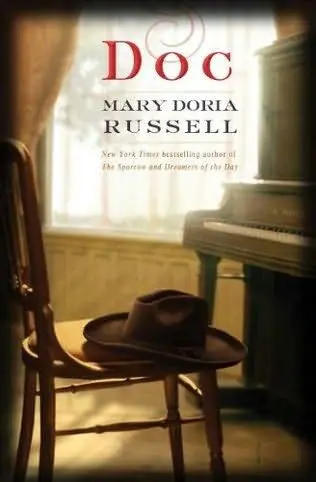
- Название:Doc
- Автор:
- Издательство:RANDOM HOUSE
- Жанр:
- Год:2011
- ISBN:978-0-679-60439-6
- Рейтинг книги:3 / 5. Голосов: 1
-
Избранное:Добавить в избранное
- Отзывы:
-
Ваша оценка:
Doc: краткое содержание, описание и аннотация
Предлагаем к чтению аннотацию, описание, краткое содержание или предисловие (зависит от того, что написал сам автор книги «Doc»). Если вы не нашли необходимую информацию о книге — напишите в комментариях, мы постараемся отыскать её.
Beautifully educated, born to the life of a Southern gentleman, Dr. John Henry Holliday is given an awful choice at the age of twenty-two: die within months in Atlanta or leave everyone and everything he loves in the hope that the dry air and sunshine of the West will restore him to health. Young, scared, lonely, and sick, he arrives on the rawest edge of the Texas frontier just as an economic crash wrecks the dreams of a nation. Soon, with few alternatives open to him, Doc Holliday is gambling professionally; he is also living with Mária Katarina Harony, a high-strung Hungarian whore with dazzling turquoise eyes, who can quote Latin classics right back at him. Kate makes it her business to find Doc the high-stakes poker games that will support them both in high style. It is Kate who insists that the couple travel to Dodge City, because 'that's where the money is.'
And that is where the unlikely friendship of Doc Holliday and Wyatt Earp really begins — before Wyatt Earp is the prototype of the square-jawed, fearless lawman; before Doc Holliday is the quintessential frontier gambler; before the gunfight at the O.K. Corral links their names forever in American frontier mythology — when neither man wanted fame or deserved notoriety.
Authentic, moving, and witty, Mary Doria Russell's fifth novel redefines these two towering figures of the American West and brings to life an extraordinary cast of historical characters, including Holliday's unforgettable companion, Kate. First and last, however, Doc is John Henry Holliday's story, written with compassion, humor, and respect by one of our greatest contemporary storytellers.
Doc — читать онлайн бесплатно полную книгу (весь текст) целиком
Ниже представлен текст книги, разбитый по страницам. Система сохранения места последней прочитанной страницы, позволяет с удобством читать онлайн бесплатно книгу «Doc», без необходимости каждый раз заново искать на чём Вы остановились. Поставьте закладку, и сможете в любой момент перейти на страницу, на которой закончили чтение.
Интервал:
Закладка:
“Anyways,” Morg said, “Charlie Sanders—that was Johnnie’s father—his regiment moved up from Texas to Fort Sill during the Indian wars. Charlie brought his family up north, too. They moved to Wichita after he mustered out. This was a few years back,” Morgan told the priest, “when the cattle drives all went to the Wichita railhead. And you’ve seen what these cow towns are like! Wichita was almost as bad as Dodge, in its day. Charlie was working as a hod carrier in the city and when he got home one night, he found a couple of drovers interfering with his wife. Beat the tar out of ’em.”
“I expect the Texans came back with their friends,” Doc said. “To even the score?”
“Murdered Charlie and his wife, both,” Morgan said.
“Don’t never bow down …” Doc said, eyes closing. “Charles Sanders had more courage than wisdom. It is a trait I fear he passed on to his son.”
“I blame myself,” von Angensperg confessed. Everyone looked at him. “I was too lenient with Johnnie. He argued often with Brother Sheehan, and I interceded, but I was wrong to do so …” He looked away.
“Sheehan. Now, there’s a name I know,” Doc said, narrow-eyed. “Tried to thrash the devil out of Johnnie a couple of times, I was told. Any truth in that?”
“Johnnie, Johnnie, Johnnie!” Kate muttered.
“Yes, and I see the reason for it now!” the priest told Doc. “There are many men in this country who would kill an Indian or a Negro who is disrespectful, or who is simply better than they—”
“Who is Johnnie Sanders to you?” Kate demanded suddenly. “Why do all of you care so much about some nappy-haired—”
“ Kate! ” Doc was working on the tea again, staring at her over the rim of the cup. “Say another word,” he warned softly, “and you will regret it.”
“These are excellent,” von Angensperg said of the peaches.
He’s learning, Morgan thought. And he was sobering up a little, too.
“They are canned,” Doc pointed out apologetically, “but they are a taste of home, and a comfort to me.”
“Ah! Georgia peaches—of course!” the priest said, his tone changing slightly. “You are a most gracious host, but I must confess, Dr. Holliday, that I am somewhat surprised by your kind regard for a boy like Johnnie, and by your keen interest in his life.”
Doc’s brows rose slightly. “And why should that be, sir?”
“Well, you are a Southerner, and … of a certain class.”
“Why, Father von Angensperg,” Doc said, “whatever do you mean?”
Morgan shifted uneasily. Doc’s voice always took on a peculiar musical quality when he was about to go off on someone. “Come on, Doc. Don’t take it like that. He didn’t mean—”
“The hell he didn’t,” Doc snapped, not even glancing Morgan’s way. His eyes remained steadily on the priest’s. “Twenty dollars says Father von Angensperg has read Mrs. Stowe’s little book and now he knows all … about … Southerners. Any takers?”
“Ah, Father,” Eddie cautioned happily, “you’re in grave danger of learning a lesson, so you are!”
“I have offended you,” the priest said.
“Yes, sir, you have.”
“C’mon, Doc,” Morgan said, “let it go.”
“No, Morgan, I don’t believe I can do that,” Doc replied with that eerie musical malice. “If the good father and I are goin’ to be friends, this is a topic worth explorin’. I am curious to know what he means by ‘a boy like Johnnie.’ I am reasonably certain I understand ‘Southerner of a certain class.’ Father von Angensperg is callin’ me a bigot.”
The priest blinked. “Not at all—”
“I beg to differ, sir,” Doc said politely. “I believe you are callin’ me an idle, vicious, slave-ownin’, nigger-beatin’ bigot.”
Von Angensperg looked stunned. “I assure you: I never meant—I said no such thing!”
“Not in those words, but that is most certainly what you meant to imply, and I will thank you not to deny it.” Doc leaned forward suddenly, the anger open now. “I was thirteen years old when the war ended, sir. I myself never owned a slave. It is true that my father had seventeen hundred acres under cotton before the war. He owned slaves who worked his fields. It is also true that I was served by slaves in my childhood. I was born to that life, sir, as princes are born to theirs.”
“Let it go, Doc,” Morgan said again, but the priest shook his head. He seemed willing to hear Doc out, which was just as well, because Doc didn’t even pause.
“Of course, we are told in Scripture that the sins of the fathers are visited upon the sons. Do you believe that, sir?” Doc asked. “Or perhaps there is somethin’ about my own behavior or my conversation that strikes you as bigoted?”
“No, of course not.”
“And yet you are surprised by my regard for John Horse Sanders. Earlier today, I took my noon meal with a Chinaman. Morgan here is a Republican. Why, at this very moment, there is an Irishman at my table!”
“Which is as low as any gentleman in Dodge is willing to go,” Eddie noted proudly.
“And I’m a whore,” Kate declared. She was really skunked now.
“Miss Kate’s marital status cannot be regularized,” Doc said in her defense, “which places all her associations beyond the pale, but I must point out that in many social circles, sir, Jesuits are considered the very worst that the Great Whore of Babylon has to offer in the way of papist idolaters. And yet: you, too, are my guest, sir. Where, then, do you suppose I might draw the line?”
Eddie was grinning his head off and even Kate seemed entertained, but Morgan felt bad for the poor damn priest, who only wanted to know something Morg himself had wondered about, because it was kind of strange how Doc was doing all this for a kid he’d only known a few weeks.
Doc’s voice was getting roupy again and he turned away, coughing hard into his handkerchief to clear some obstruction. “I admit,” he said a few moments later, “that I might not have an equal regard for other boys like John Horse Sanders. Then again, I have never met anyone remotely worthy of the category. In fact, I am inclined to argue that anyone who imagines that such categories exist should be considered a bigot himself.”
“Your points are taken, Dr. Holliday,” von Angensperg said.
“Then perhaps you would like to reconsider your words,” Doc pressed.
“All right, that’s enough, Doc,” Morgan said. He meant it, too, because John Holliday was—bar none—the most educated man Morgan Earp had ever met, and he could be the most courteous and kind, but there was just no quit in him when he got like this, and he was stupid sometimes about how long and how hard he pushed. Morgan himself had made a study of this sort of thing. You didn’t have to be chummy like Ed Masterson, and you didn’t have to bash heads with no warning, the way Virgil did. You could give an order and make it stick, like Wyatt did, but you had to leave a man some pride to walk away with. That’s what Doc just never seemed to see.
To Morgan’s surprise, the priest thought it over and replied, “Yes. I believe I would like to correct myself.” He straightened, looked directly at Doc, and declared, “There was only one John Horse Sanders. He was worthy of respect. I am pleased and grateful that he had yours, as he had mine.”
There was a considerable silence.
“ Sunt lacrimae rerum ,” Doc said finally, “for he is gone now, and that is a pity, and I offer you my hand on it, sir.”
“No victor, no vanquished!” Eddie cried.
Doc poured them all another round. “To Johnnie,” he said, “and to men who won’t bow down. Requiescant in pace , by God. They ever catch the killer, Morg?”
Читать дальшеИнтервал:
Закладка:
Похожие книги на «Doc»
Представляем Вашему вниманию похожие книги на «Doc» списком для выбора. Мы отобрали схожую по названию и смыслу литературу в надежде предоставить читателям больше вариантов отыскать новые, интересные, ещё непрочитанные произведения.






Обсуждение, отзывы о книге «Doc» и просто собственные мнения читателей. Оставьте ваши комментарии, напишите, что Вы думаете о произведении, его смысле или главных героях. Укажите что конкретно понравилось, а что нет, и почему Вы так считаете.