Bernard Cornwell - The Winter King
Здесь есть возможность читать онлайн «Bernard Cornwell - The Winter King» весь текст электронной книги совершенно бесплатно (целиком полную версию без сокращений). В некоторых случаях можно слушать аудио, скачать через торрент в формате fb2 и присутствует краткое содержание. Год выпуска: 1997, Издательство: MacMillan Publishers, Жанр: Историческая проза, на английском языке. Описание произведения, (предисловие) а так же отзывы посетителей доступны на портале библиотеки ЛибКат.
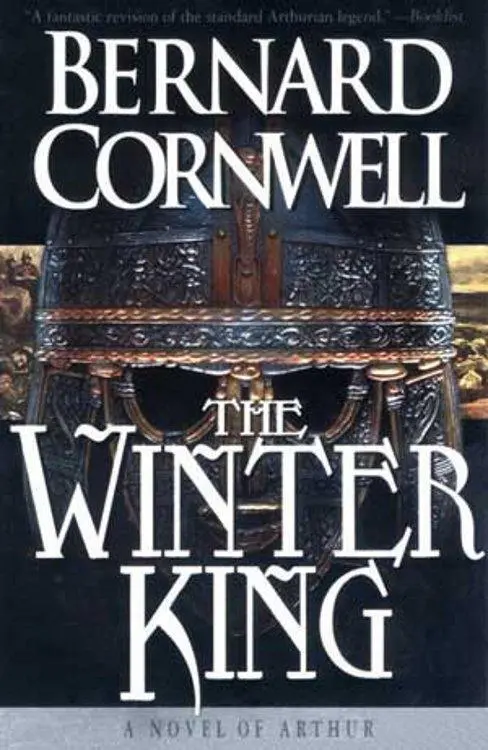
- Название:The Winter King
- Автор:
- Издательство:MacMillan Publishers
- Жанр:
- Год:1997
- ISBN:нет данных
- Рейтинг книги:4 / 5. Голосов: 1
-
Избранное:Добавить в избранное
- Отзывы:
-
Ваша оценка:
The Winter King: краткое содержание, описание и аннотация
Предлагаем к чтению аннотацию, описание, краткое содержание или предисловие (зависит от того, что написал сам автор книги «The Winter King»). Если вы не нашли необходимую информацию о книге — напишите в комментариях, мы постараемся отыскать её.
Fifth century Britain lies on the edge of darkness. Memories of Roman civilization are fading; the pagan Gods are retreating before the spread of Christianity; the Saxons are snapping and snarling at the borders. Only fragile bonds unite the unruly kingdoms of Britain against the invaders, bonds cemented by the vigour of the High King, Uther Pendragon. But the Pendragon is failing, and his heir is no strong leader but a child, born on a bitter winter night.
Only one man could keep Uther's throne safe,only he could hold the warring kingdoms together to face their true enemy, the Saxons. That man is Arthur: soldier, statesman, Merlin's protege, Uther's illegitimate son. But he has been banished, exiled by his own father to Brittany. Derfel, one of his spearmen, narrates the story of Arthur's return and of his quest for peace: embattled, bloody and, finally, triumphant.
The Winter King is a magnificent tale of the Dark Ages and the reality of war and political strife in a land where religion vied with magic for the souls of the people. It portrays Arthur the man rather than the legend, a military genius who, with a small band of warriors bound to him by loyalty and love, struggled to keep alive a flicker of civilization.
The Winter King — читать онлайн бесплатно полную книгу (весь текст) целиком
Ниже представлен текст книги, разбитый по страницам. Система сохранения места последней прочитанной страницы, позволяет с удобством читать онлайн бесплатно книгу «The Winter King», без необходимости каждый раз заново искать на чём Вы остановились. Поставьте закладку, и сможете в любой момент перейти на страницу, на которой закончили чтение.
Интервал:
Закладка:
Tewdric pointed at Galahad, who first introduced himself. “I am Galahad, Lord King,” he said, 'a Prince of Benoic. If King Gorfyd-dyd will receive no envoys from Gwent or Dumnonia, then surely he will not refuse one from Armorica? Let me go, Lord King, to Caer Sws and enquire what Gorfyddyd intends to do with Mordred. And if I do go, Lord King, will you accept my word as to his verdict?“ Tewdric was happy to accept. He was happy with anything that might avert war, but he was still anxious for Arthur's agreement. ”Suppose Gorfyddyd decrees that Mordred is safe," he suggested to Arthur.
“What will you do then?”
Arthur stared at the table. He was losing his dream, but he could not tell a lie to save that dream and so he looked up with a rueful smile. “In that case, Lord King, I would leave Britain and I would entrust Mordred to your keeping.”
Once again we Dumnonians shouted our protests, but this time Tewdric silenced us. “We do not know what answer Prince Galahad will bring,” he said, 'but this I promise. If Mordred's throne is threatened then I, King Tewdric, will fight. If not? I see no reason to fight." And with that promise we had to be content. The war, it seemed, hung on Gorfyddyd's answer. To find it, next morning, Galahad rode north.
I rode with Galahad. He had not wanted me to come, saying that my life would be in danger, but I argued with him as I had never argued before. I also pleaded with Arthur, saying that at least one Dumnonian should hear Gorfyddyd declare his intentions about our King, and Arthur pleaded my case with Galahad who at last relented. We were friends, after all, though for my own safety Galahad insisted that I travel as his servant and that I carry his symbol on my shield. “You have no symbol,” I told him.
“I do now,” he said, and ordered that our shields be painted with crosses. “Why not?” he asked me, “I'm a Christian.”
“It looks wrong,” I said. I was accustomed to warriors' shields being blazoned with bulls, eagles, dragons and stags, not with some desiccated piece of religious geometry.
“I like it,” he said, 'and besides, you are now my humble servant, Derfel, so your opinion is of no interest to me. None." He laughed and skipped away from a blow I aimed at his arm.
I was forced to ride to Caer Sws. In all my years with Arthur I never did accustom myself to sitting on a horse's back. To me it always seemed a natural thing to sit well back on a horse, but sitting thus it was impossible to grip the animal's flanks with your knees, for which you had to slide forward until you were perched just behind its neck with your feet dangling in the air behind its forelegs. In the end I used to tuck one foot into the saddle girth to give me an anchoring point, a shift that offended Galahad who was proud of his horsemanship. “Ride it properly!” he would say.
“But there's nowhere to put my feet!”
“The horse has got four. How many more do you want?”
We rode to Caer Lud, Gorfyddyd's major fortress in the border hills. The town stood on a hill in a river bend and we reckoned its sentries would be less wary than those who guarded the Roman road at Lugg Vale. Even so we did not state our real business in Powys, but simply declared ourselves as landless men from Ar-mo rica seeking entry into Gorfyddyd's country. The guards, discovering Galahad was a prince, insisted on escorting him to the town's commander and so led us through the town that was filled with armed men whose spears were stacked at every door and whose helmets were piled under all the tavern benches. The town commander was a harassed man who plainly hated the responsibilities of governing a garrison swollen by the imminence of war. “I knew you must be from Armorica when I saw your shields, Lord Prince,” he told Galahad. “An outlandish symbol to our provincial eyes.”
“An honoured one in mine,” Galahad said gravely, not catching my eye.
“To be sure, to be sure,” the commander said. His name was Halsyd. “And of course you are welcome, Lord Prince. Our High King is welcoming all…” He paused, embarrassed. He had been about to say that Gorfyddyd was welcoming all landless warriors, but that phrase cut too close to insult when uttered to a dispossessed prince of an Armorican kingdom. “All brave men,” the commander said instead. “You were not thinking of staying here, by any chance?” He was worried that we would prove two more hungry mouths in a town already hard pressed to feed its existing garrison.
“I would ride to Caer Sws,” Galahad announced. “With my servant.” He gestured towards me.
“May the Gods speed your path, Lord Prince.”
And thus we entered the enemy country. We rode through quiet valleys where newly stocked corn patterned the fields and orchards hung heavy with ripening apples. The next day we were among the hills, following an earth road that wound through great tracts of damp woodland until, at last, we climbed above the trees and crossed the pass that led down to Gorfyddyd's capital. I felt a shudder of nerves as I saw Caer Sws's raw earth walls. Gorfyddyd's army might be gathering in Branogenium, some forty miles away, but still the land around Caer Sws was thick with soldiers. The troops had thrown up crude shelters with walls of stone roofed with turf, and the shelters surrounded the fort that flew eight banners from its walls to show that the men of eight kingdoms served in Gorfyddyd's growing ranks. “Eight?” Galahad asked. “Powys, Siluria, Elmet, but who else?”
“Cornovia, Demetia, Gwynedd, Rheged and Demetia's Black-shields,” I said, finishing off the grim list.
“No wonder Tewdric wants peace,” Galahad said softly, marvelling at the host of men camped on either side of the river that ran beside the enemy's capital.
We rode down into that hive of iron. Children followed us, curious about our strange shields, while their mothers watched us suspiciously from the shadowed openings of their shelters. The men gave us brief glances, taking in our strange insignia and noting the quality of our weapons, but none challenged us until we reached the gates of Caer Sws where Gorfyddyd's royal guard barred our way with polished spearheads. “I am Galahad, Prince of Benoic,” Galahad announced grandly, 'come to see my cousin the High King."
“Is he a cousin?” I whispered.
“It's how we royalty talk,” he whispered back.
The scene inside the compound went some way to explaining why so many soldiers were gathered at Caer Sws. Three tall stakes had been driven into the earth and now waited for the formal ceremonies that preceded war. Powys was one of the least Christian kingdoms and the old rituals were done carefully here, and I suspected that many of the soldiers camped outside the walls had been fetched back from Branogenium specifically to witness the rites and so to inform their comrades that the Gods had been placated. There was to be nothing hasty about Gorfyddyd's invasion, everything would be done methodically, and Arthur, I thought, was probably right in thinking that such a pedestrian endeavour could be tipped off balance by a surprise attack.
Our horses were taken by servants, then, after a counsellor had questioned Galahad and determined that he was, indeed, who he claimed to be, we were ushered into the great feasting hall. The doorkeeper took our swords, shields and spears and added them to the stacks of similar weapons belonging to the men already gathered in Gorfyddyd's hall.
Over a hundred men were assembled between the squat oak pillars that were hung with human skulls to show that the kingdom was at war. The men beneath those grinning bones were the kings, princes, lords, chiefs and champions of the assembled armies. The only furniture in the hall was the row of thrones placed on a dais at the far dark end where Gorfyddyd sat beneath his symbol of the eagle, while next to him, but on a lower throne, sat Gundleus. The very sight of the Silurian King made the scar on my left hand pulse. Tanaburs squatted beside Gundleus, while Gorfyddyd had lorweth, his own Druid, at his right side. Cuneglas, Powys's Edling, sat on a third throne and was flanked by kings I did not recognize. No women were present. This was doubtless a council of war, or at least a chance for men to gloat over the victory that was about to be theirs. The men were dressed in mail coats and leather armour. We paused at the back of the hall and I saw Galahad mouth a silent prayer to his God. A wolfhound with a chewed ear and scarred haunches sniffed our boots, then loped back to its master who stood with the other warriors on the rush-covered earth floor. In a far corner of the hall a hard softly chanted a war song, though his staccato recitation was ignored by the men who were listening to Gundleus describing the forces he expected to come from Demetia. One chief, evidently a man who had suffered from the Irish in the past, protested that Powys had no need of the Black-shields' help to defeat Arthur and Tewdric, but his protest was stilled by an abrupt gesture from Gorfyddyd. I half expected that we would be forced to linger while the council finished its other business, but we did not have to wait more than a minute before we were conducted down the hall's centre to the open space in front of Gorfyddyd. I looked at both Gundleus and Tanaburs but neither recognized me.
Читать дальшеИнтервал:
Закладка:
Похожие книги на «The Winter King»
Представляем Вашему вниманию похожие книги на «The Winter King» списком для выбора. Мы отобрали схожую по названию и смыслу литературу в надежде предоставить читателям больше вариантов отыскать новые, интересные, ещё непрочитанные произведения.


Обсуждение, отзывы о книге «The Winter King» и просто собственные мнения читателей. Оставьте ваши комментарии, напишите, что Вы думаете о произведении, его смысле или главных героях. Укажите что конкретно понравилось, а что нет, и почему Вы так считаете.