Anchee Min - Empress Orchid
Здесь есть возможность читать онлайн «Anchee Min - Empress Orchid» весь текст электронной книги совершенно бесплатно (целиком полную версию без сокращений). В некоторых случаях можно слушать аудио, скачать через торрент в формате fb2 и присутствует краткое содержание. Жанр: Историческая проза, на английском языке. Описание произведения, (предисловие) а так же отзывы посетителей доступны на портале библиотеки ЛибКат.
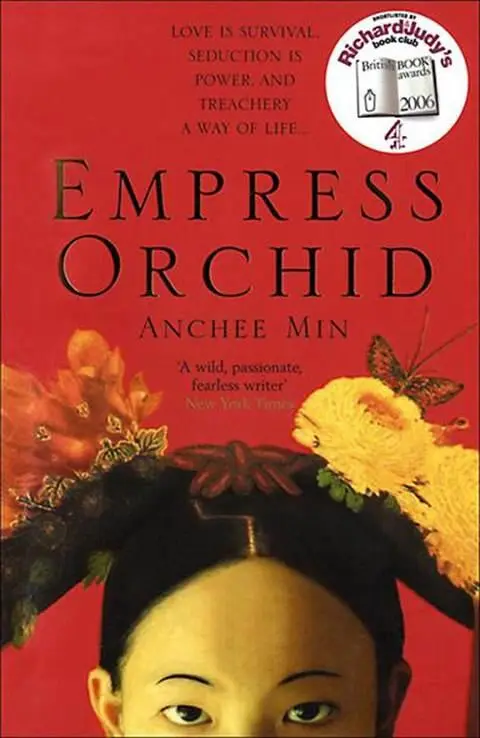
- Название:Empress Orchid
- Автор:
- Жанр:
- Год:неизвестен
- ISBN:нет данных
- Рейтинг книги:3 / 5. Голосов: 1
-
Избранное:Добавить в избранное
- Отзывы:
-
Ваша оценка:
Empress Orchid: краткое содержание, описание и аннотация
Предлагаем к чтению аннотацию, описание, краткое содержание или предисловие (зависит от того, что написал сам автор книги «Empress Orchid»). Если вы не нашли необходимую информацию о книге — напишите в комментариях, мы постараемся отыскать её.
To rescue her family from poverty and avoid marrying her slope-shouldered cousin, seventeen-year-old Orchid competes to be one of the Emperor's wives. When she is chosen as a lower-ranking concubine she enters the erotically charged and ritualised Forbidden City. But beneath its immaculate facade lie whispers of murders and ghosts, and the thousands of concubines will stoop to any lengths to bear the Emperor's son. Orchid trains herself in the art of pleasuring a man, bribes her way into the royal bed, and seduces the monarch, drawing the attention of dangerous foes. Little does she know that China will collapse around her, and that she will be its last Empress.
Empress Orchid — читать онлайн бесплатно полную книгу (весь текст) целиком
Ниже представлен текст книги, разбитый по страницам. Система сохранения места последней прочитанной страницы, позволяет с удобством читать онлайн бесплатно книгу «Empress Orchid», без необходимости каждый раз заново искать на чём Вы остановились. Поставьте закладку, и сможете в любой момент перейти на страницу, на которой закончили чтение.
Интервал:
Закладка:
An-te-hai’s “ears” in Peking reported that Prince Kung had been actively working to assemble a counterforce. Three days before, he had organized a meeting under the guise of a mourning ceremony for Em-peror Hsien Feng. In addition to the leadership of the royal clansmen, Prince Kung had invited important military commanders such as General Sheng Pao, the Mongol warrior Seng-ko-lin-chin, and General Tseng Kuo-fan, who was now also the viceroy of Anhwei province. Prince Kung had also invited the foreign ambassadors of England, France, Germany, Russia, Italy and Japan. Robert Hart had initiated the idea of the meeting. For some time, Hart had been advising Prince Kung on financial matters; he had now stepped into the role of Kung’s unofficial political advisor.
“I think we should wait,” Nuharoo said to me. “We should allow Su Shun’s evil to expose itself. We need time to prove to our citizens that Su Shun doesn’t deserve our respect. On the other hand, we should not forget that it was Emperor Hsien Feng who appointed Su Shun. The situation might backfire if we act without the support of the court.”
I tried to make Nuharoo see that this last decree severely limited Prince Kung’s chances of survival. If Prince Kung ignored Su Shun and came to Jehol, he would be accused of disobeying the decree, and Su Shun would arrest him the moment he stepped through the gate. But if Kung remained in Peking, Su Shun would gain the time he needed to take the entire court into his hands. It was only obvious and natural that he would find an excuse to prosecute us.
“You are crazy, Lady Yehonala.” Nuharoo said. “Su Shun has no legitimate reason to prosecute us.”
“He can create one. If he is capable of issuing decrees on his own, he will not hesitate when the time comes to remove us. Then he will go after Prince Kung.”
Nuharoo stood. “I must go to Hsien Feng’s coffin and pray. His Majesty should be told about this so that his spirits will help us in Heaven.”
The night guard beat his drum three times. It was three o’clock in the morning. The darkness was still deep. Lying in bed, I thought about what Nuharoo had said. Indeed, Su Shun was our husband’s choice. Hsien Feng had trusted him. Was I wrong to doubt Su Shun? Would it help if I expressed my willingness to work with him regardless of our differences? After all, we were both Manchus. Weren’t we trying to hold up the same sky?
I was unable to convince myself. Nuharoo and I were Tung Chih’s acting regents, appointed by Emperor Hsien Feng. But Su Shun regarded us as nothing but figureheads. We had no say over the edicts and decrees. A few days before, he had even refused to revise a draft that we had given our permission to issue after a few small changes. Orders and requests from us in the voice of Tung Chih made their way through the court hierarchy and came back without a response, while Su Shun’s words were carried immediately into action.
Nuharoo suggested that we make one last offer to work things out with Su Shun. I agreed.
The next morning, dressed in our official robes, Nuharoo and I summoned Su Shun for an audience in the name of the young Emperor. We went to the hall where Hsien Feng’s coffin sat behind a panel. As we waited, Tung Chih climbed on top of the coffin and lay on his stomach.
I watched my son as he knocked on the coffin. He whispered to his father about his new friend, the red-eyed rabbit. He invited his father to come out and see it. “I will hold the lid up for you.”
“Explain why the decree to Prince Kung was sent without our seals,” Nuharoo demanded when Su Shun appeared.
Su Shun stood arrogantly in his full-length brown satin robe with gold stripes on the bottom. He was wearing a hat decorated with a red button and a flamboyant peacock feather. He took off the hat and held it in his hands. His head was shaved and his braid oiled. His chin was tilted so high that he was practically facing the ceiling. He looked at us with half-opened eyes. “The court has the right to issue documents of an urgent nature without your seals.”
“But this violates our agreement,” I said, trying to control my anger.
“As His Young Majesty’s regents,” Nuharoo followed, “we object to the content of the last decree. Prince Kung has a right to come to Jehol to mourn his brother.”
“We would like to see Prince Kung get his wish,” I pressed.
“Fine!” Su Shun stamped his foot. “If you want my job, it is yours. I refuse to work until you learn not to take my kindness for granted!”
He made a sloppy bow and walked out. In the courtyard the rest of his board members, whom we had not invited, received him.
The documents piled up, creating walls in my room. All requested immediate attention. Nuharoo regretted that we had challenged Su Shun.
I tried not to panic. I reviewed the documents as I had when working for Emperor Hsien Feng. I had to prove to Su Shun that I was equal to the job. I needed to earn the respect, not of Su Shun, but of the court.
As soon as I began to work, I realized that the task was more than I could handle. Su Shun had set me up.
Many of the cases were impossible to solve. Under the circumstances, it would be irresponsible to issue a judgment; only injustice and unnecessary pain would come of it. I lacked necessary information and was prevented from gathering it. In one case, a regional governor was accused of embezzlement and more than a dozen homicides. I needed to gather evidence and ordered an investigation, but I received no reports. Weeks later, I discovered that my order had never been acted on.
I called Su Shun and demanded an explanation.
He denied any responsibility and said that he wasn’t the one in charge. He referred me to the justice ministry. When I questioned the head minister, he said he had never received the order.
Letters from all over the country had begun to complain about the slow workings of the court. It was clear that Su Shun had planted the seed in people’s minds that I was the one holding everything back. The rumors spread like a contagious disease. I wasn’t sure how bad things had become until one day I received an open letter from a small-town mayor questioning my background and credentials. There was no way the man would ever dare to send such a letter unless he was backed by someone like Su Shun.
As I paced back and forth in my document-cluttered room, An-te-hai returned from taking Tung Chih for a visit to my sister. He was so nervous that he stuttered. “The t-town of Jehol has been g-go-gossiping about a ghost story. The folks b-believe that you are the incarnation of an evil concubine who is here to destroy the empire. Talk of supporting Su Shun’s action against you is everywhere.”
Realizing that I couldn’t afford to wait any longer, I went to Nuharoo.
“But how should we act?” Nuharoo asked.
“Issue an urgent decree in Tung Chih’s name summoning Prince Kung to Jehol,” I replied.
“Would it be valid?” Nuharoo became nervous. “Usually it is Su Shun who drafts orders and prepares edicts.”
“With both of our seals it is valid.”
“How would you get the decree to Prince Kung?”
“We must think of a way.”
“With Su Shun’s watchdogs everywhere, no one can get out of Jehol.”
“We must select a reliable person for the mission,” I said, “and he must be willing to die for us.”
An-te-hai asked for the honor. In exchange, he wanted me to promise that he would be allowed to serve me for the rest of his life. I gave him my word. I made him understand that if he was caught by Su Shun, I expected him to swallow the decree and do everything to avoid making a confession.
With Nuharoo by my side, I worked on the details of An-te-hai’s escape plan. My first step was to have An-te-hai spread a rumor among Su Shun’s circle. We targeted a man named Liu Jen-shou, a notorious gossip. The story we spread was that we had lost the most powerful seal of all, the Hsien Feng seal, which we carefully hid away. We created an impression that we had been concealing the truth because we understood that the penalty for losing the seal was death. We concocted three possibilities regarding the seal’s whereabouts. One, we had lost it on our way from Peking to Jehol; two, we had misplaced it somewhere in the Palace of Great Purity back in the Forbidden City; and three, we had left it with my jewelry boxes at Yuan Ming Yuan, which likely had been stolen by the barbarians.
Читать дальшеИнтервал:
Закладка:
Похожие книги на «Empress Orchid»
Представляем Вашему вниманию похожие книги на «Empress Orchid» списком для выбора. Мы отобрали схожую по названию и смыслу литературу в надежде предоставить читателям больше вариантов отыскать новые, интересные, ещё непрочитанные произведения.






Обсуждение, отзывы о книге «Empress Orchid» и просто собственные мнения читателей. Оставьте ваши комментарии, напишите, что Вы думаете о произведении, его смысле или главных героях. Укажите что конкретно понравилось, а что нет, и почему Вы так считаете.