Anchee Min - Empress Orchid
Здесь есть возможность читать онлайн «Anchee Min - Empress Orchid» весь текст электронной книги совершенно бесплатно (целиком полную версию без сокращений). В некоторых случаях можно слушать аудио, скачать через торрент в формате fb2 и присутствует краткое содержание. Жанр: Историческая проза, на английском языке. Описание произведения, (предисловие) а так же отзывы посетителей доступны на портале библиотеки ЛибКат.
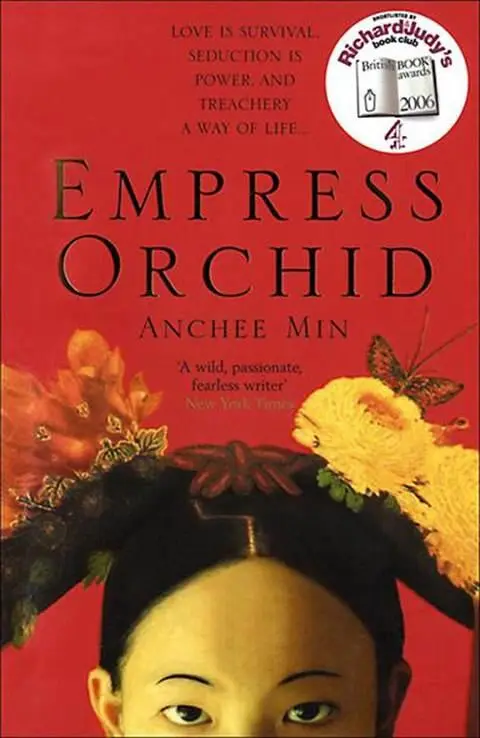
- Название:Empress Orchid
- Автор:
- Жанр:
- Год:неизвестен
- ISBN:нет данных
- Рейтинг книги:3 / 5. Голосов: 1
-
Избранное:Добавить в избранное
- Отзывы:
-
Ваша оценка:
Empress Orchid: краткое содержание, описание и аннотация
Предлагаем к чтению аннотацию, описание, краткое содержание или предисловие (зависит от того, что написал сам автор книги «Empress Orchid»). Если вы не нашли необходимую информацию о книге — напишите в комментариях, мы постараемся отыскать её.
To rescue her family from poverty and avoid marrying her slope-shouldered cousin, seventeen-year-old Orchid competes to be one of the Emperor's wives. When she is chosen as a lower-ranking concubine she enters the erotically charged and ritualised Forbidden City. But beneath its immaculate facade lie whispers of murders and ghosts, and the thousands of concubines will stoop to any lengths to bear the Emperor's son. Orchid trains herself in the art of pleasuring a man, bribes her way into the royal bed, and seduces the monarch, drawing the attention of dangerous foes. Little does she know that China will collapse around her, and that she will be its last Empress.
Empress Orchid — читать онлайн бесплатно полную книгу (весь текст) целиком
Ниже представлен текст книги, разбитый по страницам. Система сохранения места последней прочитанной страницы, позволяет с удобством читать онлайн бесплатно книгу «Empress Orchid», без необходимости каждый раз заново искать на чём Вы остановились. Поставьте закладку, и сможете в любой момент перейти на страницу, на которой закончили чтение.
Интервал:
Закладка:
Led by Chief Eunuch Shim, several guards rushed in.
“Seize the Empress of Holy Kindness and take her away for punishment!”
“Nuharoo, my elder sister!” I cried, hoping that she would come forward. All she had to do was to say that I had her permission to speak.
But Nuharoo was confused. She stared as if she didn’t understand what was happening.
The guards grabbed my arms and began to drag me away.
“Heaven above,” Su Shun said, beseeching in Peking-opera style, “help us get rid of an evil fox who has confirmed our ancestors’ worst predictions.”
“Nuharoo!” I struggled to push the guards away. “Tell them I had your permission to speak. Tell them I am the Empress and they can’t treat me like this. Please, Nuharoo!”
Su Shun walked up to Nuharoo, who was frozen in place. He bent down and whispered in her ear. His hands drew circles in the air. His broad frame blocked her view of me. I was sure what he was saying: the faster I was hanged, the better her life would be. He was describing a life for her without rivals. A life where only her words ruled. Nuharoo was too frightened to think. I knew she didn’t trust Su Shun, but she might not be able to resist his vision of her future.
The guards dragged me through the hallway. Everyone seemed caught up in the moment. If there were questions, nobody asked. I was lost in the crack of time, and I knew I would vanish before people could come to their senses.
I struggled to free myself from the guards. First my arms went limp, then my legs. As my body was tossed to the floor, my dress tore and my hairpins fell out.
“Halt!” A child’s voice pierced the air. “This is Emperor Tung Chih speaking.”
I was sure that I was hallucinating. My son stepped to the center of the room like a mature man. His manner reminded me of his father.
“Lady Yehonala has no less right to speak in this court than you, Su Shun,” my child said. “I shall order the guards to remove you if you cannot mend your behavior!”
In awe of the Son of Heaven, Chief Eunuch Shim dropped to his knees. The guards followed, and then the court, including Nuharoo and me.
The place grew as silent as a still pond. The clocks on the walls started to chime. For a long time no one dared move. The sun’s rays shot through the curtains, turning the tapestry into gold.
Standing tall by himself, Tung Chih didn’t know what to say next.
“Rise,” the child finally uttered, as if remembering a forgotten phrase from his lessons.
The crowd rose.
“I am resigning, Your Young Majesty!” Su Shun was himself again. He took his peacock-feathered hat off and placed it on the floor in front of him. “Who will follow me?” He began to walk out of the hall.
The rest of the members of the Regency looked at one another. They stared at Su Shun’s hat as if seeing its decorative jewels and feathers for the first time.
Prince Yee, Emperor Hsien Feng’s first cousin, made his move. He chased after Su Shun, yelling, “Grand Councilor, please! There is no point in lowering yourself to a child’s whim.”
The moment the words came out of his mouth, Prince Yee realized that he had made a mistake.
“What did you say?” Tung Chih stamped his feet. “You have insulted the Son of Heaven, and Zhen here orders your beheading! Guards! Guards! ”
At Tung Chih’s words Prince Yee threw himself down and knocked his head hard on the floor. “I beg Your Majesty’s forgiveness, for I am your father’s cousin and a blood relation.”
Looking at the man on the floor with a bleeding forehead, Tung Chih turned to Nuharoo and me.
“Rise, Prince Yee.” As if she finally found her place, Nuharoo spoke. “His Majesty shall forgive you this time, but he will not allow rudeness in the future. I trust that you have learned your lesson. Young as Tung Chih is, he is still the Emperor of China. You should always remember that you are his servant.”
The members of the Regency retreated. As soon as Nuharoo had Su Shun’s “forgotten” hat returned to him, the grand councilor got back to work. Not a word was spoken about the incident.
The body of Emperor Hsien Feng had been scheduled to be taken from Jehol to Peking for burial. The rehearsals for the moving ceremony were exhausting. During the day, Nuharoo and I dressed in white robes and practiced our steps in the courtyard. In our hair we wore baskets of white flowers. We made countless inspections: from the costumes worn by the paper gods to the decorative accessories for the horses; from the ropes that would tie down the coffin to the coffin bearers themselves; from the ceremonial flags to the selection of mourning music. We examined the wax pigs, cotton dolls, clay monkeys, porcelain lambs, wooden tigers and bamboo kites. In the evenings we inspected the leather silhouette figures that would be used in theatricals.
Tung Chih was drilled to perform the son’s duty. He practiced his walks, bows and kowtows in front of an audience of five thousand. During breaks, he sneaked out to watch the marching of the Imperial Guards, commanded by Yung Lu. Every night Tung Chih came to me describing his admiration for Yung Lu.
“Would you come with me next time?” he asked.
I was tempted, but Nuharoo turned Tung Chih down. “It would be improper for us to appear in our mourning gowns,” she said.
After dessert Nuharoo excused herself to chant. She had been drawn more deeply into Buddhism since Hsien Feng’s death. Her walls were covered with tapestries of Buddha figures. If it had been permitted, she would have ordered the construction of a giant Buddha in the middle of the audience hall.
I was full of unrest. One night in a dream I turned into a bee, trapped inside a forming lotus heart. With my every struggle the lotus seeds popped like little nipples. I woke and found that An-te-hai had placed a bowl of lotus-seed soup in front of me and that my vase had been filled with freshly picked lotus flowers.
“How did you know my dream?” I asked the eunuch.
“I just know.”
“Why all the lotuses?”
An-te-hai glanced at me and smiled. “It matches the color of Your Majesty’s face.”
The feelings I had been experiencing had only deepened. I could no longer deny to myself that they found their focus in the figure of Yung Lu. Listening to the news brought by Tung Chih excited me. My heart skipped when Yung Lu’s name was mentioned. I found myself hungry for details as Tung Chih described Yung Lu’s mastery of horses.
“You watched him from a distance?” I asked my son.
“I ordered a demonstration,” he replied. “The commander was happy when I commended him. Oh, Mother, you should have seen his way with the horses!”
I tried not to ask Tung Chih too much-I was afraid of arousing Nuharoo’s suspicion. To her, even thinking about any male other than our dead husband was a sign of disloyalty. Nuharoo made it clear to the Imperial widows that she wouldn’t hesitate to order their execution- by dismemberment-if she discovered an infidelity.
An-te-hai slept in my room and was a witness to my restlessness. But he never brought the subject up or mentioned any of my utterances that he might have heard. I knew that I often tossed and turned at night, especially when it rained.
On one such rainy night, I asked An-te-hai if he had noticed any changes in me. Carefully, the eunuch described my body’s midnight “uprisings.” He reported that I had cried out in my dreams, begging to be touched.
Winter came early. The September mornings were chilly and the air was fresh and clear. With the maples just starting to turn, I decided on a walk that would take me by Yung Lu’s training ground. The more I warned myself of the impropriety, the more my desire pushed me forward. In order to disguise the intent of my outing, the night before I told Tung Chih that there was a rabbit with red eyes that I would like to take him to see. Tung Chih asked where it was hidden. I answered, “In the bushes not far from the training ground.”
Читать дальшеИнтервал:
Закладка:
Похожие книги на «Empress Orchid»
Представляем Вашему вниманию похожие книги на «Empress Orchid» списком для выбора. Мы отобрали схожую по названию и смыслу литературу в надежде предоставить читателям больше вариантов отыскать новые, интересные, ещё непрочитанные произведения.


Обсуждение, отзывы о книге «Empress Orchid» и просто собственные мнения читателей. Оставьте ваши комментарии, напишите, что Вы думаете о произведении, его смысле или главных героях. Укажите что конкретно понравилось, а что нет, и почему Вы так считаете.