Anchee Min - Empress Orchid
Здесь есть возможность читать онлайн «Anchee Min - Empress Orchid» весь текст электронной книги совершенно бесплатно (целиком полную версию без сокращений). В некоторых случаях можно слушать аудио, скачать через торрент в формате fb2 и присутствует краткое содержание. Жанр: Историческая проза, на английском языке. Описание произведения, (предисловие) а так же отзывы посетителей доступны на портале библиотеки ЛибКат.
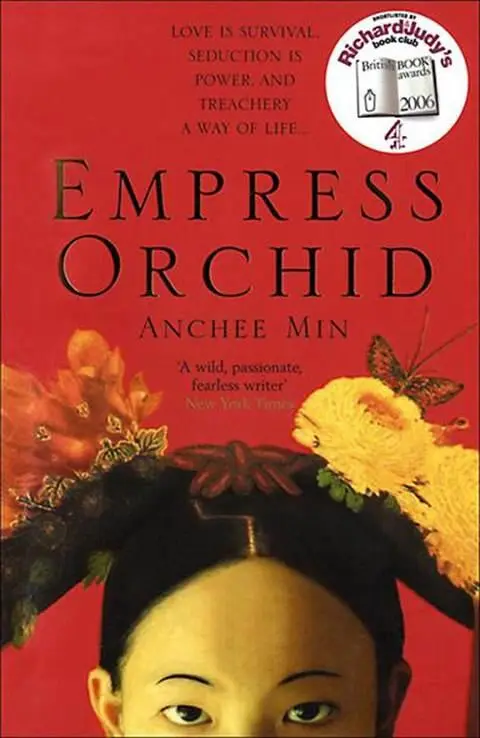
- Название:Empress Orchid
- Автор:
- Жанр:
- Год:неизвестен
- ISBN:нет данных
- Рейтинг книги:3 / 5. Голосов: 1
-
Избранное:Добавить в избранное
- Отзывы:
-
Ваша оценка:
Empress Orchid: краткое содержание, описание и аннотация
Предлагаем к чтению аннотацию, описание, краткое содержание или предисловие (зависит от того, что написал сам автор книги «Empress Orchid»). Если вы не нашли необходимую информацию о книге — напишите в комментариях, мы постараемся отыскать её.
To rescue her family from poverty and avoid marrying her slope-shouldered cousin, seventeen-year-old Orchid competes to be one of the Emperor's wives. When she is chosen as a lower-ranking concubine she enters the erotically charged and ritualised Forbidden City. But beneath its immaculate facade lie whispers of murders and ghosts, and the thousands of concubines will stoop to any lengths to bear the Emperor's son. Orchid trains herself in the art of pleasuring a man, bribes her way into the royal bed, and seduces the monarch, drawing the attention of dangerous foes. Little does she know that China will collapse around her, and that she will be its last Empress.
Empress Orchid — читать онлайн бесплатно полную книгу (весь текст) целиком
Ниже представлен текст книги, разбитый по страницам. Система сохранения места последней прочитанной страницы, позволяет с удобством читать онлайн бесплатно книгу «Empress Orchid», без необходимости каждый раз заново искать на чём Вы остановились. Поставьте закладку, и сможете в любой момент перейти на страницу, на которой закончили чтение.
Интервал:
Закладка:
The next day we rose before dawn. After breakfast we set off in palanquins, passing the flame-colored trees. The moment we saw Yung Lu’s guards, Tung Chih took off and I followed.
The path was bumpy, and the bearers tried their best to steady the palanquin. I lifted the curtain and looked out. My heartbeat quickened.
An-te-hai followed by my side. His expression told me that he knew my purpose and that he was curious and excited. It touched me with sadness to see that An-te-hai still thought a man’s thoughts. Indeed, if appearance was the measure, women would think An-te-hai more attractive than Yung Lu. My eunuch had a full forehead and a perfect jaw and his eyes were large and bright, which was unusual for a Manchu. Highly trained in court manners, he always carried himself gracefully. Turning twenty-four the week before, An-te-hai had been with me for more than eight years. Unlike many eunuchs who sounded like old ladies, he spoke in a masculine voice. I wasn’t sure if An-te-hai still had a male’s bodily needs, but he was a sensuous being. As our time together lengthened, I was more and more struck by the curiosity he showed about what went on between a man and a woman. It would become An-te-hai’s curse.
In the morning fog I watched the Imperial Guards being drilled. Hundreds trotted and marched over packed dirt. They reminded me of hopping toads in a rice field during a drought. The air was crisp and the sun was yet to fully rise.
“Watch out for Tung Chih,” I told the bearers, and asked to be let out of the palanquin. My shoes collected dew as I slowly walked along a side path. Then I saw him, the commander, on his mount. I took a moment to compose myself.
He sat unmoving on the horse but stared in my direction. The fog between us made him look like a paper-cutout warrior.
I approached him with An-te-hai by my side.
The warrior tapped the animal’s flank, and it cantered toward me. I gazed at him under the shadows cast by the rising sun.
The moment he recognized me, he slipped off the horse and threw himself on the ground. “Your Majesty, Yung Lu at your service.”
I knew that I was supposed to say “Rise,” but my tongue faltered. I nodded and An-te-hai interpreted: “You may rise.”
The man in front of me stood. He was taller than I remembered. The sunlight sculpted his figure and his face looked like a hatchet.
I didn’t know what to say. “Tung Chih wanted to visit the woods,” I said after a pause, and then added, “He is chasing a rabbit.”
“That is very nice,” he said, and then he too ran out of words.
I glanced at his men. “How… are your troops doing?”
“Almost ready.” He was relieved to find a topic.
“What are you trying to achieve exactly?”
“I am working to build my men’s endurance. At present they are capable of staying in formation for about half a day, but the parade with the coffin will last fifteen days.”
“May I trust that you are not overworking your men or yourself?” I said. Immediately I caught the softness in my tone. I realized that I had just asked a question, which etiquette forbade.
He seemed to be aware of it. He looked at me and then quickly looked away.
I wished that I could dismiss An-te-hai, but that would not be wise. Being seen alone with Yung Lu would be dangerous.
“May I have Your Majesty’s permission to check up on Tung Chih?” An-te-hai asked, reading my mind.
“No, you may not.”
Tung Chih was disappointed: he hadn’t found the rabbit. When we returned to the palace, I promised to have a wooden one made for him. An-te-hai explained my idea to the court’s best craftsman. The man asked for five days to produce the rabbit. Tung Chih waited eagerly.
On the evening of the fourth day, a fantastically crafted wooden rabbit with white “fur” was presented to Tung Chih. The moment my son saw it, he fell in love. From then on he no longer touched any other toys, no matter how fancy they were. The wooden rabbit had the cutest red eyes of chiseled rubies. Its fur was made of cotton and silk. The best part was that the rabbit had movable legs with a string winder. When Tung Chih placed the rabbit on the floor it could hop like a real one.
For the next few days Tung Chih was completely occupied by the rabbit. I was able to work with Nuharoo on the court documents delivered by Su Shun. My floor was piled with papers and I had no space to move around.
Nuharoo soon resented coming to work with me. She began to make excuses for not showing up. She wanted us to abide by the ancient Chinese philosophy that “the wisest man should appear the most confused.” She believed that if we did so, Su Shun would leave us alone: “Fool and disarm him without using a weapon.” She smiled, charmed by her own words.
I did not understand Nuharoo’s fantasy. We might fool others, but not Su Shun. For me it was harder to deal with Nuharoo than with my son. When she was tired, her temper tantrums rose. She complained about everything-the noise of crickets, the taste of her soup, a dropped stitch in her embroidery. She would insist that I help her fix the problem. I couldn’t help but be affected, and I had to quit working. Finally, I agreed to spare her under one condition-that she read my briefs and place her seal on all the outgoing documents, which I would draft in the name of Tung Chih and stamp with my own seal.
Each evening An-te-hai prepared a pot of strong Black Dragon tea as I labored into the night. By loading me down with work, Su Shun set out to discredit me in the eyes of the court. I had volunteered to put my neck in the noose, and now he was busy tying the knot. He didn’t know me. I wanted to succeed for a very practical reason-to be fit to assist my son. But I had miscalculated. While I was busy shoring up one flank, I left another exposed. I had no idea that the Imperial tutors who were responsible for Tung Chih’s education were Su Shun’s friends. My innocent neglect proved to be one of my biggest mistakes. I didn’t realize the damage being done to Tung Chih until it was too late.
At this point I was desperate to broaden my perspective. I lacked confidence and felt myself poorly informed. The subjects of the papers were vast. To grasp any understanding seemed like trying to climb a greased pole. Since I felt strongly about the role played by the government, I was determined to cut through the corruption around me. I tried to see the basic outlines of things, their true skeleton, and to evaluate everything on merit alone. I also concentrated on becoming familiar with those who had the power to control and influence. Besides reading their reports, I studied their characters, their backgrounds, and their relationships with their peers and with us. Of course I paid particular attention to their responses to our own queries and requests, most often delivered through Prince Kung. I had always loved opera, but what I was now engaged in on a daily basis was much more dramatic and bizarre.
I learned a lot about people. One document came from one of Prince Kung’s employees, the Englishman Robert Hart, China’s chief of customs. This man was my own age and a foreigner, but he was responsible for generating one third of our yearly revenue. Hart reported that he had recently met strong resistance when collecting domestic customs revenue. Many influential men, including my late husband’s most trusted general, Tseng Kuo-fan-Head-Chopper Tseng, the hero who flattened the Taiping rebels-refused to part with their money. Tseng claimed that the needs of his immediate area required that he, not the central government, keep the taels. His account books had been found vague, and Hart sought instructions from the Emperor regarding whether to press charges against the general.
Su Shun proposed an action on the cover page of Hart’s report. He wanted to have Tseng Kuo-fan investigated and charged. I was not fooled. For some time Su Shun had wished to replace Tseng with one of his loyalists.
Читать дальшеИнтервал:
Закладка:
Похожие книги на «Empress Orchid»
Представляем Вашему вниманию похожие книги на «Empress Orchid» списком для выбора. Мы отобрали схожую по названию и смыслу литературу в надежде предоставить читателям больше вариантов отыскать новые, интересные, ещё непрочитанные произведения.

Обсуждение, отзывы о книге «Empress Orchid» и просто собственные мнения читателей. Оставьте ваши комментарии, напишите, что Вы думаете о произведении, его смысле или главных героях. Укажите что конкретно понравилось, а что нет, и почему Вы так считаете.