Frances Itani - Requiem
Здесь есть возможность читать онлайн «Frances Itani - Requiem» весь текст электронной книги совершенно бесплатно (целиком полную версию без сокращений). В некоторых случаях можно слушать аудио, скачать через торрент в формате fb2 и присутствует краткое содержание. Город: Toronto, Год выпуска: 2012, ISBN: 2012, Издательство: A Phyllis Bruce Book, Жанр: Историческая проза, на английском языке. Описание произведения, (предисловие) а так же отзывы посетителей доступны на портале библиотеки ЛибКат.
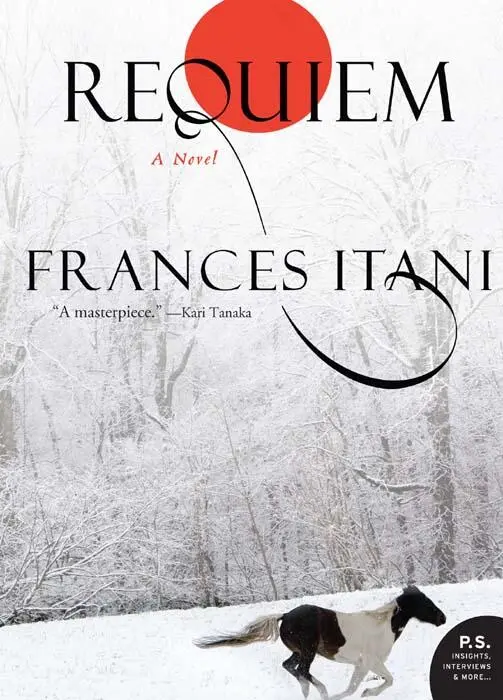
- Название:Requiem
- Автор:
- Издательство:A Phyllis Bruce Book
- Жанр:
- Год:2012
- Город:Toronto
- ISBN:978-1-44340-690-1
- Рейтинг книги:4 / 5. Голосов: 1
-
Избранное:Добавить в избранное
- Отзывы:
-
Ваша оценка:
Requiem: краткое содержание, описание и аннотация
Предлагаем к чтению аннотацию, описание, краткое содержание или предисловие (зависит от того, что написал сам автор книги «Requiem»). Если вы не нашли необходимую информацию о книге — напишите в комментариях, мы постараемся отыскать её.
delicately probes the complex adjustments we make to live with our sorrows…. [A] perfectly modulated novel.”
—
An extraordinary researcher and scholar of detail, Frances Itani—author of the best-selling novel
—excels at weaving breathtaking fiction from true-life events. In her new novel, she traces the lives, loves, and secrets in one Japanese-Canadian family during and after their internment in the 1940s.
In 1942, in retaliation for the attack on Pearl Harbor, the Canadian government removed Bin Okuma’s family from their home on British Columbia’s west coast and forced them into internment camps. They were allowed to take only the possessions they could carry, and Bin, as a young boy, was forced to watch neighbors raid his family’s home before the transport boats even undocked. One hundred miles from the “Protected Zone,” they had to form new makeshift communities without direct access to electricity, plumbing, or food—for five years.
Fifty years later, after his wife’s sudden death, Bin travels across Canada to find the biological father who has been lost to him. Both running from grief and driving straight toward it, Bin must ask himself whether he truly wants to find First Father, the man who made a fateful decision that almost destroyed his family all those years ago. With his wife’s persuasive voice in his head and the echo of their love in his heart, Bin embarks on an unforgettable journey into his past that will throw light on a dark time in history.
Requiem — читать онлайн бесплатно полную книгу (весь текст) целиком
Ниже представлен текст книги, разбитый по страницам. Система сохранения места последней прочитанной страницы, позволяет с удобством читать онлайн бесплатно книгу «Requiem», без необходимости каждый раз заново искать на чём Вы остановились. Поставьте закладку, и сможете в любой момент перейти на страницу, на которой закончили чтение.
Интервал:
Закладка:
—The present owner of the house states that she does not recognize the Japanese interest in this property. Therefore…
Yes, Lena found explanations. About the disappearance and disposal of household goods that we were forced to leave behind in our family home during the early winter months of 1942. The eventual sum, which represented total value before expenses, was assessed at $24.75. After being charged an “auctioneer’s fee” of $2.48 and a “moving fee” of $3.42, our father was paid $18.85 in 1946, after the end of the war.
Eighteen dollars and eighty-five cents. A figure not easy to forget. A cheque was sent to Father, in that amount.
For an entire house. A house full of goods.
Who knows, after all this time, what really went on behind the scenes and what happened to the parts of our lives that we had to leave behind?
Strangely enough, Lena knew. Or partly knew. Lena the historian, born in December 1946, the year of the dog, one year after the end of the war, and unaware of these events until shortly before we married. She was the one who tracked my personal history.
I did not take part in the unearthing of Lena’s discoveries. Having lived through the internment once, I had no desire to read through files and live through it again. Especially after hearing her rant after each day’s research.
Leave the past alone, I wanted to tell her.
“How can you not want to know your own history?” she asked, genuinely perplexed. “We have a son. He’ll want to read these papers someday. It’s his history, too. There are relatives he hasn’t met west of the Rockies, cousins he doesn’t know. But most of all, the history is yours—to claim, or reclaim. Whatever!”
Did she forget that she had also told me how she’d wept over the documents while sitting at a long table inside the high-ceilinged room of the archives? A comment that made me even more determined not to know. I had no desire to weep. No desire for more anger. I had, I thought, distanced myself from the past in whatever ways I could.
Despite my determination, I admit that I listened when Lena read out details of the auction and the way the ownership of our family home on Vancouver Island was transferred to strangers who later denied that our father and Uncle Kenji had built it, board by board.
But I could not make myself open the manila folder she ultimately carried home at the completion of her single-minded search. I could not make a move to lift it. I could not riffle the pages to see if they contained a single paragraph of meaningful information.
Lena, having finished what she set out to do, eventually stopped mentioning the folder and stowed it in my rolltop desk, where it has remained ever since. Until I crammed it into my pack this morning. Now it’s in the car, travelling beside me.
Perhaps I did not want Lena’s version of my history because I knew it would differ from the one I had brought to a standstill in my own memory. If I were to call it up, my version would be active. People would be on the move, changing direction, criss-crossing in my head. For decades after leaving the camps, everyone I knew was involved in the same struggle. Relocating. Trying to fit in. Moving. Moving again. Trying to find work. Dropping out of sight—sometimes for years. Maintaining an awareness of others, but silently. Sending word back, but never telling the entire truth.
Also, in my version, while some stories are unfinished, others have reached their end. Okuma-san’s, for instance. His story reached its end in 1967. It was the year I left Montreal for England, on a scholarship to continue my studies in art. I was in my late twenties. I was eager; I wanted change; I wanted to learn everything I could. I wanted to stand before the great masters in the grand museums of Europe. I wanted to meet other art students. I wanted to explore the streets of London.
But first, I went to say goodbye to Okuma-san. He had retired two years earlier and was living in a small house near the river in the west end of Ottawa. I was with him the week before he died. If he knew that those days would be his last, he did not impart the foreknowledge to me.
I hear Basil stirring, and take this to mean I should stop the car and let him out for a break, a leg stretch for both of us.
The landscape is tense and still in the frozen light. We are backtracking into winter because the highway runs north before it angles west. Birch trees have stretched their bandaged limbs, begging for alms. When I pull over to the edge of the road and turn off the engine, Basil sends a sympathetic noise in my direction, a noise that sounds like a humpback whale, searching for a soulmate under water.
CHAPTER 5
Although no one could have predicted exactly how or when the removal would take place, I learned later that there had been forebodings for weeks. Terrifying rumours, letters intercepted, newspapers stifled, community centres boarded up, schools closed, radios, cameras, binoculars taken away. Because we were isolated in our island community—the supply boat arrived only every ten days at the wharf near the village store—it wasn’t easy to obtain information. Even so, the rumours were unstoppable. It was as if they’d been lifted by waves up and down the waters of the coast, as far north as Alaska, as far south as California and back again. There was fear of invasion by the Japanese navy or air force. There was fear that Japanese Canadian families were relaying information by secret code to the enemy. A blackout along the coast had been declared as a response to this fear and as a precaution against air raids. Every lantern, every light had to be hidden behind dark curtains in our homes after dusk.
The men of our fishing community were concerned. They gathered in small groups outside the houses and in front of the recently boarded-up canning factory. We will be rounded up , the rumours said. We will be taken away . Hadn’t the men already been forced to turn in their boats under naval escort? A quick demand by authorities within days of the attack on Pearl Harbor.
Father was unhappy about the way this had been done because navy men who had no experience working the fishing boats had boarded and managed to damage many of those they’d brought in. Father was more fortunate than most. His boat, being larger, was used to tow four others, and he was permitted to remain at the helm. The boat was unharmed, but the navy men insisted that the crossing to the mainland take place at night. Both fishermen and navy men thrashed in wild wind and waves for hours in the dark, forced to approach land in the midst of terrifying swells.
After their boats were confiscated, the eight fishermen from our tiny bay were told to make their own way home from the mouth of the Fraser. They journeyed back to the west coast of Vancouver Island by ferry, by train and by mail boat. They were forced to pay their own fares. Some, more optimistic than others—Father was not one of the hopefuls—believed that their boats would be safe under naval protection.
The day the men were due home after turning in the boats, Mother watched the door for signs of Father. It was shortly before Christmas 1941. A small tree stood in a corner of our living room. Hiroshi and Keiko and I were creating decorations from paper, pipe cleaners, food colouring, and flotsam and jetsam that had washed up on our rocky beach. I could hear water lapping at the stilts beneath the floor. The tide was in. A sharp rap at the window startled us, and a man’s voice shouted in to tell us that light was spilling between our curtains and could be seen from outside. Mother rushed to the window to close the curtains tightly, and she pegged them with a clothespin to keep them completely shut. Her fear was contained, but it was there and I sensed that, and I was afraid, too. At that moment, Father came in and stood at the end of the kitchen. Mother looked towards the door as if seeing him for the first time. Neither moved towards the other. Father was frowning, his face lined with fatigue.
Читать дальшеИнтервал:
Закладка:
Похожие книги на «Requiem»
Представляем Вашему вниманию похожие книги на «Requiem» списком для выбора. Мы отобрали схожую по названию и смыслу литературу в надежде предоставить читателям больше вариантов отыскать новые, интересные, ещё непрочитанные произведения.





Обсуждение, отзывы о книге «Requiem» и просто собственные мнения читателей. Оставьте ваши комментарии, напишите, что Вы думаете о произведении, его смысле или главных героях. Укажите что конкретно понравилось, а что нет, и почему Вы так считаете.