Frances Itani - Requiem
Здесь есть возможность читать онлайн «Frances Itani - Requiem» весь текст электронной книги совершенно бесплатно (целиком полную версию без сокращений). В некоторых случаях можно слушать аудио, скачать через торрент в формате fb2 и присутствует краткое содержание. Город: Toronto, Год выпуска: 2012, ISBN: 2012, Издательство: A Phyllis Bruce Book, Жанр: Историческая проза, на английском языке. Описание произведения, (предисловие) а так же отзывы посетителей доступны на портале библиотеки ЛибКат.
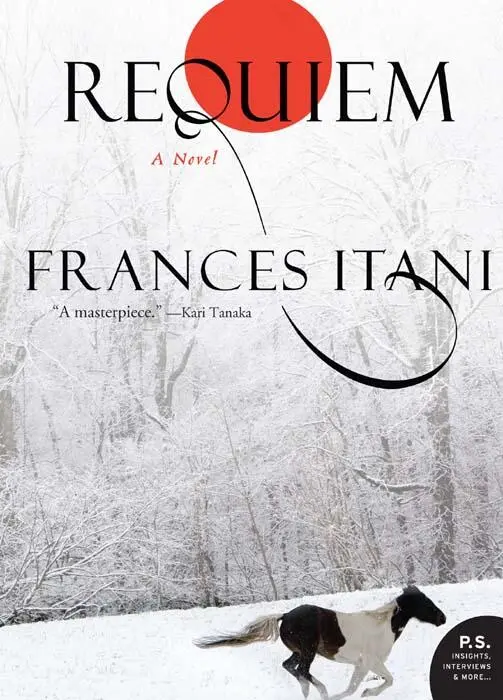
- Название:Requiem
- Автор:
- Издательство:A Phyllis Bruce Book
- Жанр:
- Год:2012
- Город:Toronto
- ISBN:978-1-44340-690-1
- Рейтинг книги:4 / 5. Голосов: 1
-
Избранное:Добавить в избранное
- Отзывы:
-
Ваша оценка:
Requiem: краткое содержание, описание и аннотация
Предлагаем к чтению аннотацию, описание, краткое содержание или предисловие (зависит от того, что написал сам автор книги «Requiem»). Если вы не нашли необходимую информацию о книге — напишите в комментариях, мы постараемся отыскать её.
delicately probes the complex adjustments we make to live with our sorrows…. [A] perfectly modulated novel.”
—
An extraordinary researcher and scholar of detail, Frances Itani—author of the best-selling novel
—excels at weaving breathtaking fiction from true-life events. In her new novel, she traces the lives, loves, and secrets in one Japanese-Canadian family during and after their internment in the 1940s.
In 1942, in retaliation for the attack on Pearl Harbor, the Canadian government removed Bin Okuma’s family from their home on British Columbia’s west coast and forced them into internment camps. They were allowed to take only the possessions they could carry, and Bin, as a young boy, was forced to watch neighbors raid his family’s home before the transport boats even undocked. One hundred miles from the “Protected Zone,” they had to form new makeshift communities without direct access to electricity, plumbing, or food—for five years.
Fifty years later, after his wife’s sudden death, Bin travels across Canada to find the biological father who has been lost to him. Both running from grief and driving straight toward it, Bin must ask himself whether he truly wants to find First Father, the man who made a fateful decision that almost destroyed his family all those years ago. With his wife’s persuasive voice in his head and the echo of their love in his heart, Bin embarks on an unforgettable journey into his past that will throw light on a dark time in history.
Requiem — читать онлайн бесплатно полную книгу (весь текст) целиком
Ниже представлен текст книги, разбитый по страницам. Система сохранения места последней прочитанной страницы, позволяет с удобством читать онлайн бесплатно книгу «Requiem», без необходимости каждый раз заново искать на чём Вы остановились. Поставьте закладку, и сможете в любой момент перейти на страницу, на которой закончили чтение.
Интервал:
Закладка:
I shift gears, nose the car up an incline and down again. Realize, with no surprise, that I’ve pointed the car towards the Ottawa River. A detour across the bridge and into nearby Quebec, to an oasis both quiet and turbulent, a place I discovered years ago and to which I often return alone. Not always alone; Lena came with me on several occasions.
“You always bring me to water,” she once said. “No matter what else you invite me to do or where we do it, we end up walking trails beside a river. Or crossing a bridge and staring down at one.”
“Maybe,” I replied. I was weighing this as a new idea, wondering if it was true.
“Remember the Enz?” she said. “When we took Greg to the Black Forest?”
“I do,” I said. “The tiny river with the large roar.” I was remembering ice formations, horseshoe shapes that clung upside down to branches along the banks. In my mind I saw frosted white against the steel-hard blue of rushing water.
“And what about wading the length of a river? Being knee-deep in the Nerepis, surrounded by eels?” She shuddered as she brought the memory forward.
I hadn’t thought about the eels for a long time, thick brown bodies of spawning eels that had come in from the sea and camouflaged the bottom of the shallow Nerepis. When we disturbed them, not knowing they were there—but they were, by the thousands—they reared their heads in rapid, wide-fanned splashes. There was something monstrous, something truly horrifying about the scene. But we had already waded some distance and couldn’t get out of the water for another quarter mile because of the tangle of scrub that had grown to the edges of the riverbank. There was no trail to climb to and no turning back. How could either of us ever forget?
“There were better places,” said Lena. “The Adirondacks.”
“The upside-down mountains in the Au Sable. Morning air like polished silver.”
“Or brooding across a dark surface in the evening,” she said.
And I thought of shadow. Of shadow and light.
Now, the sight of the Ottawa River up close brings a surge of old energy. It will be easy to recross and join the main road again before I head for the Trans-Canada Highway. I might do a quick sketch before I officially depart for the West. Make an attempt to capture the spring rage of gathering waters.
First day out and, already, I want to draw. But this is not about sex and death. Or do I deceive myself? If Otto were present, he would look away, sagely, cautiously. Otto, who has found Miki and who is searching for answers in things Japanese.
Basil has settled down, knowing we’re safely past the road that leads to the kennels. I glance in the mirror and an exchange takes place—his cheerful, shaggy face greeting my own. The hound’s permanent expression is one of enthusiasm, of being pleased with himself, though he can alter this at will. I’m convinced that he hears sadness, smells detachment, knows grief. Reading my mind again, he sniffs and lowers himself out of sight behind my seat.
Basil has always preferred Lena’s company to mine —I was born in the year of the dog , she used to say. That has to count for something. Right, Basil? But Basil loves a trip, and he won’t complain about my company. I’ve arranged to drop him off at Kay’s, in any case, once we reach Edmonton, five or six days from now. From there, I’ll travel alone and pick him up on the way back. Kay has a snappy little dog, Diva, who will keep him in line. Diva is half his size, but wicked.
I turn off the radio. Eroica is over but I don’t know when I stopped paying attention, or whether a subconscious part of me completed the piece. Did I switch to Leonore in my head? I park the car on a dirt road beside a thin stand of poplars. No one is around. Patches of snow have begun to melt into last year’s wild grasses beside the road. Along shore, jagged pieces of ice have been shoved up onto layered shale. I lock the car, zip my jacket and look out over an expanse of river that is both solid and free-flowing at the same time. It’s been a long winter and part of the river is still frozen, even this late in spring. Stray bits and pieces of ice are floating past on the current. Farther upstream, where the river is wider, the surface looks static, the dullest of greys. Close at hand, the smaller floes hold a tint of the palest blue. There must be cracks in the large sheet upstream. I know how fast the current can be. It’s a dark, continuous force, an unending murmur under ice, rushing towards open water.
I begin to walk in the direction of the current, downriver, towards an elevation of land. There’s an open stretch and I hear the roar of rapids in the distance. The river never freezes over white water there, no matter how cold the winter. Gulls wheel overhead. Basil, immensely pleased at being out of the car so soon, has found enough melting snow to roll in. His long back, his short legs and huge feet make me think of a hairy weight sinking through earth. He’ll follow when he’s ready, good hound that he is. We’ll take our chances on ice balls building up between his pads.
I walk for ten minutes under low cloud. Follow the path worn down centuries ago by Native Algonquins as they brought their furs to scattered trading posts. The portage was established long before the arrival of the voyageurs , who sought furs and adventure as they headed west, in the opposite direction. I climb the slope that looks out over fast water and ragged shore. At the highest point along the bank, I turn and look back.
In the short time since I parked the car, the huge grey mass upriver has begun to rotate. After being so tightly lodged all winter, it has made a distinct but sluggish shift, as if the river itself is threatening to turn sideways. Freed at the edges, caught by the current and with nothing to impede it, this vast floe is already picking up speed. I consider running back to the car to get the camera or my sketch pad, one or the other. But if I do, I’ll miss the spectacle that’s about to unfold.
I scramble to lower ground and wait. The river is impossibly narrow here, too narrow. The approaching ice will not have enough space to manoeuvre and will have to grind itself against shore. As it approaches, the sound is one of a persistent, slurring mush. Basil has caught up and pauses beside me, alert. He hears it, too.
First, there is sound. This is the order of things .
The sheet is wide, its farthest edges a blur. The ground shudders and ice crashes simultaneously through current and against shore, piling up layer after layer of harsh, metallic silt. What first appeared to be slush has become a chain of high, grating hills. Never again will I witness the purity of this shade of blue.
The immense portion of ice that remains in the water now flows swiftly by, but everything has happened so quickly I have difficulty separating detail. When I step back, I realize how cold I am, and pull up the hood of my jacket. I dig at a heap of newly stacked ice with the heel of my hiking boot and watch the mass explode into hundreds of candled segments, the result of days of sun preparing the melt over the river. Crystals scatter like spears from dismembered chandeliers. One form becomes another and another.
I know how impossible it would be to try to capture what has just taken place. A light rain is beginning—I can hear and feel the patter of drops on my hood. Gulls fly drunkenly into the wind. Some have begun to lift off the shore in groups of twos and threes, and are about to settle on chunks of ice that have broken away from the main floe and now trail in its wake. Each chunk is no more than a foot or two in breadth; each appears to be specially carved for riding out the waves with a bird on top. And this, before my eyes, is what the gulls now begin to do. They are hitching rides. They even seem to be selecting the best shapes. All for the purpose of partaking in some adolescent feathered rite.
Читать дальшеИнтервал:
Закладка:
Похожие книги на «Requiem»
Представляем Вашему вниманию похожие книги на «Requiem» списком для выбора. Мы отобрали схожую по названию и смыслу литературу в надежде предоставить читателям больше вариантов отыскать новые, интересные, ещё непрочитанные произведения.





Обсуждение, отзывы о книге «Requiem» и просто собственные мнения читателей. Оставьте ваши комментарии, напишите, что Вы думаете о произведении, его смысле или главных героях. Укажите что конкретно понравилось, а что нет, и почему Вы так считаете.