Frances Itani - Requiem
Здесь есть возможность читать онлайн «Frances Itani - Requiem» весь текст электронной книги совершенно бесплатно (целиком полную версию без сокращений). В некоторых случаях можно слушать аудио, скачать через торрент в формате fb2 и присутствует краткое содержание. Город: Toronto, Год выпуска: 2012, ISBN: 2012, Издательство: A Phyllis Bruce Book, Жанр: Историческая проза, на английском языке. Описание произведения, (предисловие) а так же отзывы посетителей доступны на портале библиотеки ЛибКат.
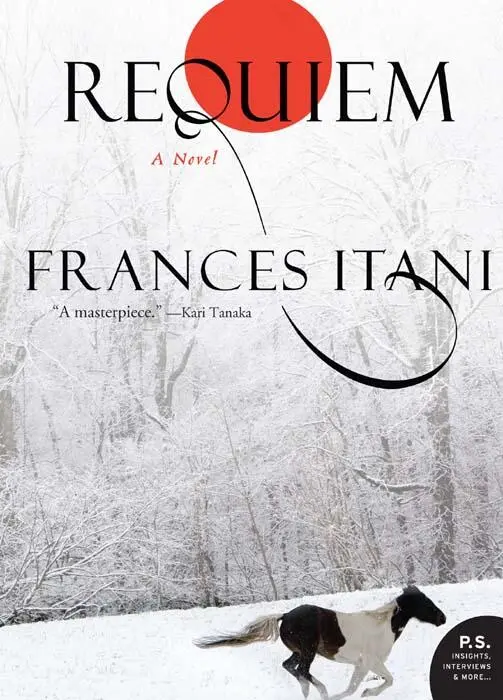
- Название:Requiem
- Автор:
- Издательство:A Phyllis Bruce Book
- Жанр:
- Год:2012
- Город:Toronto
- ISBN:978-1-44340-690-1
- Рейтинг книги:4 / 5. Голосов: 1
-
Избранное:Добавить в избранное
- Отзывы:
-
Ваша оценка:
Requiem: краткое содержание, описание и аннотация
Предлагаем к чтению аннотацию, описание, краткое содержание или предисловие (зависит от того, что написал сам автор книги «Requiem»). Если вы не нашли необходимую информацию о книге — напишите в комментариях, мы постараемся отыскать её.
delicately probes the complex adjustments we make to live with our sorrows…. [A] perfectly modulated novel.”
—
An extraordinary researcher and scholar of detail, Frances Itani—author of the best-selling novel
—excels at weaving breathtaking fiction from true-life events. In her new novel, she traces the lives, loves, and secrets in one Japanese-Canadian family during and after their internment in the 1940s.
In 1942, in retaliation for the attack on Pearl Harbor, the Canadian government removed Bin Okuma’s family from their home on British Columbia’s west coast and forced them into internment camps. They were allowed to take only the possessions they could carry, and Bin, as a young boy, was forced to watch neighbors raid his family’s home before the transport boats even undocked. One hundred miles from the “Protected Zone,” they had to form new makeshift communities without direct access to electricity, plumbing, or food—for five years.
Fifty years later, after his wife’s sudden death, Bin travels across Canada to find the biological father who has been lost to him. Both running from grief and driving straight toward it, Bin must ask himself whether he truly wants to find First Father, the man who made a fateful decision that almost destroyed his family all those years ago. With his wife’s persuasive voice in his head and the echo of their love in his heart, Bin embarks on an unforgettable journey into his past that will throw light on a dark time in history.
Requiem — читать онлайн бесплатно полную книгу (весь текст) целиком
Ниже представлен текст книги, разбитый по страницам. Система сохранения места последней прочитанной страницы, позволяет с удобством читать онлайн бесплатно книгу «Requiem», без необходимости каждый раз заново искать на чём Вы остановились. Поставьте закладку, и сможете в любой момент перейти на страницу, на которой закончили чтение.
Интервал:
Закладка:
Lena’s voice in my head again. Speaking French, as she was sometimes wont to do—having grown up in Montreal. C’est comique. C’est vraiment comique .
The chunks pick up speed, swirl and bob in the direction of the rapids. With split-second timing, the gulls lift to safety precisely as each piece of ice beneath their feet reaches white water and flips upside down. From there, they fly upstream and ride down again.
It’s the bird midway at the fair. They don’t seem to tire of these daredevil rides that tease danger. Faster and faster they travel under layers of descending cloud. And then, a last flat sheet of ice shifts and turns with a mild roar, dips to the whitecaps like a salute and is gone. Out of sight, beyond hearing. The river, still swollen, is dark but free.
I don’t know how long I’ve been standing here. I do know that this is breakup, what I have just seen.
At the car, I remove my wet jacket and open the trunk for Basil, who takes his time about climbing in. He’d run miles if I let him, even in the rain. Especially in the rain. I start the engine and turn up the heat, full blast. Glance out the side window. The gulls are circling aimlessly above the river, as if suddenly bereft.
Basil pokes his head over the back of the seat and rests the weight of his damp and hairy chin on my shoulder. A thick fug of warmth permeates the inside of the car and mixes with the odour of wet dog. I look out the window again at the gulls and imagine beginnings: the way I’ll shape angular chunks of ice, the overwhelming greyness, a flash of wing to hover over speeding darkness while the river discharges its winter debris. I think of the Fraser again, my childhood river, and a rush of images floods up so suddenly, I’m caught off balance. It happens , Kay’s maddening professional voice once said over the phone. It’s always there, the camp, close beneath the surface. For all of us .
It is when I feel the cold touch of Basil’s nose against my neck that I curse the fates, lower my head and weep.
CHAPTER 4
I’m on the road, seriously on the road, enjoying my hands on the wheel, the liberating sense of moving forward. “Travel does that,” Lena used to say. “It clips the fetters of routine.”
Every time we started out on a trip, the moment we pulled away from the curb in front of the house, she stretched her arms wide and kicked off her shoes. Until it was her turn in the driver’s seat—we switched every three or four hours. Our conversation changed, too; it became more contemplative, the two of us staring straight ahead. As I am now, with thoughts and memories tumbling unbidden, scrambling over one another to grab my attention. Inevitable, since I’m heading for the camp on the other side of the country. I look in the rear-view and swear that Basil is nodding. But he makes a smacking sound, ducks his head and settles behind me again. It’s going to be a long journey back.
FIFTY-FIVE YEARS AGO, my first journey began. It was early 1942, and despite my young age then, I can clearly recall some events from that time. Other events have been pieced together from a jumble of images, fragments of conversations overheard, body memories, sensations. Given the intervening years, it’s impossible to separate one way of remembering from another.
My brother and sister, Henry and Kay, who have lived in Alberta for decades, know more stories from the early years, simply because they were older at the time. Truth to tell, when the three of us are together, which is not often, we rarely discuss the war years or the 21,000 people of Japanese ancestry forcibly removed from their homes on the West Coast and moved inland. A considerable feat on the part of the government and the RCMP, considering how many of us there were to round up. The numbers were greater in the U.S.—114,000 Japanese Americans having been interned at the same time. These were highly organized manoeuvres on the part of both countries, quick reactions to the Japanese attack on Pearl Harbor, December 7, 1941.
During my infrequent visits to Edmonton over the years, and while trying to pretend that we are still family, no one has ever really wanted to poke at the layers of shadow that have fallen behind us since that time. Except Lena. In the early years of our marriage, when she accompanied me to Alberta, she was forthright about aiming questions.
“They changed your names? That’s an outrage! How could such a thing be allowed? What are your real names, then? Do you have two names—one English, one Japanese?”
Yes, and yes.
I remember how indignant she was on our behalf, how I’d become used to this. Henry and Kay responded politely, if not fully. Yes, their names had once been Hiroshi and Keiko. No, they hadn’t bothered to change them back. Yes, it did create confusion each time they applied for a passport. The same agencies that had taken their names away now demanded that the originals be pulled out of storage. “It’s laughable,” Henry told Lena, but there was an edge to his laughter. When he suddenly referred to the part of the coast from which we’d been removed as “the Jap-free zone,” his outburst took all of us by surprise.
Henry and Kay did not offer information that wasn’t asked for. They did not, for instance, tell Lena that my first name was changed to Benjamin by an Anglican missionary who taught some of our classes in school during the camp years—on the pretext that Japanese names were too difficult to spell and remember. And just how difficult was the name Bin? Or that my name was changed back to Bin when we left the camp. And changed again to Ben, by the next teacher, in the postwar school I attended. That when we moved east, I reclaimed my real name for the final time. I was the one who told Lena all of that. “Henry and Kay probably kept their English names because keeping them made their lives easier,” I told her. “I never asked them why.”
But perhaps I, too, am guilty of not offering information. I did not tell my brother and sister that it was Lena who requested, persisted, and finally demanded to see long-forbidden documents kept secret for more than half a century. That when the embargo on information about the internment was quietly lifted a decade ago, it was Lena who stood at the desk of the National Archives with written request in hand. As a Caucasian, she was required to present my signature as proof that she was a member of my family—hence, permitted access to the files. I had to accompany her during that first visit, but I never went back.
Locating the files wasn’t easy, but Lena was not a person to give up. After weeks of following blind alleys to their frustrating ends, after tracking references and cross-references, after sitting in darkened rooms feeding slivers of microfiche into machines, after reading pages on blurry screens—whole paragraphs having been censored and blacked out—she paid for and obtained copies of everything she could turn up. When she was not permitted to see originals, she demanded copies. Of transcripts of tapes she was not permitted to view in their entirety; of auction papers concerning the fate of homes that had once belonged to my parents, grandparents, uncles, aunts, cousins. Details of fishing boats, insurance policies, beds, tables, chairs, carpets, trunks stuffed with dishes and linens, crates packed with fishing nets and tools.
Lena read excerpts to me from some of the letters, which were couched in politely firm but always condescending language, written during and immediately after the war by representatives whose job it was to explain to 21,000 people why there was nothing left.
—It was reported that the house was ransacked. The crates you say you listed were never found at the site .
Читать дальшеИнтервал:
Закладка:
Похожие книги на «Requiem»
Представляем Вашему вниманию похожие книги на «Requiem» списком для выбора. Мы отобрали схожую по названию и смыслу литературу в надежде предоставить читателям больше вариантов отыскать новые, интересные, ещё непрочитанные произведения.





Обсуждение, отзывы о книге «Requiem» и просто собственные мнения читателей. Оставьте ваши комментарии, напишите, что Вы думаете о произведении, его смысле или главных героях. Укажите что конкретно понравилось, а что нет, и почему Вы так считаете.