Frances Itani - Requiem
Здесь есть возможность читать онлайн «Frances Itani - Requiem» весь текст электронной книги совершенно бесплатно (целиком полную версию без сокращений). В некоторых случаях можно слушать аудио, скачать через торрент в формате fb2 и присутствует краткое содержание. Город: Toronto, Год выпуска: 2012, ISBN: 2012, Издательство: A Phyllis Bruce Book, Жанр: Историческая проза, на английском языке. Описание произведения, (предисловие) а так же отзывы посетителей доступны на портале библиотеки ЛибКат.
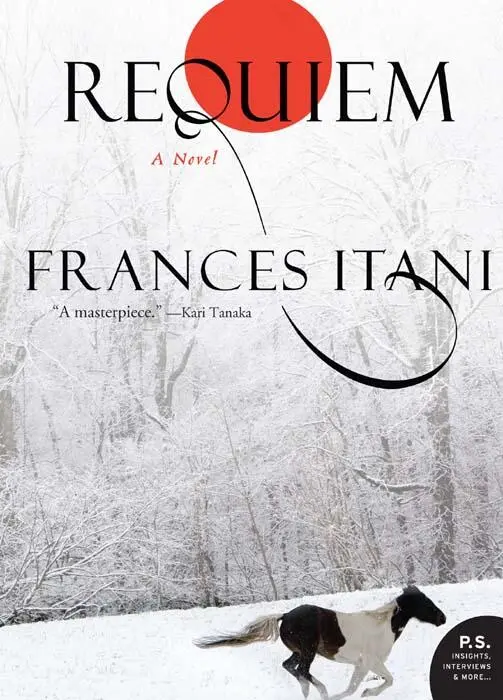
- Название:Requiem
- Автор:
- Издательство:A Phyllis Bruce Book
- Жанр:
- Год:2012
- Город:Toronto
- ISBN:978-1-44340-690-1
- Рейтинг книги:4 / 5. Голосов: 1
-
Избранное:Добавить в избранное
- Отзывы:
-
Ваша оценка:
Requiem: краткое содержание, описание и аннотация
Предлагаем к чтению аннотацию, описание, краткое содержание или предисловие (зависит от того, что написал сам автор книги «Requiem»). Если вы не нашли необходимую информацию о книге — напишите в комментариях, мы постараемся отыскать её.
delicately probes the complex adjustments we make to live with our sorrows…. [A] perfectly modulated novel.”
—
An extraordinary researcher and scholar of detail, Frances Itani—author of the best-selling novel
—excels at weaving breathtaking fiction from true-life events. In her new novel, she traces the lives, loves, and secrets in one Japanese-Canadian family during and after their internment in the 1940s.
In 1942, in retaliation for the attack on Pearl Harbor, the Canadian government removed Bin Okuma’s family from their home on British Columbia’s west coast and forced them into internment camps. They were allowed to take only the possessions they could carry, and Bin, as a young boy, was forced to watch neighbors raid his family’s home before the transport boats even undocked. One hundred miles from the “Protected Zone,” they had to form new makeshift communities without direct access to electricity, plumbing, or food—for five years.
Fifty years later, after his wife’s sudden death, Bin travels across Canada to find the biological father who has been lost to him. Both running from grief and driving straight toward it, Bin must ask himself whether he truly wants to find First Father, the man who made a fateful decision that almost destroyed his family all those years ago. With his wife’s persuasive voice in his head and the echo of their love in his heart, Bin embarks on an unforgettable journey into his past that will throw light on a dark time in history.
Requiem — читать онлайн бесплатно полную книгу (весь текст) целиком
Ниже представлен текст книги, разбитый по страницам. Система сохранения места последней прочитанной страницы, позволяет с удобством читать онлайн бесплатно книгу «Requiem», без необходимости каждый раз заново искать на чём Вы остановились. Поставьте закладку, и сможете в любой момент перейти на страницу, на которой закончили чтение.
Интервал:
Закладка:
I hear sudden shrill voices—my brother and sister. Are they quarrelling? Is Hiroshi following Father’s lead and trying to boss Keiko? Have we eaten breakfast? It is early morning, I’m certain of that. And why do I recall the stove? Bits of iron and pipe have been taken apart and are strewn around the once gleaming, now soot-covered floor. Father re-enters the kitchen, but he is no longer shouting.
“If they send us to the inland mountains,” he says, addressing Mother, “we’ll have to supply our own heat.”
Not caring that cones of ash sift down or that there are puddles on the floor. Puddles, indoors! The unthinkable has happened. Father has been pouring buckets of water over the hot stove, and as it cools, he dismantles it piece by piece, dragging each section outside to be crated on the beach, all the while ignoring black streaks that smear one end of the kitchen to the other. No one pays attention to the heaps of mud and soot inside the house, and I begin to feel a giddy kind of danger because we have always been strictly required to remove our shoes at the outside door. The floor that Mother wipes every day with a damp mop is no longer spotless, and it becomes clear to me that what is happening at this moment in our kitchen is of greater magnitude than any stray specks of dirt we children might once have dragged in.
There is another tableau stamped in my memory, this from the evening before we boarded the mail boat that took us away. Evacuation Eve , Hiroshi came to call it. The memory is of the pyre and the dolls. Of slashes of colour emblazoned as indelibly as the bruises the lid of the rice pot formed on my fat little legs as I followed, at a run, behind my mother the next morning.
Firewood has been stacked into a neat pyramid on the rocky shore. Everyone is present, all eight families from the bay—but only Japanese. The hakujin families live in a separate part of the village.
It is the men who make the decision. They instruct the women to gather the dolls and bring them to the pyramid of wood on the strip of beach, which, at low tide, is awash with curiously speckled stones, tangles of seaweed, gaping oyster shells. I see now that the dolls, in some bizarre way, might be more precious than the houses we are about to leave behind. The fate of the dolls is the only fate that can be controlled in that brief and desperate time. Of course, the adults already know what the children learn only the next morning—that our homes will be looted the moment we are taken away.
Brightly coloured reds and golds, greens and silvers, jackets of silk, kimonos with permanent folds of upholstered fabric. These are the dolls that have graced the shelves of the tokonoma , the special corner of the living room, or that were displayed in glass cases on top of cabinets or buffets. Ceremonial dolls, dolls with real hair, black hair like Mother’s, with bangs clipped evenly over the forehead. Cream-coloured faces with crescent-shaped laughing eyes and sharp, thin noses. A delicate arc of eyebrow on a face, hand-painted, as if by a calligrapher. Links to our unseen ancestors, works of art, every one—I sense and know this, even as a child. Later, I attempt to create them on paper, from memory, or I try to invent likenesses of my own.
The warrior dolls are samurai , with separate horse and leather armour. There are dolls for Boys’ Day, Girls’ Day, dolls to celebrate and honour the birth of each child. Purchased from stores in Steveston, on the mainland, or sent by great-grandparents never met. Dolls that were once lovingly packed in straw and shipped in wooden crates.
It is a symbolic fire, though the story passed down is that our parents were certain there would be no room for dolls in the bundles they would carry out of the house. It would be an outrage to think that dolls would be necessary for survival, especially during the bitter cold of that first winter in the Fraser Valley, when we ended up living in tents.
Did Mother agree with the men’s decision when she carried our dolls down the steps and out to the pyre on the rocky beach? She did not. Because she defied Father and hid two of the smallest at the bottom of her willow basket. She continued to hide the dolls all the years of the war and all the years that came after, and I found out about them only after her death in 1987, less than a year before the public apology was made to us by the prime minister in the House of Commons. Mother did not live to hear those historic and crucial words. And though Lena and I were not at her funeral, when Mother’s will was read, it was a surprise to everyone that the pair of dolls had been left to Lena. My sister, Kay, was instructed to send them to our home, which she did. Mother had known that it would be my wife who would unearth the family history. Even though she had met Lena only half a dozen times—and never in B.C.—Mother wanted our stories to be told.
On the narrow shore outside our home that evening, the dolls are heaped onto the pyre. Each of the men carries a small vessel of sake , rice wine, and sprinkles it over the pyramid of beauty, the pyramid of art. The children are ordered not to cry, one more emotion that must be buried, to simmer endlessly under the skin. My father, self-appointed leader of the now boatless fishermen—wasn’t he known as “high-catcher” at sea?—strikes the first match. And everyone—men, women, children, Mother staring straight ahead, Missisu’s eyes downcast, face expressionless—looks on in silence while cream-coloured cheeks, elbows and fingers, upholstered pantaloons, kimonos green and gold, delicate tassels beneath dimpled bisque chins, all, all are devoured by unstoppable, ferocious, orange licking flames. Could I create such a scene on paper now? In my mind I see every angle of elbow and foot, every miniature samurai blade.
In the morning, after we are herded onto the Princess Maquinna— which brings us to Port Alberni, where a train waits to take us to Nanaimo, on the east coast of the island, and from there to Vancouver by ferry—we stand with our hands gripping the railings, and watch while looters from the village move swiftly, running from house to house as the boat tugs out of the bay. The looters cannot get inside our houses quickly enough. They cannot wait until the boat is out of sight.
Almost everything left behind is dragged from our home. The grandfather clock, tables, chairs, linens, pillows, cutlery, china, sets of dishes, photograph albums, wedding gifts and heirlooms my parents had been given at the time of their marriage. Even the toy boats Hiroshi and Keiko and I had banged together from boards and nails, boats to which we’d attached string, and dragged through shallow water from the safety of shore—even those are scooped up.
I retain two final images from the house of my birth. In the first, a woman’s fair hair flies about her face in the wind as she exits our home triumphantly, bearing in her arms the prize of my mother’s portable Singer sewing machine. The woman’s eyes can barely be seen above the machine’s ebony wheel. A spool of red thread is stuck to the bobbin like a traitorous flag. Another woman, older than the first, follows behind. She is carrying the curved wooden cover that slips overtop of the Singer. In their haste, they have not stopped to fit the two parts together.
In the second image, four men push and pull at an upright piano. They are trying to squeeze it through the doorway of Missisu’s house, tilting it forward over the steps and onto the boardwalk. There is much shouting and shoving and swearing until, finally, they get that troublesome load down and onto a large, flat cart they have brought with them for the sole purpose of the piano’s removal.
As the mail boat chugs away from the bay, the looters do not look out towards the families crowded on board. They do not even bother to glance our way.
Читать дальшеИнтервал:
Закладка:
Похожие книги на «Requiem»
Представляем Вашему вниманию похожие книги на «Requiem» списком для выбора. Мы отобрали схожую по названию и смыслу литературу в надежде предоставить читателям больше вариантов отыскать новые, интересные, ещё непрочитанные произведения.






Обсуждение, отзывы о книге «Requiem» и просто собственные мнения читателей. Оставьте ваши комментарии, напишите, что Вы думаете о произведении, его смысле или главных героях. Укажите что конкретно понравилось, а что нет, и почему Вы так считаете.