Ben Elton - Two Brothers
Здесь есть возможность читать онлайн «Ben Elton - Two Brothers» весь текст электронной книги совершенно бесплатно (целиком полную версию без сокращений). В некоторых случаях можно слушать аудио, скачать через торрент в формате fb2 и присутствует краткое содержание. Город: London, Год выпуска: 2012, ISBN: 2012, Издательство: Transworld Publishers, Жанр: Историческая проза, на английском языке. Описание произведения, (предисловие) а так же отзывы посетителей доступны на портале библиотеки ЛибКат.
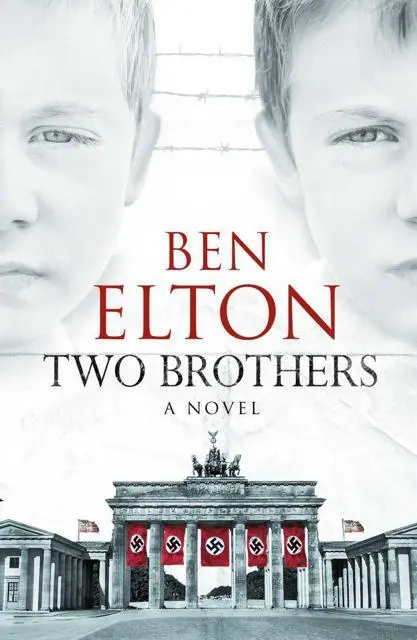
- Название:Two Brothers
- Автор:
- Издательство:Transworld Publishers
- Жанр:
- Год:2012
- Город:London
- ISBN:9780593062050
- Рейтинг книги:4 / 5. Голосов: 1
-
Избранное:Добавить в избранное
- Отзывы:
-
Ваша оценка:
Two Brothers: краткое содержание, описание и аннотация
Предлагаем к чтению аннотацию, описание, краткое содержание или предисловие (зависит от того, что написал сам автор книги «Two Brothers»). Если вы не нашли необходимую информацию о книге — напишите в комментариях, мы постараемся отыскать её.
Two Brothers BEN ELTON’s career as both performer and writer encompasses some of the most memorable and incisive comedy of the past twenty years. In addition to his hugely influential work as a stand-up comic, he is the writer of such TV hits as
and
. Most recently he has written the BBC series
on the subject of young parenthood. Elton has written three musicals,
and
and three West End plays. His internationally bestselling novels include *
,
,
,
and
. He wrote and directed the successful film
based on his novel
starring Hugh Laurie and Joely Richardson. About the Author
Two Brothers — читать онлайн бесплатно полную книгу (весь текст) целиком
Ниже представлен текст книги, разбитый по страницам. Система сохранения места последней прочитанной страницы, позволяет с удобством читать онлайн бесплатно книгу «Two Brothers», без необходимости каждый раз заново искать на чём Вы остановились. Поставьте закладку, и сможете в любой момент перейти на страницу, на которой закончили чтение.
Интервал:
Закладка:
Frieda also knew she was looking for ways to help get herself through the lonely evenings. Paulus was still living at home but he was absorbed mainly in study and kept to his room a lot of the time. Frieda missed Wolfgang and Otto terribly and so tried to fill every waking minute in an effort to distract herself from the empty spaces they had left behind.
The group was an instant success. Quite apart from the practical consideration of gaining a language with a view to emigration, the problem of boredom was endemic across the whole Jewish community. Largely shut up and hidden away, people were simply going crazy with nothing to do.
Assembling the group was therefore easy, finding something for it to talk about proved harder. Or at least something that didn’t concern the woes of their community. Frieda soon found herself developing rules and strategies to avoid falling endlessly into the same deeply depressing conversational ruts.
‘We’re playing that game again!’ she’d say two or three times at every meeting. ‘The game of who’s suffered the most and who deserves it least.’
It was almost inevitable that most conversations degenerated into an exchange of misery. People fell over each other to describe the dreadful experiences they had suffered and which they were quite certain trumped anything that their fellow group members might have gone through that day.
Sometimes the exchanges became heated. Previously calm and temperate neighbours raised their voices at each other. Arguing passionately about whether being refused service in a shop by an old acquaintance was more outrageous than being spat at in the street by a small child.
‘My daughter was ejected from the railway station lavatory.’
‘They took my umbrella. Just took it from my hand.’
‘An umbrella? So what! They took my bicycle.’
‘Ha! They took my car!’
‘I am a war veteran.’
‘I’ve paid my taxes all my life.’
Then Frieda would ring the little ‘no moaning’ bell that she kept beside her and insist, ‘We must stop this! And if we can’t stop it we must at least be civil about it. We’re all starting to bicker and snap at each other. It’s hardly surprising, all cooped up together as we are, but that’s all the more reason to try harder to show each other respect.’
Try as she might, though, it was not possible for Frieda to steer the conversation away from endless discussions about the rapidly deteriorating situation in general.
The truth was there was really little else to talk about.
The register of Jewish assets in April had been a huge psychological blow, and even Frieda herself could not help dwelling on the cruelty of the action.
‘It’s like a note through the door saying, We’re coming to get you ,’ she said. ‘Or a thug on the other side of the street just standing, watching you with a smile on his face, whacking his cosh into the palm of his hand. It’s really quite brilliant. Making us list our things and then letting it hang over us. If they ever make bullying an Olympic sport, then Germany will win Gold in Tokyo in 1940.’
‘ Ja, es ist absolut erschreckend …’ Morgenstern the ex-book dealer agreed in frustration.
‘In English, please, Mr Morgenstern,’ Frieda said. ‘This is an English conversation group.’
‘Yes. Of course,’ the old man stammered, searching in his mind for the correct words. ‘It is so very terrified, nicht wahr ? I mean, is it not?’
‘Terrify ing ,’ Frieda corrected, ‘not terrified. You are terri fied because it is terrify ing .’
In June the conversation group lost a member when the government announced that any Jew previously convicted of an offence, even as minor as a traffic violation, could be rearrested for it at the discretion of the police and sent to a concentration camp.
Schmulewitz the ex-insurance broker fell immediate victim to this new decree.
‘He was done for drunk driving in 1925,’ his tearful wife explained, bravely struggling to deliver her dreadful news in English as the rules of the group required. ‘A local policeman Hans once challenged over insurance is now having his revenge, and Hans has been sent to Ravensbrück. For a glass of schnapps he was fined for in 1925!’
In July came news that was particularly demeaning for Frieda.
‘I have to tell you all,’ she told the group, in perfect English, ‘that officially at least you must not call me “doctor”. The medical certification for all Jewish doctors is to be cancelled. I am no longer qualified. They’re only going to let us function as nurses and even then, of course, only to Jewish patients.’
‘ So haben sie endlich einen Weg gefunden …’
‘In English please, Mrs Leibovitz,’ Frieda interrupted. ‘Always in English.’
‘I was saying,’ Frau Leibovitz corrected herself, ‘that they’ve finally found a way to redress the so-called “imbalance” regarding Jewish doctors that used to worry them so much. We used to be told we had too many doctors, now we don’t have any.’
In August came the shocking decree that all Jews were required to add the names ‘Israel’ or ‘Sara’ to their own names and that a large letter J was to be stamped on to every Jewish passport.
‘They’re marking us down,’ Herr Katz said. ‘Identifying every single one of us so we can’t hide. Why? What are they planning? What more can they do to us?’
Frieda almost smiled. What more can they do to us? Each of them said it. To themselves and to each other, over and over again. Whoever could have imagined that such a phrase would be the most common English sentence used in her conversation group?
‘Ah ah, Herr Katz,’ she admonished gently. ‘You know that I have banned that phrase as overused. Try to come up with an alternative construction.’
‘Very well then, Mrs Doctor ,’ Katz said, his brow furrowed in concentration. ‘How about — the end, where will all of it be coming?’
‘Not bad,’ Frieda said. ‘The correct English sentence would be: Where will it all end? ’
The Night of the Broken Glass
Berlin, November 1938
OTTO WAS AWOKEN by the familiar harsh rasping bark of a command delivered as unpleasantly and as aggressively as the speaker knew how.
‘ Jungmannen! Parade, you lazy swine!’
Otto looked at his wristwatch. It was nearly midnight.
Of course it was.
Midnight. The Nazis’ favourite hour.
Everything felt more special at midnight, more sternly historic. Swearing-ins, oaths of allegiance, flag ceremonies. Brutal initiations and impossibly tough physical tasks. Why do them after breakfast when you can do them in the middle of the night? With bonfires, flickering torches and muffled drums?
Otto rolled out of his bunk. He had been asleep and lost in dreams of Dagmar from which he was most annoyed to have been torn.
‘Turn out, you fucking swine,’ the voice commanded. ‘On parade! Civilian clothes.’
Otto’s heart sank. It seemed to him that the dorm leaders had in mind their favourite torture. This was to force the boys on and off parade in all of their various kits in turn, summer, winter, sport, formal, swim, labouring etc., with ever decreasing periods of time in which to make the changes. Then when every single item of clothing and equipment in the school had been thrown on and thrown off in a frenzy of impossible deadlines, the leaders would call a dormitory inspection and punish the whole school for slovenly kept kit.
Otto’s options on civilian dress were more limited than the other boys’. He was an orphan without personal means, supported by the state. The school board supplied him with everything he possessed, and while Otto’s uniforms were splendid, they were not lavish with anything else. Otto had no long trousers to put on and so despite it being November he had to turn out on the frosty parade ground in shorts, which caused much sniggering amongst the younger boys.
Читать дальшеИнтервал:
Закладка:
Похожие книги на «Two Brothers»
Представляем Вашему вниманию похожие книги на «Two Brothers» списком для выбора. Мы отобрали схожую по названию и смыслу литературу в надежде предоставить читателям больше вариантов отыскать новые, интересные, ещё непрочитанные произведения.





Обсуждение, отзывы о книге «Two Brothers» и просто собственные мнения читателей. Оставьте ваши комментарии, напишите, что Вы думаете о произведении, его смысле или главных героях. Укажите что конкретно понравилось, а что нет, и почему Вы так считаете.