Ben Elton - Two Brothers
Здесь есть возможность читать онлайн «Ben Elton - Two Brothers» весь текст электронной книги совершенно бесплатно (целиком полную версию без сокращений). В некоторых случаях можно слушать аудио, скачать через торрент в формате fb2 и присутствует краткое содержание. Город: London, Год выпуска: 2012, ISBN: 2012, Издательство: Transworld Publishers, Жанр: Историческая проза, на английском языке. Описание произведения, (предисловие) а так же отзывы посетителей доступны на портале библиотеки ЛибКат.
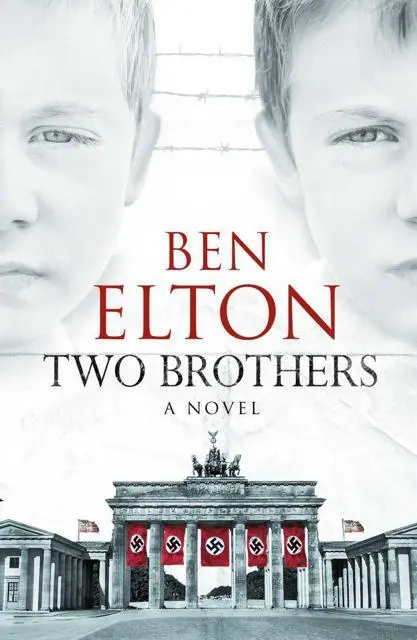
- Название:Two Brothers
- Автор:
- Издательство:Transworld Publishers
- Жанр:
- Год:2012
- Город:London
- ISBN:9780593062050
- Рейтинг книги:4 / 5. Голосов: 1
-
Избранное:Добавить в избранное
- Отзывы:
-
Ваша оценка:
Two Brothers: краткое содержание, описание и аннотация
Предлагаем к чтению аннотацию, описание, краткое содержание или предисловие (зависит от того, что написал сам автор книги «Two Brothers»). Если вы не нашли необходимую информацию о книге — напишите в комментариях, мы постараемся отыскать её.
Two Brothers BEN ELTON’s career as both performer and writer encompasses some of the most memorable and incisive comedy of the past twenty years. In addition to his hugely influential work as a stand-up comic, he is the writer of such TV hits as
and
. Most recently he has written the BBC series
on the subject of young parenthood. Elton has written three musicals,
and
and three West End plays. His internationally bestselling novels include *
,
,
,
and
. He wrote and directed the successful film
based on his novel
starring Hugh Laurie and Joely Richardson. About the Author
Two Brothers — читать онлайн бесплатно полную книгу (весь текст) целиком
Ниже представлен текст книги, разбитый по страницам. Система сохранения места последней прочитанной страницы, позволяет с удобством читать онлайн бесплатно книгу «Two Brothers», без необходимости каждый раз заново искать на чём Вы остановились. Поставьте закладку, и сможете в любой момент перейти на страницу, на которой закончили чтение.
Интервал:
Закладка:
The exhibition was on the second floor of the building and it could only be reached via a small back staircase, up which it was really only possible to shuffle in single file. Wolfgang intimated from this that the organizers had not expected a big turnout. It was obvious that the exhibition had been mounted simply that it might be reported. So that the principle that there was such a thing as Jew-inspired ‘degenerate art’ would be established. That smug burghers might be able to sneer at an example or two offered up for ridicule each day in the newspapers.
The exhibits on display had been mounted in a deliberately alienating manner, crowded together, sometimes skewed, tucked into corners and placed in unsuitable settings for their scale. The place was also hot and the crowd thick, but Wolfgang determined to appreciate every item. To mentally isolate himself within the throng, focusing with all his might on each piece, allowing people to push past as he obstinately took his time.
Everywhere the organizers had posted little slogans in an effort to remind the patrons to make sure they continued to hate.
Madness becomes method!
The German Peasant through the eyes of the Jew!
Cretins and whores, the ideal of the Degenerate .
Nature through sick minds!
Wolfgang revelled in it all. Wallowed in it. Staying until the very last moment, leaving only as the doors were being locked behind him.
This was his holiday. A trip around the world and across the universe of the imagination in a single day.
Before he took his leave.
Because Wolfgang had a plan. A plan which he explained to Frieda in the last note he ever left her. On the kitchen table they had shared together all their adult lives.
He wrote it on the train back to Berlin. My dearest, darlingest, beloved Freddy , it began.
Please don’t be angry with me. You must know that what I am doing is right .
You must also know that I have spent my last full day on earth in the company of some of the greatest spirits that ever lived. I would have preferred to have spent it with you, of course. But I couldn’t. You would have guessed — you always do — and would have tried to stop me .
Fred. You know I have to leave you .
You DO know that .
There is no possibility in all the world of any country agreeing to take me as a refugee. I am broken and there’s an end to it. If you insist on trying to take me, as I know you will, you will never leave this hell, and if you stay I do believe the end will be soon and it will be terrible .
You must get out and so must Paulus. Ottsy, too, I hope with all my heart. But you cannot if I am with you .
And so I must leave Germany by another route .
I pass without regret .
Believe that!
Believe it with all your heart or my soul will not rest .
How could I regret? I shared my life with you. No other man living or dead could ever have filled his time on earth more beautifully than that. To have lived life with you .
And with our boys .
But now that time is ended. Seventeen years of love .
And had those years been five or fifty, a minute, an hour or the half a century they should have been, it would have been just the same .
The same amount of time really. Do you see?
For in that time, no matter what length its earthly span, was contained all the love in the world .
Ha ha! There, you see! I can say something without trying to be funny!
And now it’s goodbye .
Freddy .
Once again .
You know I’m right. You know I have to do this .
Here’s hoping those heavenly choirs (in which I’m choosing at this last moment to believe) know some jazz!
Your own
Wolf
The night train arrived back in Berlin shortly before dawn. Wolfgang took a taxi back to Friedrichshain. It was an extravagance but a necessary one as he wanted to be sure to arrive home before Frieda awoke.
Asking the taxi to wait in the street outside their building, he crept slowly up the stairs to their apartment. He could not use the lift for fear of rousing Frieda. He tried hard not to wheeze as his infected lungs laboured with the climb, and almost held his breath as he approached his own front door. Creeping silently into the flat, Wolfgang left his note on the kitchen table and weighed it down with his house keys. Then, pausing only to pick up his trumpet, he made his way back out. He didn’t linger. He didn’t turn to look. He knew that had he done so the temptation to remain, to creep back into bed and kiss his beloved, would be too much.
And he had a taxi waiting.
Outside as the morning sun began slowly to find the first colours of the morning, Wolfgang asked the driver to take him to the old Moltke bridge.
Once in the middle of the bridge, Wolfgang got out and watched the taxi drive away.
Then, taking his trumpet, he stood beside the sandstone parapet above the central arch and played. He played Mack the Knife , that mournful, hypnotic hook that Weill laid down to support Brecht’s sinister lyric about the shark’s teeth and the hidden blade. Back when Berlin was beautiful and crazy.
It took him a number of stops and starts to complete the short tune even once. Wolfgang’s lungs were almost gone and even these few notes presented a challenge.
Then, rolling himself up on to the parapet, his trumpet still in his hand, Wolfgang Stengel threw himself off the Moltke bridge and into the river Spree below.
Later, when Wolfgang’s body was dragged from the river and his death was duly recorded, it was said that he had committed suicide. But Frieda knew that he hadn’t. Nor had any of the hundreds of other Jews who took their own lives that year when the whole world still recognized Hitler as a great and inspiring leader of the German nation.
‘My husband was murdered,’ Frieda said. ‘They were all murdered.’
Frieda’s Other Children
Berlin, 1938
IN THE SPRING of 1938, the German Government was flushed with victory after its popular absorption of Austria into the Reich.
This event had unleashed an orgy of anti-Semitic violence in the south, which was so far unparalleled in its spite and cruelty. Emboldened by what appeared to be a popular appetite for pitiless brutality, the Nazis began what they called the Aryanization of Reich assets.
‘I think they’re going to take our homes,’ Frieda said to her mother and father on one of her Sunday visits.
‘Nonsense,’ Herr Tauber grunted over the empty pipe on which he still sucked despite the fact that it rarely contained tobacco. ‘I won’t believe it.’
‘Dad. We have to register our assets. Property, possessions, the lot.’
‘Well, it’s like a census, isn’t it?’ the rapidly ageing man insisted, ‘except instead of people they are taking an inventory of property.’
‘Yes. Ours, Dad. No one else’s. The Nazis want to know exactly what we own. I cannot think of any other reason for them doing that than that they intend at some point to steal it. Why else would they call a list of Jewish possessions “Reich assets”? They’re certainly nothing if not shameless.’
The old couple tutted and protested into their little bit of coffee and bread and butter.
‘But think about it, Frieda dear,’ Frau Tauber said, ‘if they took our homes, where would we live? There are thousands of us, they can’t very well leave us on the streets. No. I won’t believe it. It doesn’t make sense.’
Frieda did not argue any further. In fact she regretted raising the point at all. Why should her parents face reality? It would do them no good if they did, for there was nothing they could do about their situation. They could not escape even if they had wanted to. No country would give them a visa. Better really that they should continue to live in denial, choosing to believe that somehow, in the end, the madness would stop. That it simply was not possible for the German State to be reinvented permanently as an entirely criminal organization.
Читать дальшеИнтервал:
Закладка:
Похожие книги на «Two Brothers»
Представляем Вашему вниманию похожие книги на «Two Brothers» списком для выбора. Мы отобрали схожую по названию и смыслу литературу в надежде предоставить читателям больше вариантов отыскать новые, интересные, ещё непрочитанные произведения.


Обсуждение, отзывы о книге «Two Brothers» и просто собственные мнения читателей. Оставьте ваши комментарии, напишите, что Вы думаете о произведении, его смысле или главных героях. Укажите что конкретно понравилось, а что нет, и почему Вы так считаете.