Ben Elton - Two Brothers
Здесь есть возможность читать онлайн «Ben Elton - Two Brothers» весь текст электронной книги совершенно бесплатно (целиком полную версию без сокращений). В некоторых случаях можно слушать аудио, скачать через торрент в формате fb2 и присутствует краткое содержание. Город: London, Год выпуска: 2012, ISBN: 2012, Издательство: Transworld Publishers, Жанр: Историческая проза, на английском языке. Описание произведения, (предисловие) а так же отзывы посетителей доступны на портале библиотеки ЛибКат.
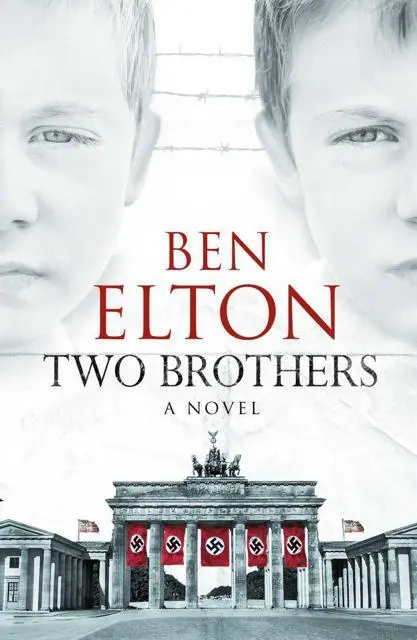
- Название:Two Brothers
- Автор:
- Издательство:Transworld Publishers
- Жанр:
- Год:2012
- Город:London
- ISBN:9780593062050
- Рейтинг книги:4 / 5. Голосов: 1
-
Избранное:Добавить в избранное
- Отзывы:
-
Ваша оценка:
Two Brothers: краткое содержание, описание и аннотация
Предлагаем к чтению аннотацию, описание, краткое содержание или предисловие (зависит от того, что написал сам автор книги «Two Brothers»). Если вы не нашли необходимую информацию о книге — напишите в комментариях, мы постараемся отыскать её.
Two Brothers BEN ELTON’s career as both performer and writer encompasses some of the most memorable and incisive comedy of the past twenty years. In addition to his hugely influential work as a stand-up comic, he is the writer of such TV hits as
and
. Most recently he has written the BBC series
on the subject of young parenthood. Elton has written three musicals,
and
and three West End plays. His internationally bestselling novels include *
,
,
,
and
. He wrote and directed the successful film
based on his novel
starring Hugh Laurie and Joely Richardson. About the Author
Two Brothers — читать онлайн бесплатно полную книгу (весь текст) целиком
Ниже представлен текст книги, разбитый по страницам. Система сохранения места последней прочитанной страницы, позволяет с удобством читать онлайн бесплатно книгу «Two Brothers», без необходимости каждый раз заново искать на чём Вы остановились. Поставьте закладку, и сможете в любой момент перейти на страницу, на которой закончили чтение.
Интервал:
Закладка:
And her eyes were rather lovely, it would be foolish to deny it. Rather like Norma Shearer’s, Dagmar thought, or perhaps Dietrich’s, or the English star Mary Astor. They slanted slightly downwards at the edges which gave them, she fancied, an expression of great mystery with perhaps a touch of melancholy too. The eyebrows were all wrong of course, thick schoolgirl eyebrows which she hated but was absolutely forbidden to pluck. She had tried to do it by stealth, taking exactly three a day from above each eye, but it had seemed to make no difference at all, and when out of impatience she upped her daily quota to ten her father was on to it immediately and harangued her over breakfast. He had told the maid to remove the honey from the table and not to return it for a week, which had been mortifying. Not the loss of the honey but the shame of being scolded publicly. In front of the maid.
She turned away from the mirror and considered the dress that had been laid out for her. It was awful of course, almost as bad as school uniform, which was the only other option her parents had been prepared to consider.
A sailor dress for heaven’s sake! She wasn’t a child.
Her figure was developing. She had a bosom.
You couldn’t wear a sailor dress with a bosom, it looked ridiculous. And socks! White socks, as if she were starting kindergarten. Dagmar considered a rebellion. After all, this was Father’s plan, not hers. She could hold on to the banister and refuse to cooperate.
But of course she couldn’t.
Her father was not a man to be disobeyed. He had given his orders and they would be followed to the letter.
‘Above all, we must show a brave face,’ he had said.
Easy for him, Dagmar thought, he didn’t have to face the world dressed as a ten-year-old.
She turned once more to her reflection.
Her face did not look very brave.
If only she could have worn a little make-up. Some of her friends at the expensive school she attended had already begun secretly to wear it when they went out. They said it made them feel smart and confident. Dagmar would have liked very much to be feeling smart and confident that morning.
She wondered whether if she sneaked some eye shadow and blusher from her mother’s dressing table it might pass unnoticed. Except she knew it wouldn’t be. If she applied enough to make her feel smart and confident then it would be enough to make her father call for a flannel and wipe it off in front of the servants.
There was no getting round it. The brave face that she put on would have to be her own, plain and unadorned. She must thrust her chest forward and her shoulders back as Fräulein Schneider her swimming mistress always insisted, and put from her mind the fact that she was dreading what her father expected her to do that morning with all of her heart.
She took up the blue and white sailor dress, put it over her head and pulled it down over her silk slip. Then she sat on the bed, lifted her long elegant legs and reached forward to put on the despised white ankle socks.
Her mother’s head appeared around the door.
‘Are you ready, dear?’ she asked. ‘Hurry with your shoes. You know how angry Father is about lateness.’
‘I look like a schoolgirl.’
‘You are a schoolgirl, dear.’
‘Why can’t we just close for the day like everybody else.’
‘Because, dear, we are not everybody else. We are the Fischer family. And as such are expected to set an example with our behaviour. With privilege comes responsibility, you must understand that. People expect us to lead by example and we shall not disappoint them. Now hurry up and put on your shoes. No, not the ones with the heels, the flat ones.’
Fischer’s department store had been a part of Berlin life for fifty years. It was founded by Dagmar’s grandfather who had begun (as most great shopkeepers do) with only a hand barrow. That tiny street business had since grown into one of the great shops of Berlin, patronized by office girls and movie stars alike. It was a symbol of stability, offering quality products at competitive prices through war and peace.
Through prosperity and disaster.
It had never once failed to open for trade.
‘And we shall open for trade today,’ Herr Fischer had said over breakfast before calmly returning to his newspaper, a newspaper which made grim reading indeed.
It was 1 April 1933 and the previous day it had been announced out of the blue that all Jewish-owned businesses were to be ‘voluntarily’ boycotted by all ‘true’ Germans from the following morning and until further notice.
The edict was shockingly comprehensive in its detail. Non-Jewish employees of Jewish-owned businesses were expected to boycott their own places of work while the ‘law’ insisted that the Jewish owners would be required to pay the absent workers in full for not attending.
That morning all over the country hundreds of thousands of Nazi Party storm troopers with the full backing and cooperation of the police were to turn out to stand ‘guard’ at the entrance to every Jewish-owned business in the country. This was in order to ensure that the population observed the spontaneous demonstration which their leaders had announced on their behalf. Paint was to be daubed on every window announcing that German citizens were committing a traitorous act if they shopped or did business there. Also to be daubed on walls and windows was the boycott slogan, coined by the notorious Nazi Gauleiter Julius Streicher, a man who was now a senior government official but who up until a few weeks before had been known to the authorities as a mentally imbalanced pervert and rapist. What Streicher’s slogan lacked in elegance it made up for in brevity.
Death to Jews .
Most of the businesses thus picketed by the all-powerful Brown Army elected simply to close up shop for the time being in the hope that this momentary ‘punishment’ for their global crimes would pass.
Herr Fischer, however, famous proprietor of Fischer’s department store, had other ideas.
‘The people of Berlin know our opening hours and they expect us to be open during those hours. We will not let them down,’ Herr Fischer told his staff on the previous evening (having ‘granted’ his non-Jewish employees a paid day off). ‘The Empress Augusta Viktoria herself visited us only a month before the Kaiser abdicated. She purchased gloves as a present for one of her ladies-in-waiting on the occasion of the girl’s engagement. Should her Imperial Highness be visiting from Holland tomorrow and wish to purchase gloves again, she will find us open, eager to serve and offering the most competitively priced and comprehensive selection of ladies’ gloves in Berlin. As usual.’
This speech was met with considerable applause and, thus buoyed up with the support of his workers ringing in his ears, Herr Fischer instructed his maintenance department to prepare two signs with which to counter the messages that had already begun to be daubed across the great plate-glass windows of his shop. The first sign was a copy of the store’s war memorial, the original of which was mounted beneath the clock in the splendid central gallery of the building. This memorial listed those employees of Fischer’s stores who had given their lives for the Fatherland in the Great War, of whom several had been Jews. Fischer ordered that those names were to be underlined and marked with a six-pointed star.
The second sign was a huge banner that was to be hung directly across the grand entrance, announcing that Fischer’s welcomed all its many regular and loyal customers, adding that in respect of that loyalty there was to be a 25 per cent discount on all purchases made on the first of April. This sale would last for one day only.
Читать дальшеИнтервал:
Закладка:
Похожие книги на «Two Brothers»
Представляем Вашему вниманию похожие книги на «Two Brothers» списком для выбора. Мы отобрали схожую по названию и смыслу литературу в надежде предоставить читателям больше вариантов отыскать новые, интересные, ещё непрочитанные произведения.








Обсуждение, отзывы о книге «Two Brothers» и просто собственные мнения читателей. Оставьте ваши комментарии, напишите, что Вы думаете о произведении, его смысле или главных героях. Укажите что конкретно понравилось, а что нет, и почему Вы так считаете.