Eleanor Catton - The Luminaries
Здесь есть возможность читать онлайн «Eleanor Catton - The Luminaries» весь текст электронной книги совершенно бесплатно (целиком полную версию без сокращений). В некоторых случаях можно слушать аудио, скачать через торрент в формате fb2 и присутствует краткое содержание. Год выпуска: 2013, ISBN: 2013, Издательство: Granta Publications, Жанр: Историческая проза, Современная проза, на английском языке. Описание произведения, (предисловие) а так же отзывы посетителей доступны на портале библиотеки ЛибКат.
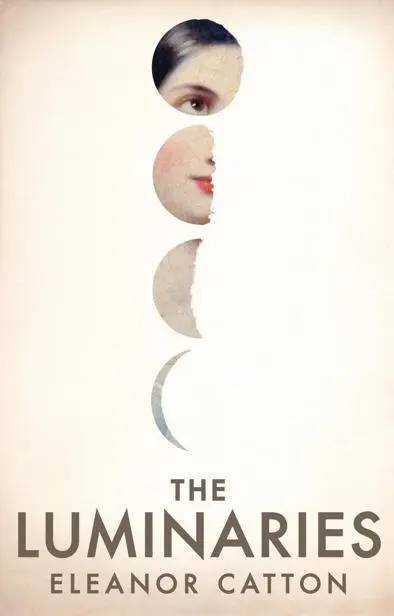
- Название:The Luminaries
- Автор:
- Издательство:Granta Publications
- Жанр:
- Год:2013
- ISBN:9781847085931
- Рейтинг книги:5 / 5. Голосов: 1
-
Избранное:Добавить в избранное
- Отзывы:
-
Ваша оценка:
The Luminaries: краткое содержание, описание и аннотация
Предлагаем к чтению аннотацию, описание, краткое содержание или предисловие (зависит от того, что написал сам автор книги «The Luminaries»). Если вы не нашли необходимую информацию о книге — напишите в комментариях, мы постараемся отыскать её.
The Luminaries — читать онлайн бесплатно полную книгу (весь текст) целиком
Ниже представлен текст книги, разбитый по страницам. Система сохранения места последней прочитанной страницы, позволяет с удобством читать онлайн бесплатно книгу «The Luminaries», без необходимости каждый раз заново искать на чём Вы остановились. Поставьте закладку, и сможете в любой момент перейти на страницу, на которой закончили чтение.
Интервал:
Закладка:
PART THREE
The House of Self-Undoing
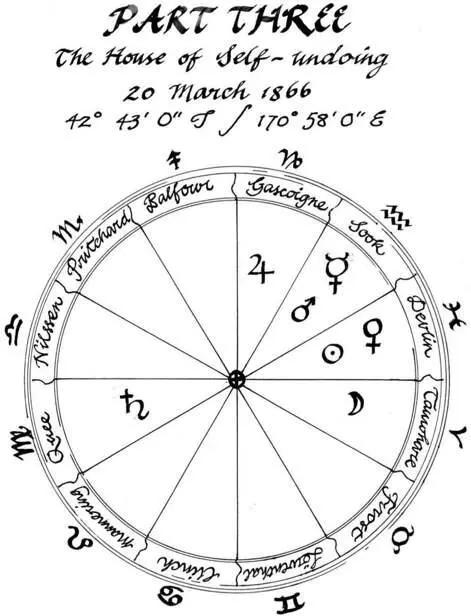
MERCURY IN AQUARIUS
In which Moody passes on some vital information, and Sook Yongsheng presents him with a gift.
On the morning of the 20th of March Walter Moody rose before the dawn, rang for hot water, and washed standing at the window, looking over the rooftops as the navy pre-dawn sky faded to grey, then pale blue, then the splendid yellow of a fresh yolk—by which time he was dressed, and descending the stairs, and calling for his toast to be buttered, and his eggs boiled hard. En route to the dining room he lingered in the hallway, leaning his ear towards the door of a locked chamber at the foot of the stairs. After listening a moment he perceived a grainy, rhythmic sound, and continued on, satisfied that the room’s inhabitant was still very sound asleep.
The Crown dining room was empty save for the intermittent presence of the cook, who stifled a yawn as he brought Moody’s pot of tea, and another as he delivered the morning edition of the West Coast Times , the pages slightly damp from the chill of the night. Moody scanned the paper as he ate. The front page was composed chiefly of repeat notices. The banks offered competing terms of interest, each promising the very best price for gold. The hoteliers boasted the various distinctions of their hotels. The grocers and warehousemen listed a full inventory of their wares, and the shipping news reported which passengers had lately departed, and which passengers had lately arrived. The second page of the paper was taken over by a long and rather spiteful review of the latest show at the Prince of Wales (‘so poor in quality as to defy—because it is beneath—criticism’), and several gossipy correspondences from goldfield speculators in the north. Moody turned to the social notices as he finished his second egg, and his eyes came to rest upon a pair of names he recognised. A modest ceremony had been planned. No date had yet been determined. There would be no honeymoon. Cards and other expressions of congratulation could be addressed care of the prospective groom, who took his nightly lodging at the Palace Hotel.
Moody was frowning as he folded the paper, wiped his mouth, and rose from the table—but it was not the engagement, nor the fact of its announcement, that preoccupied his thinking as he returned upstairs to fetch his hat and coat. It was the matter of the forwarding address.
For Moody knew very well that Francis Carver no longer lodged at the Palace Hotel. His rooms at the Palace stood as before, with his frockcoat hanging in the armoire, his trunk set out at the foot of the bed, and his bedclothes mussed and strewn about. He still broke his fast in the Palace dining room every morning, and drank whisky in the Palace parlour every night. He still paid his weekly board to the Palace proprietor—who, as far as Moody had been able to ascertain, remained quite unaware that his most notorious guest was paying two pounds weekly for an unoccupied room. The fact of Carver’s nightly relocation was not commonly known, and were it not for the accident of their conjunction, Moody might have also remained ignorant of the fact that Carver had slept every night since the night of the widow’s séance at the Crown, in a small room next to the kitchen that afforded an unobstructed view up the rutted length of the Kaniere-road.
By seven-thirty Moody was striding eastward along Gibson Quay, dressed in a grey slouch hat, yellow moleskin trousers, leather knee-boots, and a dark woollen coat over a shirt of grey serge. He now donned this costume six days out of seven, much to the amusement of Gascoigne, who had asked him more than once why he had chosen to leave off the piratical red sash, which might have finished off the ensemble very nicely.
Moody had staked a claim close enough to Hokitika to permit his continued board at the Crown Hotel. This arrangement cut into his weekly earnings rather severely, but he preferred it to sleeping in a tent beneath the open sky, something he had attempted only once, to his great discomfort. It took him an hour and twenty minutes to walk to his claim from Hokitika; before the clock struck nine every morning, therefore, he was at his cradle at the creekside, hauling pails of water, whistling, and shovelling sand.
Moody was not, truth be told, a terribly skilful prospector: he was hoping for nuggets rather than panning for dust. Too often the ore-bearing gravel slipped through the netting at the bottom of the cradle, only to be washed away; sometimes he emptied his cradle twice over without finding any flakes at all. He was making what the diggers called ‘pay dirt’, meaning that the sum total of his weekly income was more or less equal to the sum total of his weekly expenditure, but it was a holding pattern he could not sustain. He knew that he ought to heed popular advice, and go mates with another man, or with a party. The chance of striking rich was doubled in a partnership, and the chances multiplied still further in a party of five, or seven, or nine. But his pride would not permit it. He persevered alone, visualising, every hour, the nugget with which he would buy his future life. His dreams at night began to glister, and he began to see flashes of light in the most unlikely places, such that he had to look again, and blink, or close his eyes.
Stepping across the small creek that formed the northern boundary of his claim, Moody was surprised to see the pale silhouette of a tent through the scrub, and beside it, the remains of a fire. He came up short. The Hokitika diggers typically spent their weekends in town, not returning to the field until mid-morning on Monday at the very earliest. Why had this digger not joined his fellows? And what was he doing on another man’s patch of land?
‘Hello there,’ Moody called, meaning to rouse the tent’s inhabitant. ‘Hello.’
At once there came a grunt, and a flurry of motion inside the tent. ‘Sorry,’ someone said. ‘Very sorry—very sorry—’
A Chinese face appeared at the opening, blurred with sleep.
‘No trouble,’ he said. ‘Very sorry.’
‘Mr. Sook?’ said Moody.
Ah Sook squinted up at him.
‘I’m Walter Moody,’ Moody said, placing his hand over his heart. ‘Do you—ah—do you remember me?’
‘Yes, yes.’ Ah Sook knuckled his eyes with his fist.
‘I’m so glad,’ said Moody. ‘This is my claim, you see: from this creek here to those yellow pegs on the southern side.’
‘Very sorry,’ Ah Sook said. ‘No harm done.’
‘No: of course,’ Moody said. ‘In any case, Ah Sook, I’m pleased to see you. Your absence from Kaniere has been noted by a great many people. Myself included. I am very pleased to see you—very pleased, not angry at all. We feared that something had happened to you.’
‘No trouble,’ the hatter said. ‘Tent only. No trouble.’ He disappeared from sight.
‘I can see you’re not causing trouble,’ Moody said. ‘It’s all right, Mr. Sook: I’m not worried about you making camp! I’m not worried about that at all.’
Ah Sook clambered out of the tent, pulling his tunic down as he did so. ‘I will go,’ he said. ‘Five minutes.’ He held up five fingers.
‘It’s all right,’ Moody said. ‘You can sleep here if you like; it’s of no consequence to me.’
‘Last night only,’ said Ah Sook.
‘Yes; but if you want to tent here tonight also, I don’t mind a bit,’ said Moody. His manner was alternating between bluff cheer and clumsy condescension, as it might if he were speaking to someone else’s child.
Читать дальшеИнтервал:
Закладка:
Похожие книги на «The Luminaries»
Представляем Вашему вниманию похожие книги на «The Luminaries» списком для выбора. Мы отобрали схожую по названию и смыслу литературу в надежде предоставить читателям больше вариантов отыскать новые, интересные, ещё непрочитанные произведения.







Обсуждение, отзывы о книге «The Luminaries» и просто собственные мнения читателей. Оставьте ваши комментарии, напишите, что Вы думаете о произведении, его смысле или главных героях. Укажите что конкретно понравилось, а что нет, и почему Вы так считаете.