Stewart Binns - Conquest
Здесь есть возможность читать онлайн «Stewart Binns - Conquest» весь текст электронной книги совершенно бесплатно (целиком полную версию без сокращений). В некоторых случаях можно слушать аудио, скачать через торрент в формате fb2 и присутствует краткое содержание. Город: London, Год выпуска: 2011, ISBN: 2011, Издательство: Penguin Books, Жанр: Историческая проза, на английском языке. Описание произведения, (предисловие) а так же отзывы посетителей доступны на портале библиотеки ЛибКат.
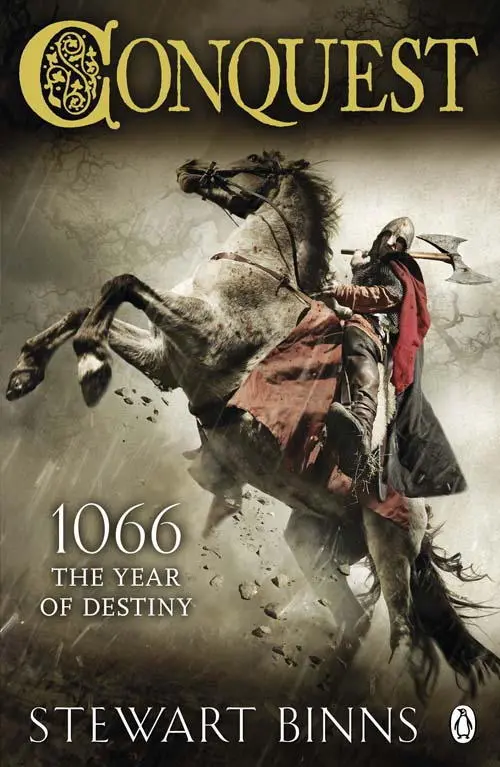
- Название:Conquest
- Автор:
- Издательство:Penguin Books
- Жанр:
- Год:2011
- Город:London
- ISBN:978-0-141-96059-3
- Рейтинг книги:5 / 5. Голосов: 1
-
Избранное:Добавить в избранное
- Отзывы:
-
Ваша оценка:
Conquest: краткое содержание, описание и аннотация
Предлагаем к чтению аннотацию, описание, краткое содержание или предисловие (зависит от того, что написал сам автор книги «Conquest»). Если вы не нашли необходимую информацию о книге — напишите в комментариях, мы постараемся отыскать её.
The battle is hard fought and bloody, the lives of thousands have been spent, including that of King Harold. But England will not be conquered easily, the Anglo-Saxons will not submit meekly to Norman rule.
Although his heroic deeds will nearly be lost to legend, one man unites the resistance. His name is Hereward of Bourne, the champion of the English. His honour, bravery and skill at arms will change the future of England. His is the legacy of the noble outlaw.
This is his story.
Conquest — читать онлайн бесплатно полную книгу (весь текст) целиком
Ниже представлен текст книги, разбитый по страницам. Система сохранения места последней прочитанной страницы, позволяет с удобством читать онлайн бесплатно книгу «Conquest», без необходимости каждый раз заново искать на чём Вы остановились. Поставьте закладку, и сможете в любой момент перейти на страницу, на которой закончили чтение.
Интервал:
Закладка:
Hereward was issuing vital commands in between close-quarter encounters with Norman knights who had breached the defensive line. He brought several down by scything their huge destriers from under them; others he hewed out of their saddle with a single sweep of his legendary axe. At crucial moments, Harold rode along the line, encouraging his men, but they hardly needed it. Their line was holding and the Normans were dying in droves.
William sat impassively on his destrier and waited. He knew the day was still young and that this would be a bloody battle of attrition at the cost of many lives. Eventually, in what appeared to be an English breakthrough, the Breton left reeled and retreated at a gallop. Naïvely thinking the battle won, large groups of fyrdmen on the English right broke ranks and hurried after them.
Hereward and his comrades were off at full pelt even before the King issued his urgent command: ‘Stop them! Hereward, get them back into the shield wall! Hurry!’
William had also seen the English fyrdmen break ranks and immediately galloped into the fray with his Matilda Squadron. English housecarls had followed the Fyrd to try and re-establish discipline. When Hereward and his companions arrived, they organized a redoubt on a small hillock. Martin sounded his horn to summon a recall and Hereward ripped the jerkin off a dead Norman archer and waved it above his head on a spear to signal a rallying point for the fyrdman, now scattered far and wide. Within minutes, a new wall was formed on the hillock and the fyrdmen had closed ranks behind the housecarls.
Harold ordered the English archers to put up a lethal volley of arrows above William’s advancing squadron just as it got within 100 yards of the redoubt. William’s horse took an arrow through its neck and collapsed under him, violently throwing him to the ground. A great cry of alarm went up from the Normans, who feared their leader was dead. But the Duke quickly regained his feet and was soon on a new mount, raising his helmet to show that he was still alive. He waved his Baculus furiously, berating the fleeing Bretons and demanding that they turn and fight. His dramatic intervention worked and the Breton cavalry formed up behind his Matilda Squadron to launch another assault.
Hereward tried to keep the fyrdmen in tight formation as he ordered the housecarls to make a disciplined withdrawal back up Senlac Ridge. But when William’s elite cavalry careened into the wall, many breaches were forced. Hereward had no choice but to order the shield wall to disengage and retreat en masse. Despite the valiant efforts of small groups of housecarls to defend the escaping fyrdmen by using their spears to try and slow the Norman momentum, chaos and carnage were inevitable.
William recalled his cavalry. Fortune had smiled once more on one of Harold’s battles – but this time on his opponent. The headlong rush by the Fyrd was a folly which might prove to be decisive. There had been heavy casualties all along the English shield wall, so much so that when Harold ordered it to tighten its formation, a line of defence that had started at over 750 yards was now barely 500 yards long.
Hereward and his companions were among the last to get back into position, marshalling the final laggards and helping some of the wounded to get back to relative safety.
Both William and Harold looked at the sun as it moved towards the tall trees in the woods to the west. Morning had turned into afternoon. Reports were coming in that hundreds of housecarls were approaching from London and would soon reinforce Harold’s position.
With the battle hanging precariously in the balance, Harold turned to Hereward.
‘I need an hour less in the day, or five hundred more men. If William continues to throw his cavalry at the wall, it will break before the sun falls behind those trees.’
‘Sire, if we’re still holding at four hours past midday, William will have to retreat and we will have him in the morning.’
‘Yes, Hereward. But I don’t think we can hold for four hours; two and a half, three at the most. Let’s rally the men. Somehow, they will have to buy us that hour.’
William had also done his calculations. After twenty minutes of regrouping, he ordered attack after attack: first infantry, then cavalry. Then, after a brief respite for regrouping, the onslaughts were repeated again and again. Like the English housecarls, he was battling against the hourglass as well as a ferocious enemy. The fighting was savage, with both sides taking huge losses, as William sacrificed his men to shorten Harold’s shield wall.
Crucially, as it shrank to protect its own flanks, it began to turn into a crescent, allowing the Normans to reach the flat terrain of Senlac Ridge. From there, their cavalry could gain much more momentum and their infantry could fight on even ground. Nevertheless, Harold’s army was still holding firm after two hours of vicious fighting. Harold and Hereward led by example; first on the left flank, then on the right. Both men were in the thick of the relentless struggle, as wave after wave of Norman destriers broke against the barricade of Englishmen. The defenders, although diminished in number, had lost none of their redoubtable spirit nor their renowned discipline. The sun was now low in the sky. The scales were tipping towards Harold; the courage of his housecarls was buying him the time he needed.
Then the Duke pulled off a masterstroke. Throughout the day he had been disappointed that his archers had been far less effective than he had hoped, so he tried a new tactic. He summoned the captains of his elite cavalry squadrons and his master bowmen and described to them a complex synchronized attack, where precise timing would be critical. He had made an important mental calculation about the speed of his cavalry and the length of time his arrows would be in the air.
If he got his arithmetic right, it could strike a mortal blow to the heart of the English line.
He ordered his archers to form up 100 yards behind his crossbowmen and for both to deploy in small units so that his cavalry squadrons could make their charge between their ranks. Next he ordered his squadrons to charge at full gallop and, as they passed his archers, they were to loose off the first of two rapid volleys high into the air against the English shield wall. By the time the cavalry reached the crossbowmen, they would be at full tilt. At that moment, the crossbowmen would shoot a single volley of bolts at a low trajectory. This would coincide with the English raising their shields in the testudo to protect them against the first hail of arrows from overhead, catching them in a withering cross-shoot of arrows and bolts. Usually, the testudo would deal with such a two-pronged attack with ease. However, with the Norman cavalry descending on them in overwhelming numbers, the testudo would have to break to allow the housecarls to deploy their spears against the destriers. If, at that exact moment, the second volley of arrows arrived from above, there would be slaughter – especially when, within seconds, the cavalry fell upon them.
William’s calculations were murderously precise; the timing of the Norman archers, bowmen and cavalry was perfect and Harold’s shield wall was thrown into disarray. At the vital moment in the battle, William had produced a stroke of military genius.
English reinforcements rushed forward to try and seal the devastated shield wall, exhausting Harold’s reserves. For the first time, rather than reinforcing gaps, his personal hearthtroop was heavily engaged. Two Godwinsons fell within moments of one another: Earl Leofwine took an arrow in the eye and Earl Gyrth was cut down by a formidable Norman knight who caught him in open ground.
The tide had turned.
Hereward looked at the distant trees and saw that the sun had just fallen behind the tall branches of the canopy. It was perhaps four thirty in the afternoon, but dusk had not come soon enough for the English; neither would reinforcements. The King had been right: if the day had been perhaps an hour shorter, or if 500 more housecarls had arrived from London, the outcome would have been different. William’s ploy would still have been effective, but almost certainly not decisive. The English would have had the numbers to regroup, leaving the Normans with no alternative but to take flight to the coast in search of their ships.
Читать дальшеИнтервал:
Закладка:
Похожие книги на «Conquest»
Представляем Вашему вниманию похожие книги на «Conquest» списком для выбора. Мы отобрали схожую по названию и смыслу литературу в надежде предоставить читателям больше вариантов отыскать новые, интересные, ещё непрочитанные произведения.








Обсуждение, отзывы о книге «Conquest» и просто собственные мнения читателей. Оставьте ваши комментарии, напишите, что Вы думаете о произведении, его смысле или главных героях. Укажите что конкретно понравилось, а что нет, и почему Вы так считаете.