Stewart Binns - Conquest
Здесь есть возможность читать онлайн «Stewart Binns - Conquest» весь текст электронной книги совершенно бесплатно (целиком полную версию без сокращений). В некоторых случаях можно слушать аудио, скачать через торрент в формате fb2 и присутствует краткое содержание. Город: London, Год выпуска: 2011, ISBN: 2011, Издательство: Penguin Books, Жанр: Историческая проза, на английском языке. Описание произведения, (предисловие) а так же отзывы посетителей доступны на портале библиотеки ЛибКат.
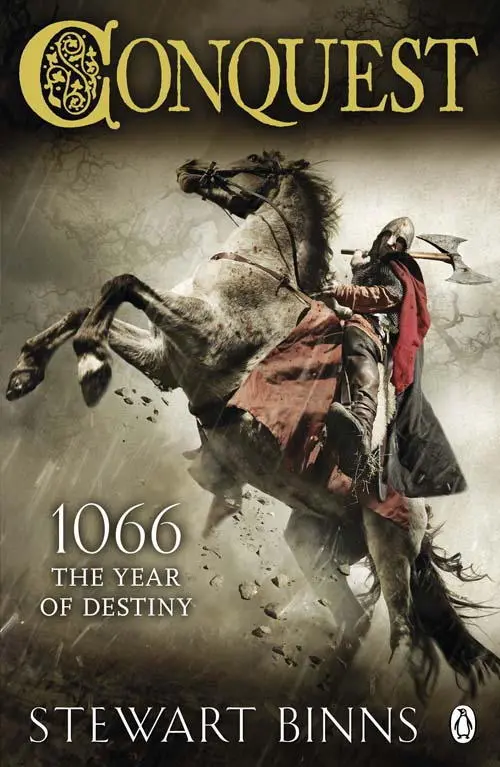
- Название:Conquest
- Автор:
- Издательство:Penguin Books
- Жанр:
- Год:2011
- Город:London
- ISBN:978-0-141-96059-3
- Рейтинг книги:5 / 5. Голосов: 1
-
Избранное:Добавить в избранное
- Отзывы:
-
Ваша оценка:
Conquest: краткое содержание, описание и аннотация
Предлагаем к чтению аннотацию, описание, краткое содержание или предисловие (зависит от того, что написал сам автор книги «Conquest»). Если вы не нашли необходимую информацию о книге — напишите в комментариях, мы постараемся отыскать её.
The battle is hard fought and bloody, the lives of thousands have been spent, including that of King Harold. But England will not be conquered easily, the Anglo-Saxons will not submit meekly to Norman rule.
Although his heroic deeds will nearly be lost to legend, one man unites the resistance. His name is Hereward of Bourne, the champion of the English. His honour, bravery and skill at arms will change the future of England. His is the legacy of the noble outlaw.
This is his story.
Conquest — читать онлайн бесплатно полную книгу (весь текст) целиком
Ниже представлен текст книги, разбитый по страницам. Система сохранения места последней прочитанной страницы, позволяет с удобством читать онлайн бесплатно книгу «Conquest», без необходимости каждый раз заново искать на чём Вы остановились. Поставьте закладку, и сможете в любой момент перейти на страницу, на которой закончили чтение.
Интервал:
Закладка:
As their position worsened to the point of desperation, the English Fyrd melted away. William’s strategy of attrition had taken all day, but it had worked. Many of Harold’s surviving housecarls began to form a final redoubt around their King. No more than 1,000 Englishmen stood between the Normans and the greatest prize in northern Europe.
In the ever-deepening gloom, the ensuing slaughter of the Anglo-Saxon military and aristocratic elite lasted over an hour. No quarter was offered, or sought, as the protective ring around the King became smaller and smaller and the pile of corpses grew higher and higher.
Eventually, the Norman destriers were encouraged to rake away the fallen English with their hooves, so that more could be killed. Squads were despatched by the Norman sergeants of infantry to clear the ground of dead to allow yet more carnage. Harold stood at the epicentre of it all, valiantly challenging his housecarls to even greater efforts and yet more courageous resistance. Around him were the strongest and bravest of his men, determined to make the Normans pay the highest possible price for their victory. Hereward stood beside his King, as he had promised he would, matching every blow of Harold’s with one of his own, inspiring his men and writing his name into legend.
Harold remained unharmed. Hereward had been less fortunate, having taken a crossbow bolt in his thigh and one in the shoulder. He had also taken a sword slash across his chest, from which blood was seeping through his hauberk. Despite Hereward’s insistence that they make their way to safety should the battle appear lost, Martin, Einar and Alphonso remained close by.
Alphonso spoke first as the circle became tighter and tighter around the King.
‘Hereward, the day is lost. The English are finished. You must leave. We can regroup in the North and fight another day.’
‘Not while the King stands, Alphonso. He won’t leave the field and if he is to perish, then I will die by his side –’
Martin interjected. ‘Let’s get the King away. We and his hearthtroop can fight our way out. If needs be, Einar can carry him out!’
Einar needed no second invitation and was already making for the King. He would have readily knocked him cold and thrown him over his shoulder to ensure his safety.
‘Hold!’ Hereward bellowed at his friend. ‘The King has chosen his ground. There is no retreat; I stand here with him.’
‘Then we stand with you.’
Duke William was circling the melee from a distance of about 100 yards, his Baculus dripping crimson from the punishment it had meted out. He had been heavily involved in the fighting and was now on his third mount of the day. He summoned four of his most powerful knights: Eustace of Boulogne, Hugh of Ponthieu, Walter Gifford and Hugh de Montfort.
‘The English are finished. Bring me the body of Harold, then the rest will scatter.’
The four collected discarded lances from the battlefield, raised their maces and set off at a gallop into the boiling scrum of fighting men. They made straight for the King, who was trying to seal breaches in the ring of housecarls. As the knights’ destriers bludgeoned their way towards him, Hereward was alert to the danger and brought Eustace of Boulogne to the ground by scything away the front legs of his mount with the Great Axe of Göteborg. Horse and rider hit Hereward hard as they fell, pinning him to the ground. Walter Gifford grasped the opportunity and plunged his lance through the shoulder of Hereward’s hauberk, a blow that exited below his collarbone and stuck firmly into the ground beneath him. Hereward, still trapped under the horse, quickly lost consciousness.
The knights made for the King. He had become completely isolated from his bodyguards as the massed Norman cavalry engulfed the English defenders. Surrounded by four ferocious knights, three on horseback, he stood little chance.
Hereward’s companions had a simple choice: to attempt to protect the King or to save their friend and mentor. They did not hesitate and were at Hereward’s side in an instant. While Martin lifted and pulled Hereward’s shoulders, Einar and Alphonso used their shields and spears to lever the weight of the stricken destrier, freeing him from under the animal. Mercifully, he was unconscious, so they could act without regard for pain. Einar used his great strength to break off the head of the lance and pull out its shaft, while Alphonso dragged out the arrows, tearing flesh as he did so.
The day was almost done and it was all but dark. They took their chance to escape in the gloom and the growing hysteria of the victorious Normans. Einar hauled Hereward on to his shoulder, picked up his weapons and, with Martin and Alphonso providing protection from would-be assailants, they made for the distant undergrowth, where Alphonso had tethered their horses.
Despite a prolonged and valiant resistance, his housecarls dead or facing their own demise in small pockets around the last redoubt, the four Norman assasins showed Harold no pity. After bringing him to exhaustion by their onslaught, they taunted him with their lances, piercing his flesh as a hag would stick pins in a clay effigy. They smashed his head and body with their maces, and then impaled him on their lances as if they were skewering a wild pig. Finally, while he still lived, they hacked him to pieces with their swords.
Harold’s gruesome death did not have the effect anticipated by Duke William. Its savagery roused the remaining housecarls to fight even more ferociously, until none was left standing. It was a scene of mayhem. Men, crazed by killing, screamed like animals as their horses trampled over the dead and the dying. Many of the Norman knights rode off in pursuit of fleeing Englishmen in order to commit yet more acts of brutality.
The Wyvern of Wessex was ripped to shreds and Harold’s personal standard, the Fighting Man, blood-spattered and torn, was handed to William, who immediately gave it to a messenger with instructions to have it delivered to the Pope in Rome.
In the murk of the autumn evening 500 housecarls drew close to the battlefield; they were the reinforcements for which Harold had prayed. Ashamed by the cowardly stance taken by the earls Edwin and Morcar, many of the younger thegns of Mercia and Northumbria had made the long march from the North. On hearing of the muster at Caldbec, they had ridden straight through London, picking up provisions as they rode.
It was an astonishing feat of endurance but, sadly for Harold and for England, they were forty-five minutes too late to save the day. When they saw the Norman knights hounding the remnants of Harold’s army in headlong flight, they formed up on a ridge above a narrow valley and ambushed wave upon wave of them, until several hundred bodies filled the ravine at a place the Normans immediately christened the ‘Malfosse’. Although the moment seemed sweet, the Northerners soon heard of the catastrophe at Senlac and the slaughter of the King. They had little choice but to melt away to avoid the main force of Normans.
After sounding a general recall to try and get some discipline back into his forces, William and his high command, too exhausted to go anywhere, spent the night on the battlefield amid the bodies of the dead and dying.
Hereward’s companions escaped under darkness and took his shattered body westwards across the Downs as far as they could, before descending into a wooded valley to find water and a place to camp. Hereward’s breathing was shallow, his complexion ashen and his body temperature minimal. Death was near. Alphonso, the most knowledgeable about wounds and healing, faced a dilemma: should he cauterize the wounds with a hot blade to prevent infection? If he did, the shock might be too much in Hereward’s weakened state.
Читать дальшеИнтервал:
Закладка:
Похожие книги на «Conquest»
Представляем Вашему вниманию похожие книги на «Conquest» списком для выбора. Мы отобрали схожую по названию и смыслу литературу в надежде предоставить читателям больше вариантов отыскать новые, интересные, ещё непрочитанные произведения.








Обсуждение, отзывы о книге «Conquest» и просто собственные мнения читателей. Оставьте ваши комментарии, напишите, что Вы думаете о произведении, его смысле или главных героях. Укажите что конкретно понравилось, а что нет, и почему Вы так считаете.