Stewart Binns - Conquest
Здесь есть возможность читать онлайн «Stewart Binns - Conquest» весь текст электронной книги совершенно бесплатно (целиком полную версию без сокращений). В некоторых случаях можно слушать аудио, скачать через торрент в формате fb2 и присутствует краткое содержание. Город: London, Год выпуска: 2011, ISBN: 2011, Издательство: Penguin Books, Жанр: Историческая проза, на английском языке. Описание произведения, (предисловие) а так же отзывы посетителей доступны на портале библиотеки ЛибКат.
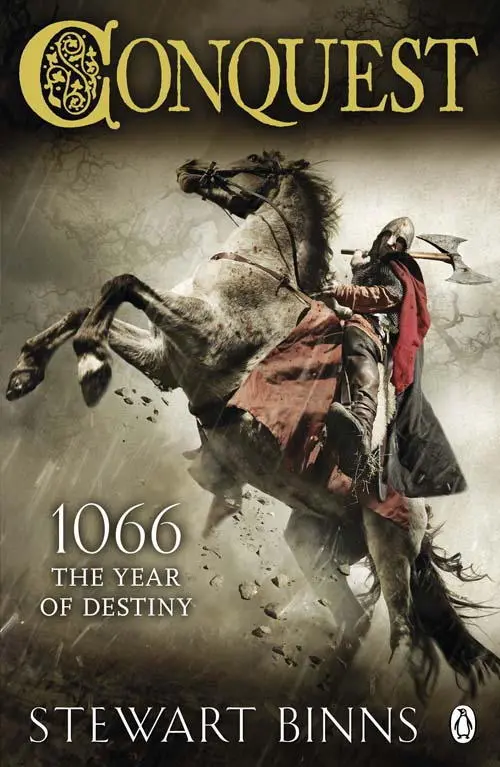
- Название:Conquest
- Автор:
- Издательство:Penguin Books
- Жанр:
- Год:2011
- Город:London
- ISBN:978-0-141-96059-3
- Рейтинг книги:5 / 5. Голосов: 1
-
Избранное:Добавить в избранное
- Отзывы:
-
Ваша оценка:
Conquest: краткое содержание, описание и аннотация
Предлагаем к чтению аннотацию, описание, краткое содержание или предисловие (зависит от того, что написал сам автор книги «Conquest»). Если вы не нашли необходимую информацию о книге — напишите в комментариях, мы постараемся отыскать её.
The battle is hard fought and bloody, the lives of thousands have been spent, including that of King Harold. But England will not be conquered easily, the Anglo-Saxons will not submit meekly to Norman rule.
Although his heroic deeds will nearly be lost to legend, one man unites the resistance. His name is Hereward of Bourne, the champion of the English. His honour, bravery and skill at arms will change the future of England. His is the legacy of the noble outlaw.
This is his story.
Conquest — читать онлайн бесплатно полную книгу (весь текст) целиком
Ниже представлен текст книги, разбитый по страницам. Система сохранения места последней прочитанной страницы, позволяет с удобством читать онлайн бесплатно книгу «Conquest», без необходимости каждый раз заново искать на чём Вы остановились. Поставьте закладку, и сможете в любой момент перейти на страницу, на которой закончили чтение.
Интервал:
Закладка:
Earl Gyrth was the last to speak. ‘Godric speaks well. The advice you have heard today, my noble brother and Lord King, is sound. Let me lead the raiding parties. Give me Hereward of Bourne as my second-in-command and we will make life miserable for the Normans and buy you a month to build the greatest army England has ever seen. Do not rush to battle, my brother.’
The King cast a glance at Hereward before he responded. Hereward’s nod in return indicated that he concurred with what had been said. Harold rose slowly and looked around the Great Hall of Westminster before speaking. He looked into the faces of the assembled men; there were over a hundred.
Finally, he spoke.
‘My lords, abbots, sheriffs, thegns of England, brothers in our common cause, I am grateful to you for your wisdom. I have been king for barely three seasons of a year, but already I am at a crossroads in our history. We have repelled Hardrada at Stamford Bridge, but now we are to confront an even greater threat. The people of England stand on a precipice between ignominy and glory. We have had a Roman Age in this land; we have had the Age of Alfred and the West Saxons; we have had the Age of the Danes. Now we have the chance to create an era that many of my predecessors have yearned for: an English Age for all the people of these islands, be they Saxon, Dane or Celt.
‘Hardrada tried to wrest that opportunity from us; but his daunting frame lies at rest in its shroud, soon to be consumed in a Viking funeral in his homeland. Now another stands in our way: William, Duke of Normandy. He wants this land, not to lead its people, not to protect them or cherish their culture and their traditions, but for himself, to feed his greed and lust for power. I have met this man and ridden into battle alongside him. This is not a man anyone would choose as their Lord. He is vain and capricious, ruthless and cruel. He will murder and maim our people, strip them of their lands, confiscate our abbeys and monasteries and abuse our women. He is an ungodly creature and every moment he spends on English soil is an abomination. We must not delay. This crossroads for our people is lit by a beacon and it lights the way to Pevensey. That is the road we must take. And we must take it without delay!’
Still heaving from the forceful delivery of his rhetoric, he looked into their eyes once more, hoping that his words had persuaded them. It was a stirring speech – his words so powerful, his conviction so firm. By its end, every man present was prepared to forego his doubts and support his King.
Loud cheers echoed around the hall, as the warriors raised their axes and beat their shields like drums of war.
The King raised his hands, appealing for a final word. ‘I am not deaf to the advice given here today. Your counsel is wise, but I am responsible for every man, woman and child who, at this very moment, is being put to the sword by the Norman butchers. I will wait until dawn on the morning of the eleventh, but no longer. All men who have made it to London by then will muster on Lambeth Fields at first light and we will leave for the coast as soon as the tally is done. Any forces not assembled by then must come on as soon as they can.’
Harold had bowed a little to those who had argued for caution and decided upon a delay of five days for preparation, consolidation and the arrival of fresh men. He had done some very agonizing arithmetic: every day meant more men for his army, but every day brought more death and suffering for the people of the south coast.
His solution to the ghastly equation was five days.
Harold raised his sword in one hand and his mace of kingship in the other. ‘God bless you all. For England!’
‘For Harold! For England!’ came the instant reply.
17. Slaughter on Senlac Ridge
At a tearful gathering on the north side of the old bridge at Westminster on the evening of 10 October, Hereward and his followers said their farewells. They had made elaborate plans for a rendezvous, whether in victory or in defeat, in Glastonbury on the eve of All Hallows, the last day of October. The following day, on the day of celebration for All Saints, they would decide their future and determine whether their destiny had been fulfilled.
Hereward took Torfida to one side to whisper his final thoughts. ‘The King has been very generous; make sure you keep the silver safely hidden. There is enough for all of you for the rest of your lives. If I don’t return, but the King is victorious, you will be able to live out your days here in England. If the King perishes, this land will not be worth living in. Go south; from what Alphonso tells me, Aquitaine, Castile and León are lands to explore. It will be warm there and the girls will grow strong and healthy.’
Torfida looked at Hereward as resolutely as she could, even though her eyes were full of tears. ‘I don’t need any more instructions; I’m not a child. Just return safely. Stay close to the King; he will need you. He is the rightful inheritor of the Talisman of Truth and a noble warrior. Everything he has done in the past nine months has had the sure touch of a wise and gracious monarch.’
The two embraced tightly.
Hereward spoke first. ‘Until All Hallows Eve, my darling.’
‘Until the Feast of the Dead, my brave Hereward – the feast of the Norman dead!’
Hereward, Einar and Alphonso crossed the bridge at Westminster. Martin was already in the midst of danger, scouting the Norman camps.
The other three were about to join him in a battle which would be a fight to the death for Harold and those close to him.
By nightfall on 13 October, the Saxon army had arrived at Caldbec Hill, a well-known landmark within a few miles of the south coast, which the King had specified as the ideal rendezvous point. Martin and the other scouts had made their reports and confirmed that William was well prepared, but that he had exhausted all local supplies and would soon venture beyond his bridgehead. Morale was still high in his army, despite some impatience about the delay in attacking the hinterland and in being denied the booty waiting to be seized.
William first became aware of Harold’s force as it moved from Caldbec Hill at first light the next morning. Realizing that Harold held the higher ground, the Duke despatched a contingent of horsemen and archers to try and prevent the Saxon army reaching Senlac Ridge, a point just beyond Caldbec Hill which would give Harold an ideal defensive position for his shield wall. Harold was alert to the move and immediately ordered a mass advance in battle order, a manoeuvre that was successful, despite some serious losses from the lethal crossbows of Richard of Evreux. The Saxons had never seen crossbows before and some of the fyrdmen were unnerved by them. Nevertheless, Harold had the ground he wanted and slowly, over the next two hours, the armies got themselves into position.
The English line was about 750 yards long, with housecarls at the centre and fyrdmen on the outlying flanks. The Wyvern Dragon of Wessex and his own personal standard, the Fighting Man, flew from the King’s command position. There were the standards of Leofwine and Gyrth, and banners and colours from burghs and shires throughout the land. Harold’s uncle, Aelfwig, the Abbot of Winchester, had arrived just before dawn. He was nearly sixty years of age and had not wielded a weapon in three decades, but he was determined to fight and had brought twelve monks and a score of men. As befitted their calling, the men of the cloth carried only maces, as the spilling of blood by the sharp edge of a sword was thought inappropriate for men of God. Aelfwig’s arrival meant that there were three generations of Godwins at the battle.
Horns were sounded to usher men into position; by mid-morning both sides had settled into a state of readiness.
Читать дальшеИнтервал:
Закладка:
Похожие книги на «Conquest»
Представляем Вашему вниманию похожие книги на «Conquest» списком для выбора. Мы отобрали схожую по названию и смыслу литературу в надежде предоставить читателям больше вариантов отыскать новые, интересные, ещё непрочитанные произведения.








Обсуждение, отзывы о книге «Conquest» и просто собственные мнения читателей. Оставьте ваши комментарии, напишите, что Вы думаете о произведении, его смысле или главных героях. Укажите что конкретно понравилось, а что нет, и почему Вы так считаете.